
When I last wrote about Attensity I classified it as a “pure play” text analytics vendor, but the latest release of its product has lead me to revise my opinion. Its product Respond uses natural language-based analysis to derive insights from any form of text-based data and among other results can produce analyses of customer sentiment, hot issues, trends and key metrics. The product supports what Attensity calls LARA – listen, analyze, relate, act – which is a form of closed-loop performance management.
When I last wrote about Attensity I classified it as a “pure play” text analytics vendor, but the latest release of its product has lead me to revise my opinion. Its product Respond uses natural language-based analysis to derive insights from any form of text-based data and among other results can produce analyses of customer sentiment, hot issues, trends and key metrics. The product supports what Attensity calls LARA – listen, analyze, relate, act – which is a form of closed-loop performance management. It begins by extracting data from multiple sources of text-based data, (listening), analyzing the content of the data (analyze), linking this data with other sources of customer data, and producing alerts, workflows and reports to encourage action to be taken based on the insights (act).
An increasingly common source of text-based data is social media. The latest announced version of the product, Attensity Respond6, adds additional capabilities to support special media and takes the “act” step further. It has a full Twitter firehose, feeds from most of the other popular social media sites (including Facebook, Google+ and YouTube) and APIs that can extract text from email, surveys, social media forums and blogs. Respond6 then uses natural language analysis to add context to the content, such as determining which words relate to a company (for example, Orange Inc. as opposed to the fruit called orange), different versions of the same name (AA and American Airlines), occurrence of entities (product or company names, locations and times), events, issues (“This product doesn’t work,” “My call to the contact center was a waste of time”), sentiment (“I love this product”) and intentions (“I plan to cancel my contract”). Using this analysis, the product’s rules-based engine determines the appropriate action to be taken to respond to the interaction (such as call the customer back or alert a supervisor). Rules can be set up to match any situation and can trigger a variety of actions, including write to another system, search for information, send out a survey to gather more feedback or ask for support.
Respond6 also can route the record of the interaction, along with other information needed to execute the action, to the person or system responsible for taking the action; for example, it could pass a tweet, with the tweeter’s influence rating, to a social media team to respond, or create a ticket in a CRM system so that a customer service representative would be told to respond. This routing of interactions and actions takes Respond6 beyond “pure play” text analytics and puts it at the heart of what is now being called omni-customer experience management –the movement to provide consistent, personalized customer experiences across multiple channels.
Attensity has also made some technical improvements to the product.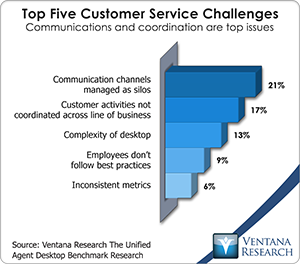 The architecture now supports multitenancy and automatic load balancing, which are especially useful in handling very large volumes of tweets. Reporting has been enhanced to include more visualization options, trend analysis, emerging hot issues, and process and performance analysis.
My benchmark research into the unified agent desktop shows that companies face several challenges in making customer service meet customer expectations. The two most common are that communications channels are managed as silos and that customer-related activities (such as handling customer interactions) are not coordinated across lines of business. These two factors alone make it hard for companies to provide high-quality, consistent experiences across all touch points and all forms of interactions. Respond6 has tools to analyze text-based interactions more effectively and also to enable better responses to them, especially social ones. I recommend that companies evaluate how it can support their efforts to improve customer engagement and the customer experience.