We use cookies, including third-party cookies from Google to serve personalized ads through AdSense, to operate this site and understand how it is used. By continuing to browse, you accept this use. See our Privacy Policy and Terms of Use for details, including how to opt out of personalized advertising.
Accept
SmartData CollectiveSmartData Collective
  • Analytics
    AnalyticsShow More
    chatgpt image jul 21, 2026, 04 34 30 pm
    4 Core Benefits of Predictive Maintenance after Vibration Analysis
    10 Min Read
    How Does Data Mining Boost Customer Satisfaction in Logistics? Harnessing Analytics for Results -- AI-generated illustration
    How Does Data Mining Boost Customer Satisfaction in Logistics? Harnessing Analytics for Results
    11 Min Read
    chatgpt image jul 13, 2026, 04 23 45 pm
    How Data Analytics Helps Companies Improve User Engagement
    19 Min Read
    chatgpt image jul 13, 2026, 03 59 46 pm
    How Data Analytics Improves Multi-Location Search Strategies
    10 Min Read
    cybersecurity efforts
    How Behavioral Analytics and AI Are Redefining Cybersecurity for Boca Raton Businesses
    14 Min Read
  • Big Data
  • BI
  • Exclusive
  • IT
  • Marketing
  • Software
Search
© 2008-25 SmartData Collective. All Rights Reserved.
Reading: From BI to Enterprise IT Integration
Share
Notification
Font ResizerAa
SmartData CollectiveSmartData Collective
Font ResizerAa
Search
  • About
  • Help
  • Privacy
Follow US
© 2008-23 SmartData Collective. All Rights Reserved.
SmartData Collective > Business Intelligence > Decision Management > From BI to Enterprise IT Integration
Business IntelligenceDecision Management

From BI to Enterprise IT Integration

Barry Devlin
Barry Devlin
5 Min Read
From BI to Enterprise IT Integration
Photo by SpotOn POS on Pexels (https://www.pexels.com/photo/bar-training-session-with-tablet-technology-37594392/)
SHARE

Autumn has arrived here in Cape Town and with it a slight chill in the air.  In a couple of weeks, I head up to Europe where spring is warming the land.  It’s a time of transitions.  And so it is too for the IT industry and BI in particular.

I’m presenting three seminars on the transformation of BI into Enterprise IT Integration in Europe: a half day each in Copenhagen and Helsinki (4 and 5 April) and a full two-day deep dive in Rome (11-12 April).  I started teaching these classes in early 2010, and as I review and update the contents, I’m struck by two impressions.  First, a lot has changed in the BI / Data Warehousing market in the past year.  Second, the new architecture, BI2, that I’ve been developing since 2009 continues to closely map the emerging technology. That’s hugely gratifying!

So, what are the big changes?  One is the exploding interest in “Big Data“.  Now, as I’ve discussed elsewhere, the name is a total misnomer–the stuff is neither necessarily big nor data in the strict meaning of the words–but, the interesting thing is how the concepts and technologies around this area have energized thinking about BI.  Pre-defined reports have become even less interesting in the face of innovative data mining and predictive analytics in the big data environment.  And the information we can use to gain analytic value has expanded in variety and volumes beyond our wildest dreams.

Another important change has been the acquisitions of innovative start-ups, particularly in the analytic appliances field by both BI and other-than-BI giants–Netezza by IBM, Vertica by HP and Sybase by SAP to name a few. The acquisitions highlight the importance of these emerging technologies in a sea change in the way BI will be and increasingly is being delivered.

More Read
BI Case Study: Building an Open Data Portal
How AI is Helping Drive Advances in Inventory Management Software
Artificial Intelligence In Healthcare Is Changing The Fabric Of The Industry
The Analytics Journey
The Winning Formula to Being a Kaggle Data Scientist

The third change is at the hardware level.  While much more is going on, two aspects are important to BI: the increasing number of cores in commodity processors and the move towards silicon-based data storage, whether on solid state disks or in memory.  Both of these trends suggest that internal database design approaches established since the 1970s are due for a big shake-up.

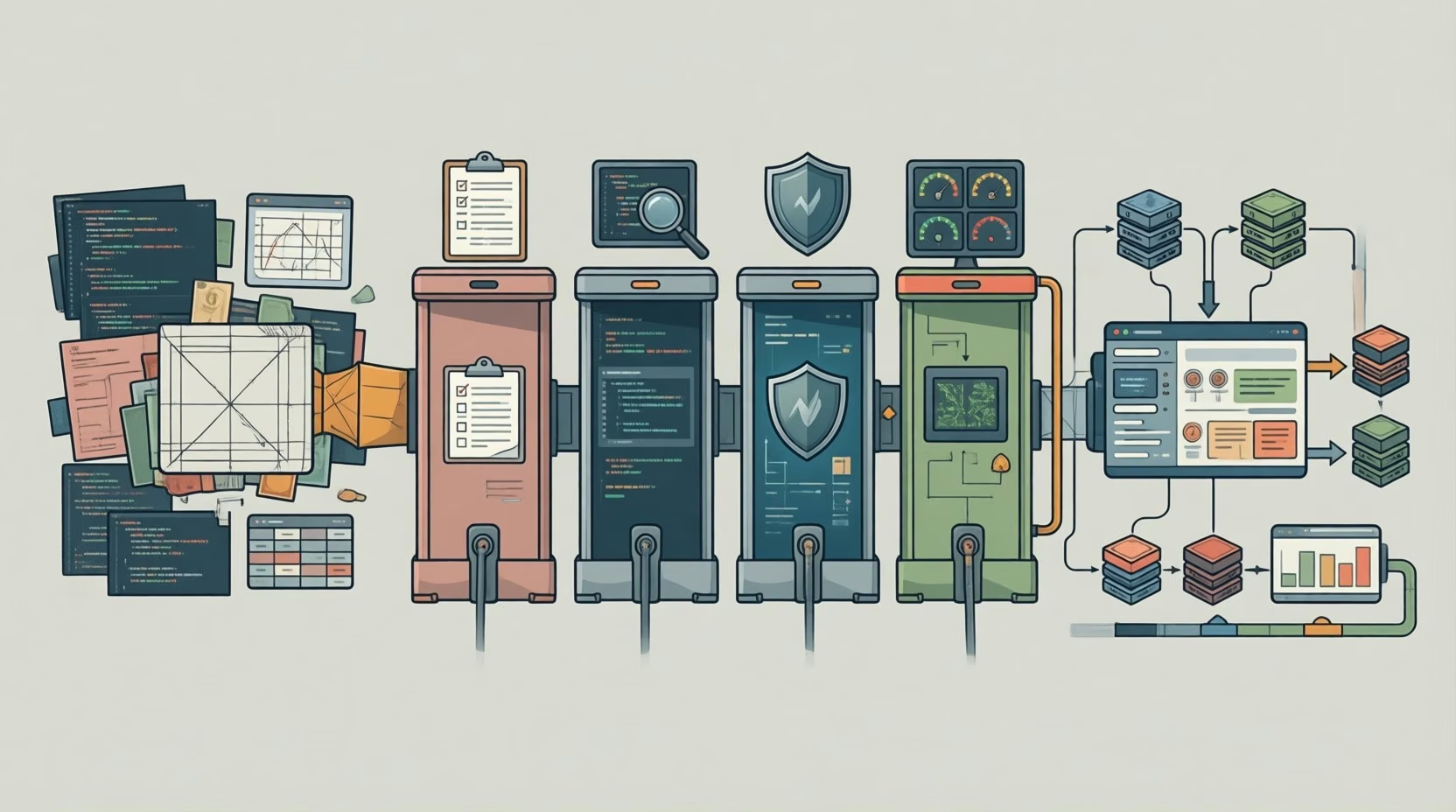
None of these trends is particularly new.  But their speed-up and convergence in the past year or so are rapidly pushing the BI environment to a tipping point–the architecture we’ve successfully used for over twenty years is rapidly being made irrelevant!  That architecture, dating from a 1988 paper that I co-authored, was based on business needs and technological solutions that were appropriate for their time.  Today’s bus-tech ecosystem is so different that I have been arguing for a number of years that we need to look beyond our current silos of operational systems, BI and office/collaborative systems to a new architecture that crosses all of IT.  This architecture, which I call Business Integrated Insight, proposes that we treat the entire information asset of the business as a single, logical entity–the Business Information Resource (BIR).

Such a change of focus has widespread implications for the entire IT support infrastructure.  The challenges are big, but the technology as it is emerging is enabling this change.  My European seminars describe the new architecture in depth, but, more importantly, link what needs to be done to current technologies and provides practical guidance on how to begin the transformation.

TAGGED:architecturebig data
Share This Article
Facebook Pinterest LinkedIn
Share

Follow us on Facebook

Latest News

The Information Governance Practices That High-Demand Social Work Roles Require -- AI-generated illustration
The Information Governance Practices That High-Demand Social Work Roles Require
Data Management Exclusive Policy and Governance Security
8 MCP Tools for Market and Consumer Intelligence Workflows -- AI-generated illustration
8 MCP Tools for Market and Consumer Intelligence Workflows
Artificial Intelligence Exclusive
How Local Service Businesses Can Map Which Neighborhoods Generate the Most Revenue -- AI-generated illustration
How Local Service Businesses Can Map Which Neighborhoods Generate the Most Revenue
Business Intelligence
Best VMware Alternatives in Thailand for Private Cloud and HCI Deployments -- AI-generated illustration
Best VMware Alternatives in Thailand for Private Cloud and HCI Deployments
Cloud Computing Exclusive IT

Stay Connected

1.2KFollowersLike
33.7KFollowersFollow
222FollowersPin

You Might also Like

Why Businesses Are Using Data to Rethink Office Operations
Big DataExclusive

Why Businesses Are Using Data to Rethink Office Operations

7 Min Read
Understanding The Nature Of Proxy Servers In The Big Data Age
Best PracticesBig DataData ManagementExclusiveITPrivacySecurity

Understanding The Nature Of Proxy Servers In The Big Data Age

7 Min Read
Smart Data
Best PracticesBig DataData ManagementData QualityDecision ManagementPredictive AnalyticsRisk ManagementSocial Data

Can Smart Data Ensure Cybersecurity and Data Protection?

6 Min Read
Google Search Algorithms Use Big Data for Multilingual Latent Semantic Indexing
Big DataExclusiveMachine LearningNews

Google Search Algorithms Use Big Data for Multilingual Latent Semantic Indexing

6 Min Read

SmartData Collective is one of the largest & trusted community covering technical content about Big Data, BI, Cloud, Analytics, Artificial Intelligence, IoT & more.

How To Get An Award Winning Giveaway Bot
Big Data Chatbots Exclusive
5 Great Tips for Using Data Analytics for Website UX
Big Data

Quick Link

  • About
  • Contact
  • Privacy
Follow US
© 2008-26 SmartData Collective. All Rights Reserved.
Welcome Back!

Sign in to your account

Username or Email Address
Password

Lost your password?