For a long time, office operations ran on habit. Cleaning crews followed the same routes each night. Supplies were ordered on a familiar schedule. Breakrooms were stocked based on rough estimates. Conference rooms, kitchen areas, and shared amenities were treated as fixed parts of the workplace, not moving pieces that needed regular review.
That approach made sense when office attendance looked much the same from one week to the next. It makes less sense now. Hybrid work has changed how people use offices, when they show up, and what they expect once they arrive. Businesses can no longer assume that Monday looks like Thursday, or that one floor gets used the same way as another.
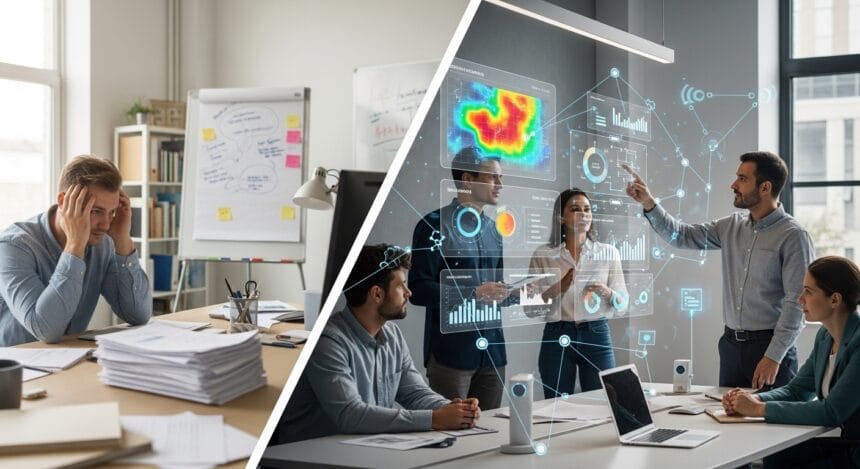
That is why more companies are turning to data to rethink office operations. They are drawing insights from badge swipes, desk reservations, room bookings, Wi-Fi activity, support tickets, and employee surveys to get a more accurate picture of what is happening in the workplace. Instead of asking what an office used to need, they are asking what employees actually use today, and what helps the space run better.
Operations Work Better When Demand Is Measured
One of the clearest benefits of workplace data is that it exposes waste. A meeting room may look busy in the booking system, but sit half empty for most of the day. A heavily used collaboration zone may need more cleaning attention than a row of desks that only fills up twice a week. A kitchen area may feel crowded on peak days and underused the rest of the time.
When leaders can see those patterns, operations become easier to manage. Cleaning schedules can be adjusted around traffic instead of tradition. Restocking can be tied to real demand. Service vendors can be aligned with actual attendance, not old assumptions from a full-time office model.
This is also changing how companies think about smaller workplace details. A commercial water dispenser might not sound like a strategic decision, but in a modern office, it can be. If usage data show that employees most often gather near a collaboration hub, it makes sense to place hydration access there. If service calls point to recurring maintenance issues in one area, that becomes an operations signal, not just a nuisance. Data turns even basic amenities into measurable parts of the employee experience.
This broader shift matters financially. CBRE’s 2026 Global Workplace & Occupancy Insights describes a workplace shaped by hybrid schedules, tighter space planning, and more active performance tracking. In related reporting from the same research program, CBRE says the global average building utilization rate has climbed to 53%. In comparison, global occupancy has reached 111%, meaning more people are assigned to buildings than there are physical seats. Those numbers show why businesses are managing space and services more carefully than before. The office is no longer static, so operations cannot be static either.
Better Data Also Improves the Employee Experience
Cost control is only part of the story. Businesses are also learning that day-to-day office operations shape how employees feel about the workplace.
In a hybrid environment, people are less likely to accept friction. If they come in and cannot find the right type of space, wait too long for shared resources, or run into crowded common areas, the office starts to feel less useful. On the other hand, when the workplace is easy to navigate and well-supported, employees notice.
This is where operations and culture start to overlap. Architects and workplace strategists may design the physical office, but it is experienced through the basics. Are there enough quiet areas on busy days? Are meeting rooms actually usable? Are shared spaces clean and stocked when people need them? Are the most-used amenities placed where people naturally gather?
Gensler’s Global Workplace Survey 2025 reinforces how important that experience has become. The firm says employees in great workplaces are nearly three times more likely to stay with their company, feel their contributions are valued, and believe their environment supports their growth. The survey was based on responses from 16,809 full-time office workers across 15 countries, underscoring that the workplace experience is now closely tied to retention and engagement.
For operations teams, that means the office cannot be managed as a background function. It has to be managed as a system that supports how people work now. The most useful data is not just about space, it is about behavior. Where do employees cluster? Which days create pressure on shared services? Which spaces are booked but ignored? Which amenities quietly improve the rhythm of the day?
The Next Office Will Run on Signals, Not Routine
Businesses are using data to rethink office operations for a simple reason: routine no longer tells the full story. The office changes too much from day to day, team to team, and season to season for that.
The companies making the smartest changes are not always chasing flashy upgrades. Many are focusing on practical improvements that make the workplace easier to use and easier to manage. They are adjusting service levels, moving resources closer to demand, and reviewing whether long-standing setups still fit a hybrid office.
That is the real promise of workplace data. It helps businesses stop treating operations as a fixed checklist and start treating them as an ongoing performance issue. The result is a workplace that wastes less, responds faster, and feels more intentional to the people using it.
In that kind of office, every decision carries more weight, even familiar ones. A commercial water dispenser is no longer just a standard fixture. It becomes part of a larger question: what does this workplace need to function well for the people who rely on it?