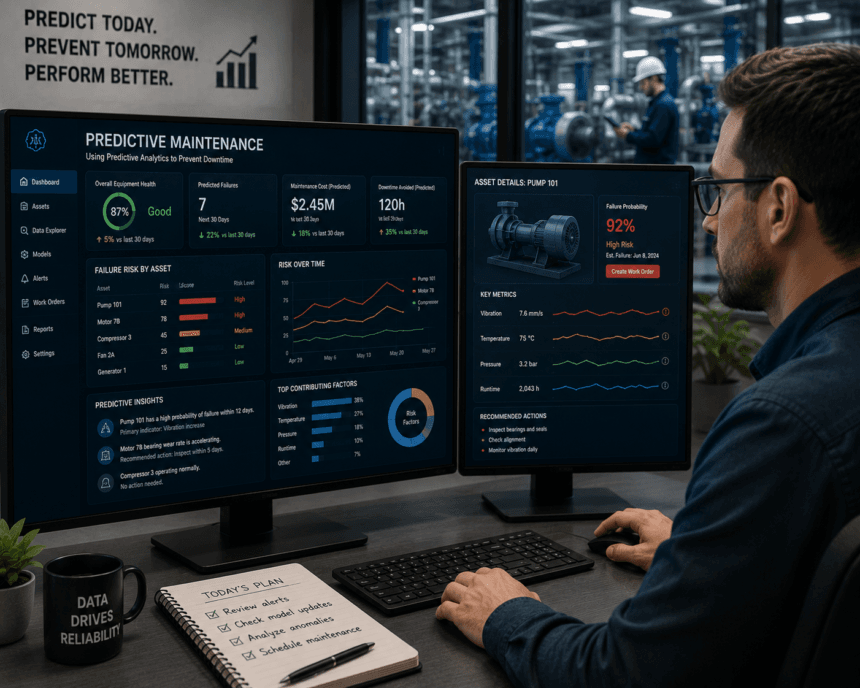
Smart Data Collective has covered a lot of posts about how predictive analytics can help companies make smarter decisions with their data. It is especially useful for businesses that want to get more value from vibration analysis and build stronger predictive maintenance programs.
The Predictive Analytics Market Study from Deloitte found that the maturity of PA tools is already advanced and ready to be scaled, with 22% of companies already using it and 62% planning to implement it soon. Something that makes this important is that predictive maintenance depends on spotting equipment risks early, before vibration changes turn into expensive failures. Keep reading to learn more.
Predictive Analytics Can Strengthen Maintenance After Vibration Analysis
“PA is a technology that uses a wide array of data, statistical techniques, and machine learning algorithms to identify patterns and make informed predictions about future events. By incorporating a wealth of data into the forecasting, planning, and budgeting processes, PA helps Finance Departments, especially Financial Planning and Analysis (FP&A), estimate future revenues, costs, and risks with greater precision. It allows Finance professionals to update estimates as soon as new data becomes available, spot trends and potential outcomes early through advanced scenarios, and perform data-driven benchmarking,” Deloitte reports.
Vibration analysis gives companies a clearer view of how equipment is behaving during normal operations. There are many ways predictive analytics can build on this data by finding patterns that may point to bearing wear, imbalance, looseness, misalignment, or other mechanical concerns. Another thing it can do is help maintenance teams compare current machine behavior against past performance.
Joško Ivankov of WorkTrek reports that predictive maintenance can lower costs by 25%. It is a strong reason for companies to take vibration data seriously instead of waiting for equipment to fail.
“These advanced tools enable companies to predict when machinery will fail and schedule repairs before that happens, reducing costly unplanned downtime. Not only does this keep the operations running, but it also reduces the risk of accidents. This combination of enhanced safety and cost savings explains why more companies are adopting predictive maintenance and why the market continues to expand. Now, who is leading the charge? Industry giants like IBM, Schneider Electric SE, Siemens, and Microsoft are heavily investing in these technologies, making predictive maintenance more accessible and accurate than ever before,” Ivankov says.
One major benefit of predictive maintenance after vibration analysis is lower downtime. Something that makes this so useful is that companies can schedule repairs when they cause the least disruption instead of shutting down production after a sudden breakdown. Another thing teams can do is order parts earlier, plan labor more carefully, and reduce emergency repair costs. It is easier to keep operations on track when equipment problems are caught before they become urgent.
A second benefit is better use of maintenance budgets. There are many cases where companies replace parts too early or wait too long because they lack clear equipment data. Something that predictive analytics can show is which machines need attention now and which ones can keep running safely.
A third benefit is stronger workplace safety. It is much easier to protect workers when maintenance teams can identify vibration patterns that may point to a future failure, overheating issue, or mechanical breakdown.
A fourth benefit is longer asset life because equipment can be maintained based on actual condition instead of guesswork. There are many machines that can keep performing well when problems are found early and corrected before they damage nearby parts. Another thing predictive analytics can support is better planning across many sites, machines, and maintenance teams.
As mentioned above, vibration analysis is one of the core processes for predictive maintenance. The insights collected from the process enable experts to prevent assets from malfunctioning or deteriorating without a proper plan in place. In this section, we explore the benefits of performing predictive maintenance after understanding what vibration analysis is. Read on to find out more.
What is Vibration Analysis?
By definition, vibration analysis is the process of collecting, processing, and interpreting equipment or machine signals to identify the fault type. It also helps to estimate the severity of the fault and to forecast the remaining useful life of the particular equipment. When combined with other techniques, this constant monitoring helps the experts drive more efficient predictive maintenance as well as planning.
1. Reduced Downtime
One of the costliest mistakes in a business is unexpected equipment failure. It costs your business significant amounts of time and money due to the schedule disruption. Once you employ vibration analysis for predictive maintenance, you can detect the early signs of failure in your systems and equipment. It becomes even easier for you to schedule repairs outside business hours, thus minimising downtime.
2. Minimised Maintenance Costs
When most people talk about servicing assets and equipment, they often focus on preventive maintenance. This often results in over-maintenance, where assets are unnecessarily taken care of. However, predictive maintenance majorly focuses on fixing the parts or elements that need attention. The insights from vibrational analysis show you exactly what is breaking down, and this minimises the consumption of spare parts, labour charges, and service hours. It is a huge win for you.
3. Extended Asset Lifespan and Safety
Predictive maintenance focuses on ensuring that all your equipment works optimally. This reduces wear and tear and unnecessary disassembling of parts, which can be a risk for your employees and other stakeholders. Over time, it enhances the longevity of the assets while still ensuring ultimate safety.
Additionally, properly maintained equipment keeps the work environment safe for your employees and customers. By identifying risks early on and taking care of them, you eliminate the hazards that may harm people in the premises. If for nothing else, predictive maintenance will ensure you comply with the required safety rules for your industry.
4. Increased Return on Investment(ROI)
There are so many techniques and systems that contribute to the success of predictive maintenance. For instance, while vibrational analysis focuses on checking the sources of vibrations in the equipment, you will need diagnostic software to process the vibration data and identify the anomalies. You will need a different one to determine the most appropriate action to correct the issue.
Just like your equipment and assets, all these systems are not a cheap affair. Nevertheless, you can be sure to get a high return on your investment as predictive maintenance ensures everything runs smoothly. The software comes with great reporting and analytical features that refine your maintenance strategies, which all come down to better equipment performance. With this, your ROI is assured.
Conclusion
Predictive analytics helps companies turn vibration analysis into practical maintenance decisions. Something that matters most is using the data to act early, reduce downtime, control costs, and protect equipment before failures become larger problems.
Companies that use predictive analytics after vibration analysis can make maintenance more planned and less reactive. It is a practical way to improve equipment reliability, reduce avoidable losses, and give teams clearer information for daily decisions.
As you can see, predictive maintenance heavily relies on vibration analysis, among other techniques, to collect, process, and effectively act on data. Having reliable vibration analysis for predictive maintenance comes with a lot of perks, including minimised downtime for your business, reduced maintenance, and an extension in the lifespan of your assets. The biggest of them all must be the increased return on investment both for the equipment and for the systems.
—
Sources:
1. https://www.icareweb.com/knowledge/predictive-maintenance/what-is-vibration-analysis-predictive-maintenance/
2. https://www.marketresearchfuture.com/reports/predictive-maintenance-market-2377
3. https://www.forbes.com/councils/forbestechcouncil/2025/06/25/how-predictive-maintenance-supports-resilient-manufacturing/
4. https://www.ibm.com/think/insights/ai-in-predictive-maintenance