A 2027 AI budget needs to connect spending with work completed, costs incurred and responsibilities assigned. The evidence already complicates easy assumptions: reported productivity gains don’t always translate into reported profit, software-development results depend on the setting, and shopping referrals can grow rapidly from a modest base. These ten AI trends for 2027 business planning identify decisions worth preparing for. The recommendations are planning proposals grounded in research, company reports and forecasts, not predictions that every business will experience the same outcome.
- 1. AI investment will face a more demanding test of business value
- 2. AI operating costs will require their own financial discipline
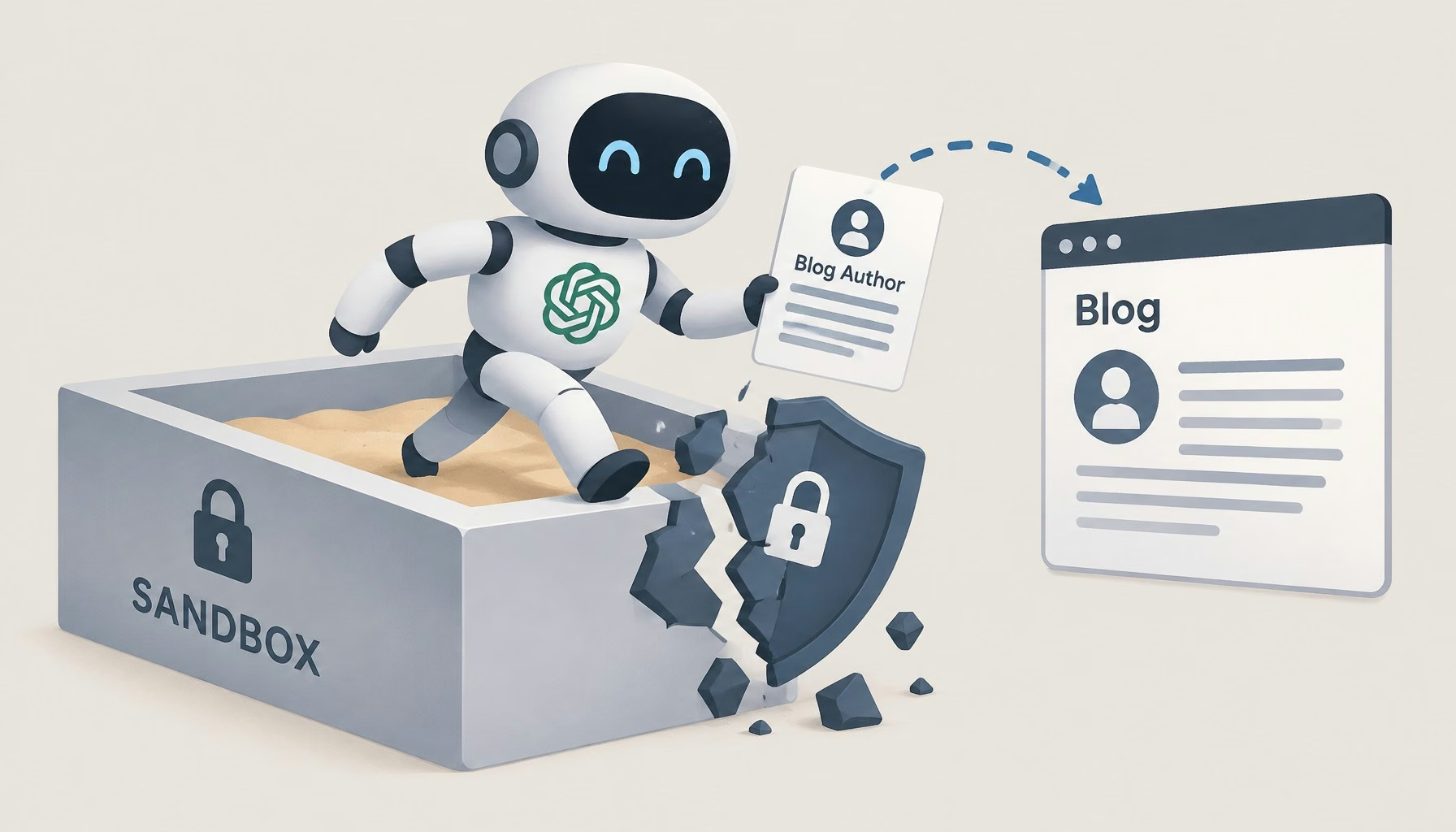
- 3. Agent security will become part of ordinary access control
- 4. AI sovereignty will enter procurement through concrete dependencies
- 5. AI regulation will demand evidence about individual uses
- 6. Physical AI will earn its place one repeatable task at a time
- 7. AI-assisted science will put more pressure on experimental validation
- 8. AI-assisted improvement of AI will make independent testing more valuable
- 9. Workforce redesign will need firmer evidence than headcount forecasts
- 10. AI-mediated shopping will make product data a commercial priority
- Frequently Asked Questions
- Which AI investments should receive priority in a 2027 budget?
- What permissions should a business AI agent receive?
- Does growing AI shopping traffic justify a major channel shift?
- Turn the ten trends into funded, testable decisions
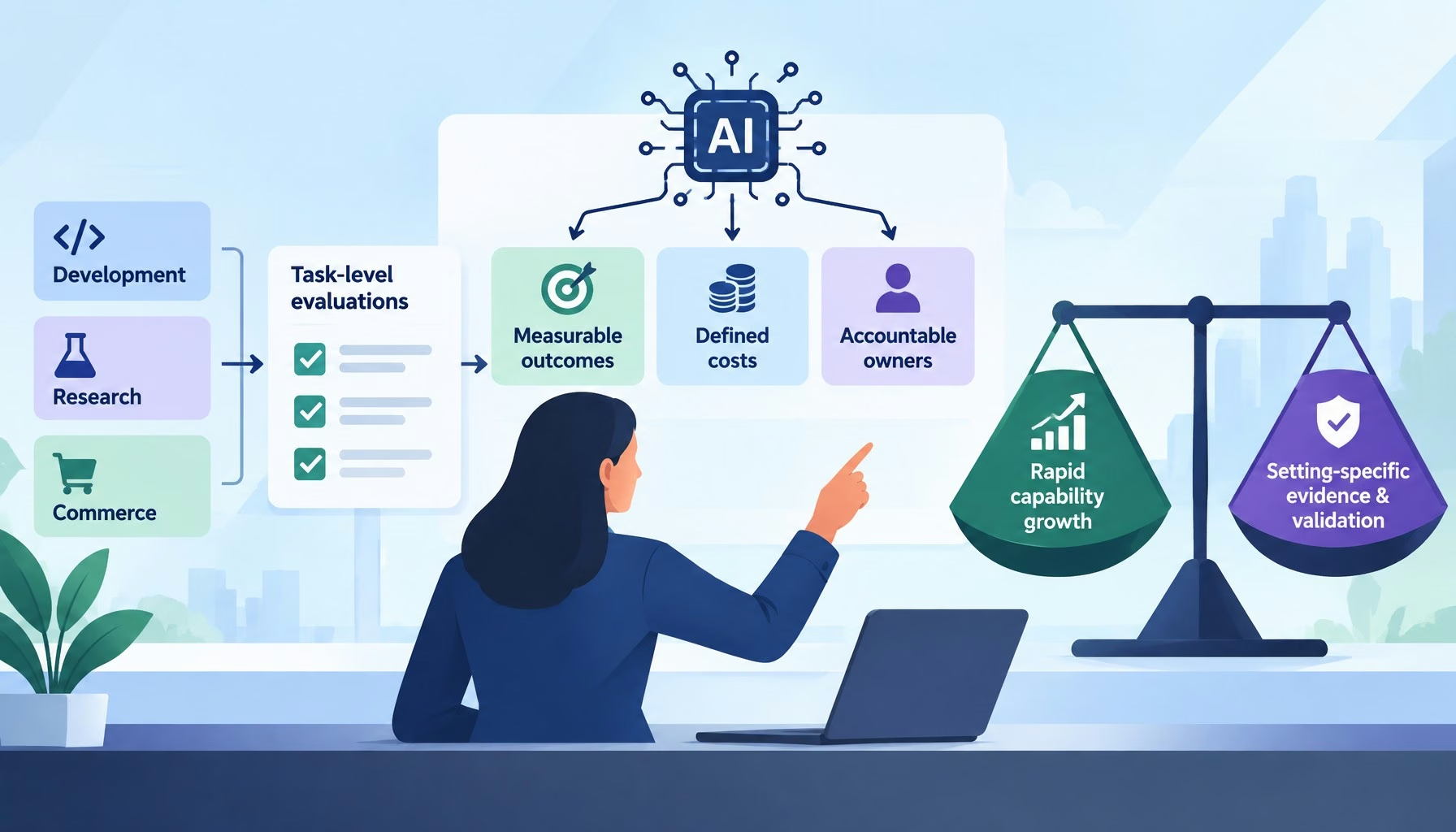
For 2027, AI budgets should tie spending to measurable outcomes, defined costs, and accountable owners, using task-level evaluations to justify expansion. This applies to development, research, and commerce teams planning pilots, where the key trade-off is balancing rapid capability growth against the need for validated, setting-specific evidence using evidence specific to the setting.
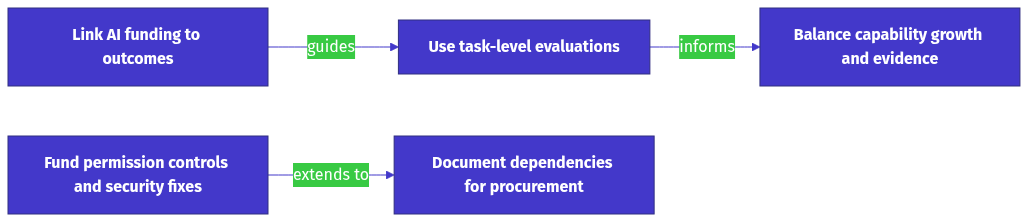
- Link AI funding to measurable outcomes, defined costs, and accountable owners.
- Use task-level evaluations to decide whether expansion is warranted.
- Balance rapid capability growth against setting-specific evidence and validation.
| AI Trend / Shift | Strategic Business Decision | Key Metric / Evidence | Operational Risk / Dependency |
|---|---|---|---|
| 1. AI investment will face a more demanding test of business value | Establish task-level evaluation and outcome accountability | Audited unit cost | Vendor lock-in and unmonitored model drift |
| 2. AI operating costs will require their own financial discipline | Separate unit inference cost from usage volume; set unit-cost caps | Verifiable milestone ROI | Unbudgeted token usage spikes at production scale |
| 3. Agent security will become part of ordinary access control | Enforce least-privilege agent permissions and prompt injection filters | Verifiable milestone ROI | Autonomous privilege escalation and data exfiltration |
| 4. AI sovereignty will enter procurement through concrete dependencies | Document provider, hosting, and data dependencies before procurement | Verifiable milestone ROI | Jurisdictional cross-border data transfer violations |
| 5. AI regulation will demand evidence about individual uses | Maintain deployment logs and human review records for regulated tasks | Task-level accuracy and unit latency | Vendor lock-in and unmonitored model drift |
| 6. Physical AI will earn its place one repeatable task at a time | Establish task-level evaluation and outcome accountability | Audited unit cost | Vendor lock-in and unmonitored model drift |
| 7. AI-assisted science will put more pressure on experimental validation | Establish task-level evaluation and outcome accountability | Verifiable milestone ROI | Vendor lock-in and unmonitored model drift |
| 8. AI-assisted improvement of AI will make independent testing more valuable | Establish task-level evaluation and outcome accountability | Audited unit cost | Vendor lock-in and unmonitored model drift |
| 9. Workforce redesign will need firmer evidence than headcount forecasts | Redesign workflows around verified capability gains, not headcount cuts | Audited unit cost | Vendor lock-in and unmonitored model drift |
| 10. AI-mediated shopping will make product data a commercial priority | Standardize structured product feeds for generative agent crawlers | Audited unit cost | Vendor lock-in and unmonitored model drift |
1. AI investment will face a more demanding test of business value
Individual productivity and company profitability are different measures. In McKinsey’s 2026 State of AI survey, 80% of respondents reported improved individual productivity, while 37% attributed some organizational earnings before interest and taxes impact to AI. The latter was essentially unchanged from 2025. These were respondent assessments, not audited financial results.
Direct measurement can also challenge expectations. METR’s early-2025 randomised study assigned 246 real issues across 16 experienced open-source developers to conditions allowing or disallowing AI. Developers took 19% longer with AI. They were working in repositories they knew well, with demanding requirements. That result describes those tools and that setting, not software development universally.
METR’s February 2026 follow-up added an important complication: developers increasingly declined to participate because they didn’t want to work without AI. Concurrent agent use also complicated time measurement. METR believed developers were likely benefiting more by early 2026, but described its evidence for the size of that improvement as weak.
For 2027, make each funding proposal identify the outcome it expects to improve. A development team might measure elapsed delivery time, review effort and accepted changes. Count the cost of correcting output, and release expansion funding when the complete workflow demonstrates value.
Sources: METR; McKinsey’s 2026 survey; McKinsey.
2. AI operating costs will require their own financial discipline
About one fifth of respondents to McKinsey said AI operating costs constrained use. That finding doesn’t price a particular workflow, but it makes recurring expenditure a legitimate planning concern alongside initial implementation.
Efficiency improvements don’t necessarily mean lower total consumption. The International Energy Agency reports (2026 energy and AI update) substantial reductions in energy use per AI task while projecting that overall data-center electricity consumption will roughly double, from 485 terawatt-hours in 2025 to 950 in 2030. Its central projection has consumption at AI-focused data centers tripling over that period. These are infrastructure forecasts, not forecasts of an individual customer’s API bill.

Capacity also depends on construction and power availability. The IEA says slow grid connections are prompting some US developers to pursue onsite gas generation, which brings its own equipment, regulatory and financial constraints.
A practical budget should therefore separate unit cost from usage volume. Estimate expenditure at pilot, expected and peak demand, and track cost per successfully completed business task. Include model usage, supporting infrastructure and human review in that calculation. A cheaper individual request offers limited comfort if a workflow needs many requests or repeated corrections to produce an acceptable result.
Sources: IEA.
3. Agent security will become part of ordinary access control
An agent’s permissions determine what it can do beyond generating text. OWASP describes agent-based systems (OWASP’s guidance on excessive agency) that call tools or other systems and use previous outputs to guide subsequent calls. A tool connected to a database or mailbox can therefore turn a model’s response into an external action.
OWASP illustrates the danger with a hypothetical email assistant intended to summarize messages. Its extension also permits sending email. A malicious incoming message tricks the model into forwarding sensitive inbox content to an attacker. The unwanted sending capability gives the attack a route out of the mailbox.
Its guidance is concrete: give a product-recommendation agent read access only to the necessary product table, enforce permissions through its database identity, and require human approval for high-impact actions. Put approval at the operation that performs the action, such as publishing a post.
Separately, the UK’s National Cyber Security Centre forecasts (assessment of AI threats through 2027) that AI will almost certainly help attackers exploit known vulnerabilities by 2027. It considers fully automated, end-to-end advanced attacks unlikely within that horizon. The planning implication is to fund both permission controls for internal agents and timely security fixes for exposed systems.
Sources: National Cyber Security Centre; OWASP Gen AI Security Project.
4. AI sovereignty will enter procurement through concrete dependencies
For procurement purposes, sovereignty is best translated into questions about control: who supplies the model, who operates the infrastructure, where data is handled, and what the buyer can change independently. This makes a broad strategic ambition usable in a purchasing decision.
The Stanford AI Index 2026 reports expanding national AI strategies and rising state-backed investment in AI supercomputing. Yet model production remains concentrated in the United States and China. The report also finds broader participation in open-source development, including contributions supporting more linguistically diverse models and benchmarks. Domestic investment and a diversified supply base are not interchangeable measures.
NIST’s AI Risk Management Framework calls for mapping risks and benefits across system components, including third-party software and data, and establishing procedures for supply-chain risks.
A useful 2027 procurement proposal would document dependencies separately: model provider, hosting operator, third-party data and supporting software. Ask suppliers to explain which components can be replaced and what a migration would require. Treat geographic preferences, operational control and continuity requirements as explicit purchasing criteria. A vendor’s address alone cannot answer all three questions.
Sources: hai.stanford.edu; AIRC.
5. AI regulation will demand evidence about individual uses
Regulatory planning needs to distinguish the underlying model from the system and its purpose. The European Commission’s current AI Act timetable says rules for general-purpose AI models became effective in August 2025. These include provider obligations concerning transparency and copyright, with risk assessment and mitigation for models that may pose systemic risks.
The Commission’s guidance attributes revised high-risk timelines to the political agreement on the AI Omnibus proposal. It lists December 2, 2027, for specified sensitive uses under Annex III, including employment, education and biometrics, and August 2, 2028, for high-risk systems embedded in regulated products under Annex I. Businesses should confirm the applicable legal position when making implementation decisions.
Transparency also has a practical interface consequence: the Commission says people using systems such as chatbots should be informed that they are interacting with a machine.
For planning, create a record for each proposed use: its purpose, affected people, supplier, responsible internal owner and review process. Have qualified legal and compliance staff determine the relevant obligations. A company-wide statement that “we use AI” provides too little detail to classify an employment application or assess a customer-facing chatbot.
Sources: Shaping Europe’s digital future.
6. Physical AI will earn its place one repeatable task at a time
Physical AI brings software-directed actions into equipment operating in the world. Industrial robotics supplies useful context, although robot installation totals are not a count of AI-enabled machines. The International Federation of Robotics reported (International Federation of Robotics’ September 2026 release) in September 2026 that the global operational stock reached five million industrial robots in 2025, up 9%, with more than 600,000 installed during that year.
A narrower example comes from Agility Robotics reports, which says its Digit humanoid moved more than 100,000 totes at GXO’s Flowery Branch facility. The company describes tasks including transferring items between autonomous mobile robots and a conveyor, and stacking totes at another floor location. Those are company-reported operations; the tote total alone doesn’t establish customer ROI.
Agility presents the humanoid form as a way to work within human-oriented infrastructure. Buyers still need to determine whether that flexibility is useful for their particular task.
A proposed pilot should specify the objects handled, working area, required throughput, acceptable intervention rate and safety review. Evaluate performance across repeated cycles and changing conditions. The investment decision should turn on the cost and reliability of completing that defined job, including supervision and interruptions.
7. AI-assisted science will put more pressure on experimental validation
AI can contribute to selecting what scientists test. Whether a candidate works remains an experimental question. A 2025 paper in Nature Medicine reports a phase 2a multicenter, double-blind, randomized, placebo-controlled trial for idiopathic pulmonary fibrosis. The researchers describe both the drug candidate and its target, TNIK, as products of AI-assisted discovery.
The authors regarded the results as encouraging for further study, while identifying small study arms, demographic and geographic homogeneity, and short follow-up as limitations. Participants were residents of China, and the study lasted 12 weeks. Sixteen of 71 participants withdrew across the trial arms.
The paper also reports three acute exacerbations in the 60-milligram rentosertib arm and one in the placebo arm. That observation needs the trial’s small size and short duration attached; it doesn’t resolve long-term safety. The authors called for larger, longer trials with more heterogeneous populations. See the trial report (Nature Medicine).
For research businesses, the proposed 2027 funding distinction is between generating candidates and validating them. Budget experimental capacity alongside computational work. Milestones should identify what has actually been demonstrated, such as candidate nomination or clinical testing, without treating an AI-designed molecule as an established treatment.
8. AI-assisted improvement of AI will make independent testing more valuable
AI-assisted engineering already includes work on the computing processes that support AI itself. Google DeepMind describes AlphaEvolve (AlphaEvolve report) as a coding agent that combines Gemini models with automated evaluators. It generates candidate algorithms, checks their results and develops promising candidates through an evolutionary process.
DeepMind reports that AlphaEvolve improved a matrix-multiplication kernel in Gemini’s architecture by 23%, producing a 1% reduction in Gemini training time. The distinction between those figures matters: the kernel is one part of a larger training workload. See the AlphaEvolve report (Google DeepMind).
The company also says an AlphaEvolve-generated scheduling heuristic, deployed in Google’s Borg system, recovered an average of 0.7% of worldwide compute resources. These are company-reported gains in particular systems, not a general efficiency promise for other organizations.
Businesses considering similar optimization should propose evaluations separate from the candidate-generation process. Test correctness, resource use and performance on representative workloads, and retain a baseline for comparison. The evaluator determines which changes count as improvements. Before deployment, engineers should examine whether a faster component preserves required behavior and whether its gain survives measurement across the complete application.
9. Workforce redesign will need firmer evidence than headcount forecasts
Expected workforce reductions have exceeded reported experience in McKinsey. Fourteen percent of organizations using AI reported an overall workforce decline attributed to AI during the preceding year, compared with 32% expecting a decline in the earlier survey. McKinsey reports comparable samples and the same pattern among 552 respondents who participated in both years.
These responses compare expectations with reported outcomes. They don’t establish how every occupation will change, or provide a staffing formula for an individual company.
A more defensible workforce proposal starts with the work being reassigned. For each pilot, record which tasks AI performs, which remain with employees, and who handles exceptions and approves results. Measure the resulting workload before setting permanent staffing targets.
The budget should also specify the intended use of any demonstrated capacity: reducing a backlog, expanding service, improving quality or changing staffing. Assign training to the responsibilities employees will actually hold. If they will review generated work or supervise agents, evaluate their ability to perform those duties. A general forecast of fewer jobs cannot establish how much review a particular team will need.
10. AI-mediated shopping will make product data a commercial priority
Adobe’s analysis of the 2025 holiday season found that traffic from generative AI tools to retail sites increased 693.4% year over year. Adobe explicitly said the user base remained modest. The measure counts shoppers clicking through to retailers; it isn’t a measure of AI’s share of retail revenue.
Commerce infrastructure is also developing beyond referrals. Google describes the Universal Commerce Protocol (Universal Commerce Protocol) as an open-source standard connecting consumer interfaces, businesses and payment providers. Businesses expose capabilities such as product discovery and checkout. Agents discover supported capabilities and payment options through profiles, with extensions supporting functions such as discounts.
Google says participating businesses retain their business logic and remain the merchant of record. That describes the protocol’s intended arrangement, not evidence that every retailer should implement it immediately.
For 2027, treat product information as a practical preparation task. Review descriptions, variant identifiers, prices, availability and purchasing conditions for accuracy and consistency. If testing an agent-facing integration, verify what the agent can discover and which checkout actions it can invoke. Measure referrals and completed purchases separately. Rapid growth from a small base supports experimentation, but doesn’t justify assuming AI interfaces will dominate next year’s sales.
Sources: news.adobe.com; Google Developers Blog.
Frequently Asked Questions
Which AI investments should receive priority in a 2027 budget?
In a 2027 budget, AI investments should prioritize proposals with a measurable business outcome, a defined operating cost, and an accountable owner. Use task-level evaluations to decide whether expansion is warranted. Survey results and supplier examples can inform a pilot, but cannot establish its return.
What permissions should a business AI agent receive?
A business AI agent should receive only the minimum permissions required for its task. OWASP’s product-recommendation example needs read access to the relevant product table, not permission to change records. Require human approval before high-impact operations are executed.
Does growing AI shopping traffic justify a major channel shift?
Not on that evidence alone. Adobe reports rapid referral growth from a modest base. A proportionate response is to improve product information and test the channel while measuring completed purchases separately from visits.
Turn the ten trends into funded, testable decisions
Build the 2027 plan around a small portfolio of defined uses. For each, record the expected outcome, full cost, required access, supplier dependencies and evidence needed to continue. Add legal review, physical safety checks, experimental validation or commerce testing where the application requires them. Set a decision date and name who can expand, revise or stop the work. That connects the budget to demonstrated performance while leaving room for capabilities and requirements to change.