Digital marketing relies heavily on visual assets, and businesses constantly look for ways to capture attention, produce engaging content, and stand out from competitors. Aerial photography and video have become valuable assets for real estate agencies, tourism brands, event organizers, construction companies, and creative studios. Still, managing drone-based content at scale takes more than reliable aircraft and high-resolution cameras.
- Why Aerial Content Is Becoming More Valuable in Digital Marketing
- How Custom UAV Platforms Improve Marketing Workflows
- AI and Computer Vision Are Changing Aerial Content Production
- Connecting Drone Platforms with Marketing Technology
- Custom Drone Software vs. Standard Applications
- Measuring Business Value, Operational ROI Frameworks, and Cost Factors
- Reducing Production and Administrative Costs
- Improving Content Reusability
- Tracking Marketing Performance
- Building a Scalable and Secure UAV Marketing Platform
- The Future of Aerial Marketing Is More Connected and Automated
- FAQ
- Turning Aerial Content into a Long-Term Business Advantage
Calculating the return on a drone technology business investment is a process that requires weighing upfront hardware, software, and compliance costs against recurring operational savings. Dedicated custom drone software provides centralized flight scheduling, automated media management, and enterprise integrations that reduce manual post-production hours and repeat site shoots.
- Distinctive aerial angles help businesses showcase products and locations more effectively to support brand differentiation.
- A centralized platform lets teams schedule missions, assign tasks, track project status, and keep production standards consistent.
- Computer vision models identify objects, classify scenes, and analyze visual details inside aerial footage to assist production.
When aerial content becomes part of routine marketing operations, teams need better ways to schedule flights, process footage, organize digital assets, and connect production workflows with their marketing platforms. Custom drone software development addresses these challenges by building applications tailored to specific business processes. Technology providers such as Wezom build solutions that connect UAV operations with automation, cloud infrastructure, and enterprise systems, alongside inspection-focused platforms such as Zeitview (formerly DroneBase), whose evolution illustrates how commercial aerial services continue maturing into specialized software ecosystems.
Here is a closer look at how intelligent drone platforms support modern marketing strategies, why off-the-shelf applications can limit business growth, and which technologies help organizations turn aerial content into a lasting competitive advantage with measurable ROI.
Why Aerial Content Is Becoming More Valuable in Digital Marketing
Visual storytelling shapes how businesses communicate with customers. Traditional photography and video remain necessary, yet drone technology opens up perspectives that would otherwise require expensive equipment or complicated production setups.
For real estate companies, aerial footage shows the full scope of properties, surrounding infrastructure, and neighborhood layouts. Tourism brands use drone videos to highlight destinations, resorts, and outdoor experiences. Construction firms document project progress from above, while event organizers capture large venues and crowds from angles ground-based cameras simply cannot reach.
The commercial return goes well beyond attractive visuals. Drone content supports several core marketing objectives:
- Brand differentiation: Distinctive aerial angles help businesses showcase products and locations more effectively.
- Content production: Reusable footage feeds websites, social media channels, sales decks, and paid ad campaigns.
- Customer engagement: Interactive maps, aerial tours, and immersive videos give prospects new ways to explore offerings.
- Sales communication: Visual documentation helps buyers understand property layouts, facilities, and site progress.
How Custom UAV Platforms Improve Marketing Workflows

Off-the-shelf drone applications usually focus on aircraft control, camera settings, and basic flight planning. While those features work fine for occasional shoots, organizations running multiple campaigns at once need broader tools.
Custom UAV platforms connect flight operations across the full content production lifecycle, from initial planning through final distribution.

Centralized Mission Planning and Content Production
Marketing agencies operating across several regions often have to coordinate multiple drone pilots, production calendars, and client specs at the same time.
A centralized platform lets teams schedule missions, assign tasks, track project status, and keep production standards consistent. Flight plans link directly to specific campaigns, locations, or client accounts, making progress easy to monitor.
For recurring jobs, saved mission templates speed up repeat shoots. A property management firm, for instance, can run standardized flight paths to document multiple developments the exact same way every month.
Automated Media Management
Drone shoots generate huge video and image files that must be transferred, reviewed, tagged, and stored. Manual file handling breaks down fast when teams produce assets for dozens of active campaigns.
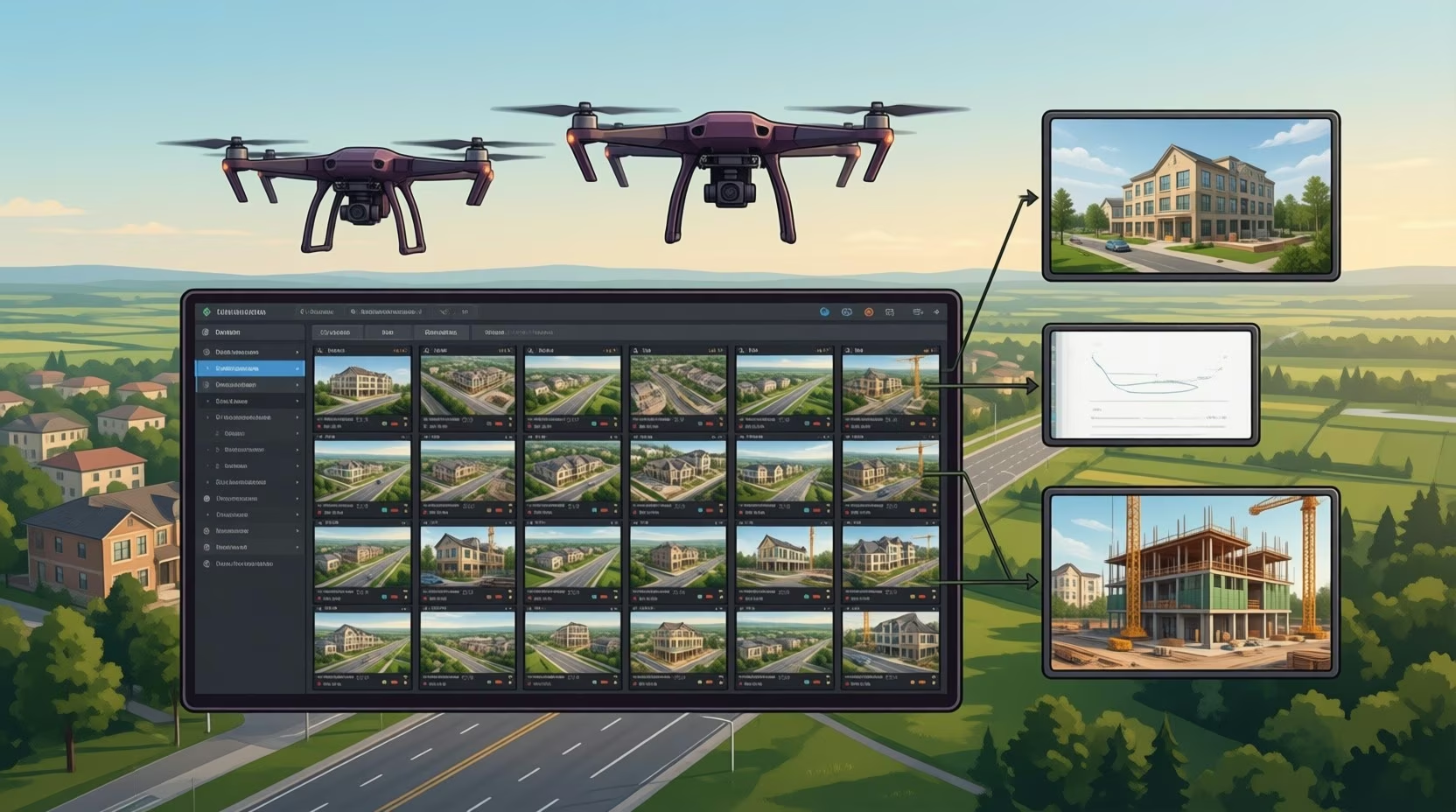
Custom software automates uploads, tags media with project metadata, and gives marketing teams searchable asset libraries.
In typical custom configurations, files can be sorted by location, shoot date, campaign, client, or media type as an illustrative workflow setup. Built-in approval workflows also help stop unedited or unauthorized clips from going live.
These features cut down on administrative busywork and free up creative teams to focus on actual production.
AI and Computer Vision Are Changing Aerial Content Production
Artificial intelligence expands what businesses can do with raw drone imagery. Instead of relying solely on manual sorting and editing, teams can use automated tools to speed up repetitive post-production work.
Computer vision models identify objects, classify scenes, and analyze visual details inside aerial footage. AI-assisted tools also handle metadata tagging, image enhancement, and initial clip selection.
For marketing teams handling large shoots, these tools can reduce the time spent sorting through raw photos and video clips, depending on shoot volume and model setup.
Practical use cases include:
- Automatically sorting aerial images by location or visual subject.
- Flagging the best clips for upcoming promotional campaigns.
- Generating thumbnails and lightweight proxy previews.
- Running automated quality checks to filter out blurry or unusable frames.
- Structuring visual assets for quick search and reuse across teams.
These tools don’t replace creative professionals. Instead, they clear away repetitive sorting tasks and make high-volume production manageable.
AI also supports business operations outside the marketing department. A real estate developer can use the same aerial footage for promotional campaigns and construction progress tracking, letting a single drone deployment serve two departments at once.
Connecting Drone Platforms with Marketing Technology
One major advantage of custom UAV software is its ability to plug aerial content production directly into existing marketing stacks.
Most companies already use CRM platforms, digital asset management (DAM) systems, cloud storage, and content management systems (CMS). When drone apps sit in a silo, staff have to move large files by hand and update project trackers manually.
Direct integration eliminates that friction.
In an integrated workflow, once a flight wraps up, the platform can be configured to push approved footage into a central DAM library and connect with business intelligence reporting. Marketers can then pull those assets straight into their project management or publishing tools.
Common integration points include:
| Business System | Potential Integration Value |
|---|---|
| Content management systems | Direct publishing of approved aerial media |
| Digital asset management platforms | Centralized storage, automated tagging, and fast retrieval |
| CRM platforms | Linking media projects directly to client accounts |
| Cloud storage services | Automated background uploads and role-based file access |
| Project management tools | Synced production schedules and client approvals |
| Marketing analytics platforms | Tying published aerial assets to campaign performance data |
The goal isn’t simply connecting more software for its own sake. It’s cutting out manual steps between capturing footage and launching campaigns.
For teams handling high production volumes, those saved hours translate directly into lower operating costs.
Custom Drone Software vs. Standard Applications
Off-the-shelf drone apps remain a practical choice for solo operators, small video teams, and companies that only need aerial footage occasionally.
They offer quick setup and lower upfront costs. Most also include dependable flight controls and basic media tools that handle simple projects well.
Still, businesses with specialized workflows often hit walls around custom integrations, automated file routing, multi-team collaboration, or asset organization.
Custom drone software makes financial sense when a company needs capabilities that packaged products cannot deliver cost-effectively.
Evaluation Criteria | Custom UAV Platform | Standard Drone Application |
|---|---|---|
Workflow flexibility | Built around specific internal processes | Restricted to preset features |
Marketing integrations | Supports custom API connections | Limited to native plugins |
Content management | Tailored tagging and approval workflows | Standard folder and media tools |
Scalability | Architecture scales with growing operations | Tied to vendor tiers and seat pricing |
Initial investment | Higher upfront build cost | Lower initial entry cost |
Long-term development | Guided by internal product roadmap | Dependent on the vendor’s release cycle |
From a practical planning perspective, neither option is right for every scenario.
Decision-makers should weigh flight frequency, current software gaps, integration needs, and projected ROI before commissioning a custom platform.
For enterprises running regular aerial shoots across multiple branches or client teams, the operational flexibility often pays back the initial development cost.
Measuring Business Value, Operational ROI Frameworks, and Cost Factors
Spending money on custom drone technology should tie directly to measurable business outcomes and structured drone program ROI calculations that weigh hardware, software, and training costs against operational savings. In our assessment, sharp footage alone won’t fix weak marketing performance, and new software doesn’t guarantee positive returns on its own without a clear strategic business case for drone adoption.
Leaders need to track how a UAV platform affects production speed, operating expenses, asset quality, and campaign results. Industry benchmarks reported by Construction Dive on enterprise drone ROI show that 1 in 10 firms with $50 million or more in revenue use drones, with the construction and engineering sector reaching a 35% adoption rate and 92% of adopting firms capturing positive ROI within one year. For technical managers evaluating internal flight operations, those adoption numbers show why pairing aerial capture with analytics and structured data pipelines speeds up payback.
As the morning sun cast long shadows across the manufacturing complex, Operations Director stared at the spreadsheet with growing concern. Another equipment failure had halted production for six hours. That afternoon, everything changed when an autonomous drone navigated through the facility, capturing thermal imagery that immediately identified three machines on the verge of failure.
Rohith Chindi, Author, Vecros, in Calculating ROI: The Financial Benefits of Implementing AI Drones, 2025Reducing Production and Administrative Costs
Centralized scheduling, automated file transfers, and standardized checklists cut down the hours staff spend coordinating flights and chasing down footage.
As an illustrative scenario, a marketing agency handling aerial shoots for multiple real estate clients can reduce administrative overhead by linking flight planning, file sorting, and client sign-offs inside one system.
The exact financial return depends on shoot volume, staff hourly rates, software upkeep, and the cost of existing manual workflows.
Improving Content Reusability
Raw aerial footage usually holds value long after its initial campaign ends.
Integrating drones into existing business workflows improves efficiency and data management, and from our perspective, a searchable, well-tagged media library helps teams pull approved clips for websites, social posts, pitch decks, and future ads.
In the author’s observation, reusing existing footage stretches the lifespan of every flight and helps cut down on repeat shoots under typical operating assumptions.
Tracking Marketing Performance
Teams should also track how aerial visuals impact downstream marketing metrics.
Useful KPIs include audience engagement rates, video completion percentages, landing page conversion rates, lead quality, and total cost per produced asset.
Tracking these numbers helps marketers separate clips that merely look impressive from assets that actually drive revenue.
Building a Scalable and Secure UAV Marketing Platform
Companies planning a custom UAV application should start by auditing their current content workflows.
First, pinpoint the biggest operational bottlenecks. Common pain points include disjointed scheduling, scattered cloud folders, slow client sign-offs, or trouble sharing large video files across departments.
Development priorities should target the problems costing the most time and money.
A practical rollout plan follows five steps:
- Define business goals. Set clear targets for production turnaround times, asset organization, and campaign ROI.
- Map existing workflows. Document how flight requests, media transfers, edits, approvals, and publishing currently happen.
- Prioritize core features. Build the tools that fix the most expensive or time-consuming bottlenecks first.
- Plan integrations early. Map out how the platform will pass data and files to existing CRM, DAM, and CMS tools.
- Validate with real users. Test the system in the field with pilots, video editors, and marketers before rolling it out company-wide.
Security and regulatory compliance also demand close attention. Drone platforms frequently hold sensitive GPS coordinates, client records, and proprietary media.
Role-based access controls, encrypted data transfers, audit logs, and secure cloud buckets keep those assets protected. Flight scheduling tools must also account for local aviation rules, privacy laws, and airspace restrictions.
Rolling the software out in phases lets teams adopt new tools without disrupting active campaigns.
The Future of Aerial Marketing Is More Connected and Automated
In our observation, commercial drone hardware continues to mature alongside AI, cloud infrastructure, and real-time data processing.
From the author’s perspective, next-generation UAV platforms will focus heavily on automated mission planning, instant media classification, and tighter connections with enterprise marketing stacks.
In typical field setups, we observe that edge computing allows initial image sorting and quality checks to run directly on the aircraft or controller, reducing the need to upload large volumes of unusable footage before review. Cloud collaboration suites also make it simpler for remote creative teams to review and approve cuts in real time.
In our view, better computer vision models will further speed up automated scene tagging and library organization, particularly for enterprises managing large archives of aerial video.
Still, in our assessment, the real operational edge won’t come from chasing every new feature. It comes from picking tools that solve concrete workflow bottlenecks and deliver measurable financial returns.
FAQ
Is drone technology a good investment?
Commercial drone technology is a worthwhile investment for organizations that produce recurring visual media, conduct multi-site inspections, or document physical properties across regions. According to AAI-Drones research on commercial drone ROI, drones have transitioned from a niche technology to a mainstream tool across agriculture, construction, surveillance, and marketing by reducing recurring production expenses and accelerating content turnarounds.
How do you calculate ROI on drone technology for business?
To calculate ROI on a business drone program, compare total upfront and recurring expenses (aircraft hardware, custom or off-the-shelf software, pilot training, and regulatory compliance) against measurable operational savings. Track labor hours saved through centralized scheduling and automated file transfers, avoided reshoot costs from searchable asset libraries, and downstream conversion gains tied to aerial campaigns.
Turning Aerial Content into a Long-Term Business Advantage
Drone hardware has opened up new creative angles for marketers, yet the lasting financial value goes well beyond shooting sharp aerial video.
Custom UAV platforms link flight operations directly to scheduling, asset management, automated tagging, analytics, and enterprise marketing tools. That connection cuts out manual steps and makes drone media much easier to scale across teams and client campaigns.
As visual assets take up a larger share of marketing budgets, investing in the right software backbone turns aerial production from an occasional one-off project into a repeatable, high-margin capability.
Companies that see the strongest long-term return are those that tie drone operations to clear revenue targets, streamlined production workflows, and an integrated digital strategy.