Data governance has moved far beyond the domain of IT teams and compliance departments. Today, it is a strategic business issue that affects growth, risk, customer trust, operational efficiency, and enterprise value. As enterprise data assets expand across cloud repositories and automated pipelines, corporate directors are expected to verify how data is systematically controlled, audited, and aligned with long-term strategic objectives.
- Data Is a Core Business Asset
- Regulatory Pressure Is Increasing
- Cybersecurity and Data Governance Are Connected
- AI Has Raised the Stakes
- Better Governance Improves Decision-Making
- Customer Trust Depends on Responsible Data Use
- Making Data Governance a Board Priority
- Future-Proofing Enterprise Governance for the AI Era
- Frequently Asked Questions
Data governance is a board-level priority because data collection, use, and storage create business risks that require ongoing oversight. Boards must set acceptable risk levels, fund mitigation, and track management’s remediation. That oversight also covers where data reside, who can compel access, and how management will respond when regulatory frameworks change.
What puts data governance on the board agenda
Your board’s decisions about data reach beyond compliance spending. Inaccurate reports affect strategy, unclear ownership delays corrections, and sensitive data create exposure wherever your company stores or shares them. NACD’s discussion of continuous data oversight also identifies AI risks involving de-anonymization, unauthorized cross-border transfers, and autonomous agents acting on sensitive data.
- Asset value: Pricing, customer engagement, and business reporting depend on accurate, accessible, properly managed data.
- Regulatory exposure: Data collection, use, and storage need policies and accountable owners, with board oversight of acceptable risk and mitigation budgets.
- Cybersecurity and AI: Management must know where sensitive information resides and who can access it. AI adds questions about permitted use, fairness, and accountability.
- Oversight without daily approvals: Directors track management’s progress on data risks. Operational teams handle issues and enforce the standards that guide daily work.
Deficient data governance creates severe operational, legal, and financial exposure across the enterprise. Companies absolutely must know where sensitive information resides, who can access it, how it is used, and whether it supports accurate decision-making. For example, you might cross-reference litigators against Trestle’s tcpa litigator list as part of a broader risk management process when evaluating compliance exposure. For boards, this level of oversight is often central to protecting the company’s reputation and financial health.
Data Is a Core Business Asset
For many companies, data is one of their most valuable assets. It informs pricing, customer engagement, product development, supply chain decisions, fraud prevention, and market expansion. However, data only creates value when it is accurate, accessible, secure, and properly managed.
Without strong governance, organizations often struggle with duplicate records, outdated information, inconsistent reporting, and unclear ownership. By establishing a reliable data governance foundation, leadership eliminates reporting discrepancies and missed opportunities. A board that understands data governance can better assess whether the organization is truly positioned to use data as a competitive advantage.
Regulatory Pressure Is Increasing
Privacy and data protection regulations continue to expand across the United States and globally. Laws such as the California Consumer Privacy Act, state-level privacy statutes, industry-specific rules, and international regulations like the GDPR have raised expectations for how companies handle personal information. Further, global governments are working to introduce regulatory frameworks that fit new AI technologies, which will likely make data governance more crucial than ever.
Boards must ensure that management has appropriate policies, controls, and accountability structures in place. Failing to comply with data regulations can result in fines, lawsuits, consent orders, and reputational damage. More importantly, regulators increasingly expect senior leadership and boards to demonstrate active oversight of data-related risks.
Cybersecurity and Data Governance Are Connected
Cybersecurity often receives board attention, but data governance is an essential part of the same conversation. An organization cannot protect data effectively if it does not know what data it has, where it is stored, how long it should be retained, or who is responsible for it.

Strong governance supports better cybersecurity by reducing unnecessary data retention, limiting access to sensitive information, and improving incident response. If a breach occurs, companies with well-governed data environments are often better prepared to assess the impact, notify affected parties, and respond to regulators.
AI Has Raised the Stakes
The rapid adoption of artificial intelligence has made data governance even more important. AI systems depend on large volumes of data, and the quality of that data directly affects the quality, fairness, and reliability of AI-driven outcomes.
Boards are increasingly asking questions about AI risk, including bias, explainability, data privacy, intellectual property, and accountability. These issues cannot be addressed through technology alone. They require governance frameworks that define acceptable data use, establish review processes, and ensure that AI initiatives align with ethical, legal, and business standards.
Better Governance Improves Decision-Making
Executives and directors rely on reports, dashboards, and analytics to make critical decisions. If the underlying data is incomplete or inconsistent, leadership may be acting on a distorted view of the business.
Boards should engage with management to understand how the company evaluates risks—from regulatory exposure to reputational impact—related to its data collection, use, and storage. Those risks should be measured against an enterprise risk management framework, with the board setting explicit expectations for acceptable risk, allocating capital for mitigation, and actively tracking remediation progress.
Beth George, Christine Lyon, and Pam Marcogliese in Harvard Law School Forum on Corporate GovernanceEffective data governance creates common definitions, clear data ownership, and quality standards across the enterprise. When leadership prioritizes engineering trust into enterprise data systems, decision-makers gain verified confidence in reporting metrics and strategic forecasting. For boards, trustworthy data is essential for evaluating executive performance, setting strategy, and monitoring enterprise risk.
Customer Trust Depends on Responsible Data Use
Consumers are more aware than ever of how companies collect and use their personal information. A single data misuse incident can undermine years of brand-building. Customers want transparency, control, and assurance that their data is being handled responsibly.
Board-level attention to data governance signals that the organization takes trust seriously. It also encourages the business to build privacy, security, and ethical data use into products and customer experiences from the beginning.
Making Data Governance a Board Priority
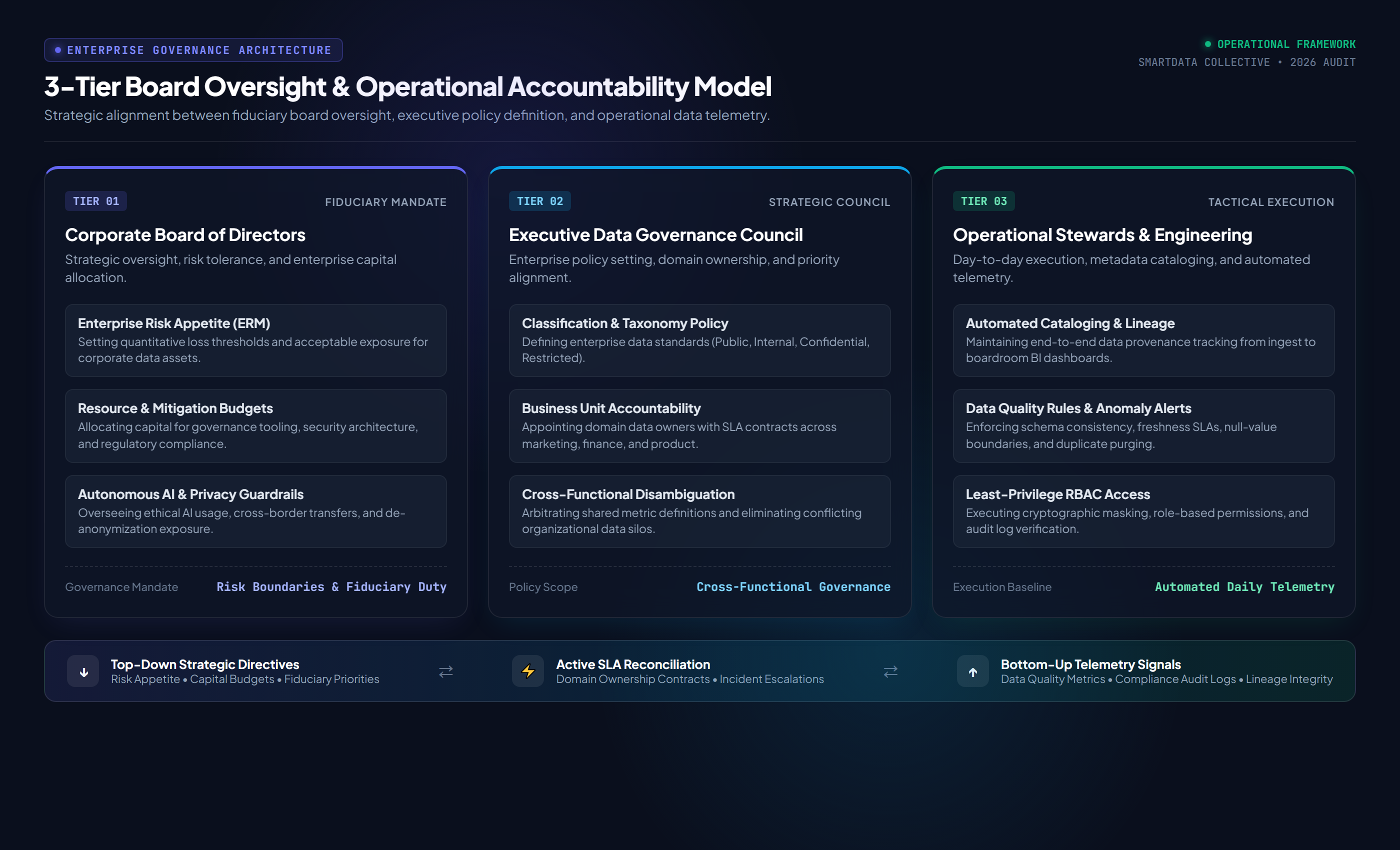
While corporate boards delegate day-to-day data stewardship to operational management, directors maintain fiduciary accountability for enterprise risk appetite, regulatory compliance, and internal controls. Effective board oversight centers on fundamental governance vectors: establishing explicit domain data ownership, validating automated data-quality metrics, approving mitigation budgets, and ensuring artificial intelligence initiatives operate within verified ethical and legal boundaries.
Board-level oversight and operational responsibilities
A disputed business definition or routine access request should not automatically wait for board approval. OvalEdge distinguishes a strategic governance council from an operational committee: the council sets direction and overarching policies, while the committee resolves issues, enforces standards, and aligns stakeholders. This gives your team a distinction between decisions about policy and the work of applying it.
The data governance board operating model assigns policies, standards, accountabilities, priorities, and exceptions to the governance board, while keeping individual definitions, access requests, and quality fixes at the lowest appropriate level. That internal governance body has a different remit from the corporate board of directors, whose oversight includes risk appetite, mitigation budgets, and management’s progress.
| Responsibility | Corporate board oversight | Strategic governance council or board | Operational governance teams |
|---|---|---|---|
| Direction and accountability | Set expectations for acceptable data risk and oversee management. | Define overarching policies, standards, accountabilities, and priorities. | Apply standards and align stakeholders in daily work. |
| Risk mitigation and remediation | Allocate mitigation budgets and track management’s remediation progress. | Govern priorities and exceptions. | Resolve issues and carry out data-quality remediation at the appropriate level. |
| Routine decisions | Oversee the governance approach without managing daily execution. | Keep individual definitions and access requests at the lowest appropriate level. | Handle business definitions, access requests, and quality fixes within delegated authority. |
Future-Proofing Enterprise Governance for the AI Era
As enterprise operations become increasingly data-dependent, board oversight must advance from passive compliance checks to proactive risk calibration. Treating data governance as an ongoing boardroom agenda item protects enterprise reputation, fortifies legal defensibility, and ensures organizations deploy artificial intelligence upon verified, trustworthy foundations.
Frequently Asked Questions
Why is data governance becoming a board-level priority?
Data governance has moved far beyond the domain of IT teams and compliance departments. As enterprise data assets expand across cloud repositories and automated pipelines, corporate directors are expected to verify how data is systematically controlled, audited, and aligned with long-term strategic objectives.