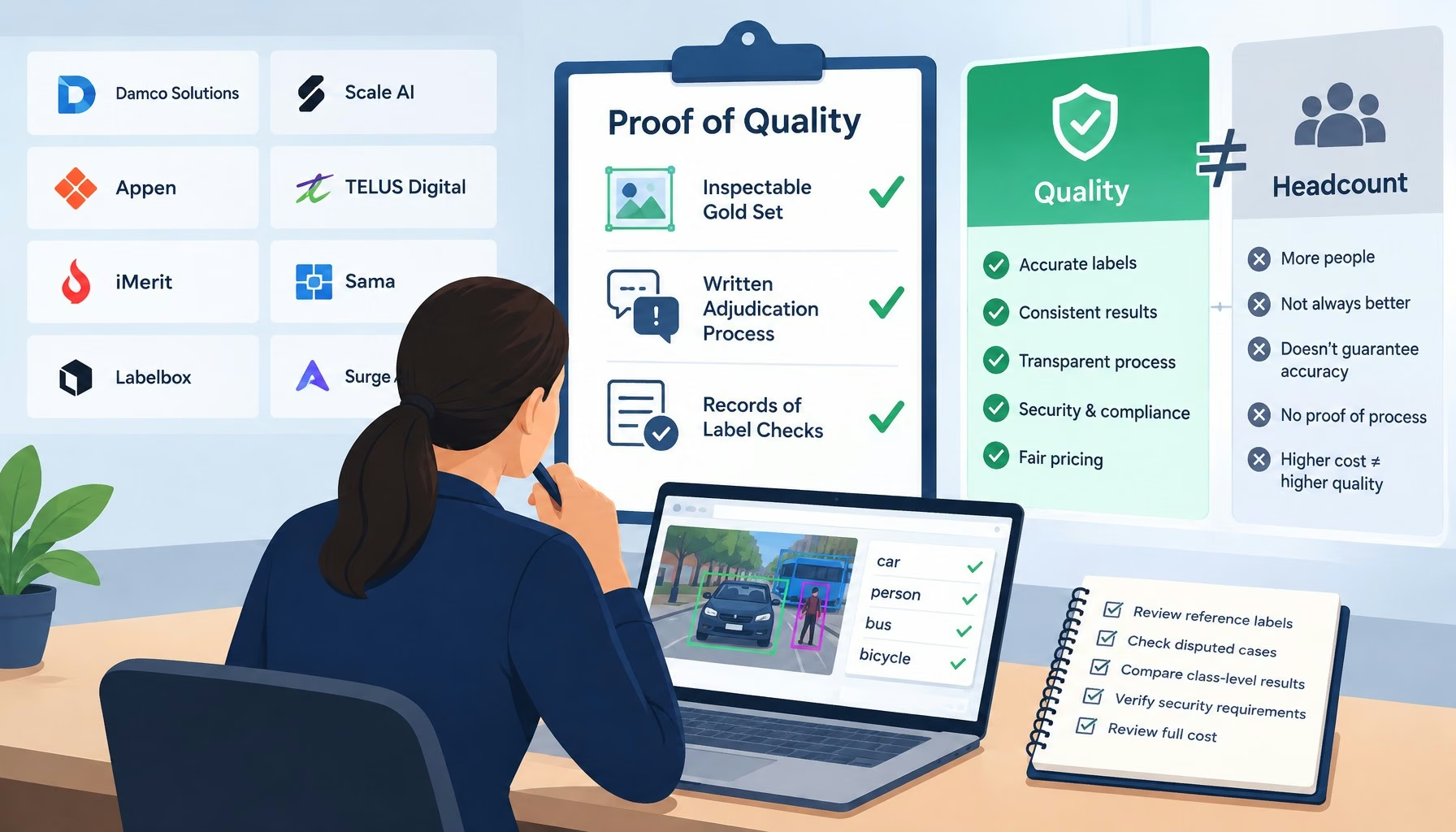
Damco Solutions, Scale AI, Appen, TELUS Digital, iMerit, Sama, Labelbox and Surge AI are providers buyers can compare. This is an unranked shortlist based on publicly documented services. Select a provider through a task-specific pilot: inspect its reference labels, review disputed cases and request records showing how individual labels were checked. Compare class-level results alongside security requirements and the full cost of accepted work.
Headcount and supported data types help narrow a supplier search. They do not establish whether a team will label a blurry pedestrian correctly at dusk or resolve a disputed medical annotation. Buyers need evidence from the data their model will encounter.
- Why Headcount Alone Cannot Establish Label Quality
- The Three Proofs of Quality Worth Asking For
- How Top Data Annotation Companies Present Their Quality Story
- Quality Controls to Check in Any Data Annotation Service
- Security and Compliance Belong in the Quality Review
- Run a Pilot with Explicit Acceptance Criteria
- Label Quality Gets Harder to Fake as AI Projects Scale
- Frequently Asked Questions
Automated pre-labeling changes which tasks need human attention. Its usefulness depends on the model, modality and dataset; it does not remove the need for expert review. Use a pilot to check routine items and the cases where a model is uncertain, then examine how the provider corrects mistakes.
Key takeaways
- Headcount helps predict volume. Accuracy on rare and difficult items depends on guidelines, reviewers, and quality measurement.
- Request an inspectable gold set, a written adjudication process, and a per-label audit trail so your team can check both the labels and the decisions behind them.
- Run a pilot on hard items using the same guidelines and time frame for each provider. Compare results by class and inspect how disagreements were resolved.
Why Headcount Alone Cannot Establish Label Quality
A large workforce may help a provider handle volume and deadlines. Label accuracy also depends on task instructions, reviewer expertise and the checks applied to the work. Evaluate those separately from staffing claims.
Meta’s SAM 3 research paper reports a data engine with four million unique concept labels, including hard negatives, across images and video. The authors report a twofold accuracy improvement over existing systems on promptable concept segmentation. That is a result for the paper’s task and evaluation, not evidence that any annotation vendor achieves twice the quality or needs fewer reviewers.
When a model proposes a mask or a sentence label, reviewers still need to check whether it fits the instructions. Ambiguous items may need a domain expert, and rare cases may require new examples or revised guidance. Ask who handles these decisions and how their corrections are checked.
A headline accuracy figure can hide poor results on rare classes. In an illustrative dataset with 900 negative items and 100 positive items, predicting every item as negative gives 90% accuracy while missing every positive case. Ask for class-level errors and the sample counts behind each score; do not accept a single percentage without its denominator.
The Three Proofs of Quality Worth Asking For
Use the following three evidence requests as a procurement checklist. They are recommendations for evaluating suppliers, not findings from a comparative test of the companies below.
An Inspectable Gold Set
A gold set is a reference sample with reviewed labels used to evaluate submitted annotations. Agree its construction with domain experts and include difficult cases. Keep a held-out evaluation subset separate from examples used to train workers. Record disputed reference labels and revise them when the evidence warrants it; agreement with a reference is useful only if the reference itself is defensible.

A Written Adjudication Process
Ask for a documented process for label disagreements. It should identify who reviews the conflict, which evidence they consider and how the outcome is recorded. Review examples where majority voting was insufficient or the guideline needed clarification. For subjective tasks, retaining multiple defensible interpretations can be more appropriate than inventing a single correct label.
An Audit Trail per Label
Request a traceable record for each sampled label: its reviewer or controlled pseudonymous identifier, guideline version, review status and reason for a change. Access must follow privacy and contractual limits. A traceable decision record helps your team investigate a model error without unnecessarily exposing annotators’ personal information.
The research preprint Who Annotates in NLP, revised in September 2026, examines 2,667 annotation tasks extracted from 1,603 ACL-venue papers published between 2018 and 2025. It reports released guidelines for 34.1% of tasks and annotator training for 18.7%. Those are research-reporting rates, not a survey of commercial vendors or proof that unreported practices never occurred. They illustrate why buyers should request documentation directly.
How Top Data Annotation Companies Present Their Quality Story
The following eight providers illustrate different service and platform approaches. Descriptions were checked against their public pages on October 22, 2026; those pages establish positioning, not independently measured quality. No paid pilot or certification audit was performed for this comparison. Confirm current scope and contractual access to quality records before shortlisting.
Damco Solutions
Damco Solutions offers image, video, text and audio annotation services. Its page describes human review and quality assurance for AI data projects. Ask for quality results by modality, the qualifications of any domain reviewers and an example of a corrected annotation.
Scale AI
Scale AI markets training-data and evaluation services through its Data Engine. Ask how customer projects and data access are separated, which reviewers will work on your task and how expert disagreements are measured and resolved.
Appen
Appen describes services spanning multilingual speech, search relevance, multimodal data and model evaluation. Ask how it selects specialists for your task, keeps instructions consistent and checks reference labels across teams.
TELUS Digital
TELUS Digital offers data collection, annotation and model-evaluation services across language and computer-vision tasks. Ask which quality controls apply to your specific delivery team and which records your organization can export or audit.
iMerit
iMerit offers data annotation services and the Ango Hub platform, with public offerings in healthcare AI, autonomous mobility and other specialist domains. Ask who adjudicates domain-specific cases and how the platform records their decisions.
Sama
Sama markets human-verified annotation, validation and evaluation, including computer-vision work. Ask for escalation examples and results on rare classes across the actual team assigned to your project.
Labelbox
Labelbox documents managed labeling services alongside its platform. Customers provide project instructions and can request an expert workforce for annotation or review. Ask which quality controls are software features, which are performed by people and how your team can inspect the resulting evidence.
Surge AI
Surge AI describes expert demonstrations, preference data, reinforcement-learning environments and custom evaluations. Ask how it validates specialist expertise, builds task-specific rubrics and records disagreements between experts.
Use the comparison below to prepare evidence requests, then score each provider against the same task. Public descriptions can support a shortlist; only project-specific evidence can support your acceptance decision.
| Provider | Public positioning | Focus areas | Quality evidence to request |
|---|---|---|---|
| Damco Solutions | Image, video, text and audio annotation services. | Enterprise AI training-data projects. | Task-level scores, reviewer qualifications and correction records. |
| Scale AI | Training-data and evaluation services through Data Engine. | AI training and model evaluation. | Project access controls, task reviewer qualifications and disagreement records. |
| Appen | Human data across speech, multimodal tasks and evaluation. | Multilingual data and model development. | Specialist selection, guideline consistency and reference-label maintenance. |
| TELUS Digital | Data collection, annotation and model evaluation. | Language, computer vision and emerging AI tasks. | Project-specific quality procedures and audit/export access. |
| iMerit | Annotation services and the Ango Hub platform. | Healthcare AI, autonomous mobility and other specialist domains. | Domain reviewer qualifications and recorded adjudication decisions. |
| Sama | Human-verified annotation, validation and evaluation. | Computer vision and other AI data projects. | Rare-class results and escalation records for the assigned delivery team. |
| Labelbox | Annotation platform with documented managed labeling services. | Data annotation, review and model evaluation. | Separate platform controls from service-team obligations; inspect exported records. |
| Surge AI | Expert data, training feedback and custom evaluations. | Model training, preference data and domain-specific evaluation. | Specialist verification, task rubrics and expert-disagreement records. |
Quality Controls to Check in Any Data Annotation Service
Apply the following checks to every shortlisted service. An attractive demonstration is insufficient if your contract does not specify who owns the quality review and how failures will be corrected.
- They measure quality by class, not in total. Reports break out accuracy for rare and difficult categories, not just the overall figure.
- They treat guidelines as a living document. Every adjudicated disagreement can change the guideline, and each version is tracked.
- They separate production from review. The people who check labels are not the people who created them.
- They welcome client audits. Buyers can pull random samples and score them against the gold set at any time.
- They report uncertainty. Items that remain ambiguous after review retain that status and a reason. The export should preserve any valid multiple labels the task requires.
A successful pilot supports a limited decision about the tested task and sample. Keep reviewing production batches for changes in data, staffing and instructions. A vendor’s performance on one domain should not be treated as proof for another.
Security and Compliance Belong in the Quality Review
Annotation work can expose sensitive medical images, identity documents and customer conversations. Determine which privacy rules apply to the data, organization and processing activity before sharing a pilot dataset. HHS explains that HIPAA applies to covered entities and business associates; it does not automatically cover every health-related dataset. Assess GDPR obligations separately when the processing falls within its scope.
Ask where annotators work, which devices they use, how access is restricted and what happens to data when the project ends. Identify any third-party model receiving data for pre-labeling and agree retention and deletion terms. Request relevant independent assurance: a SOC 2 report and, where relevant, an ISO/IEC 27001 certificate. Check their scope, dates and exceptions against the entity and service you will use. SOC 2 is an examination report, not a certification; neither document proves annotation accuracy.
Run a Pilot with Explicit Acceptance Criteria
Design the pilot around the decisions your model must get right. Treat the steps below as a proposed evaluation workflow, not a universal sample-size standard. Choose sample counts and thresholds for your classes, risk and statistical uncertainty.
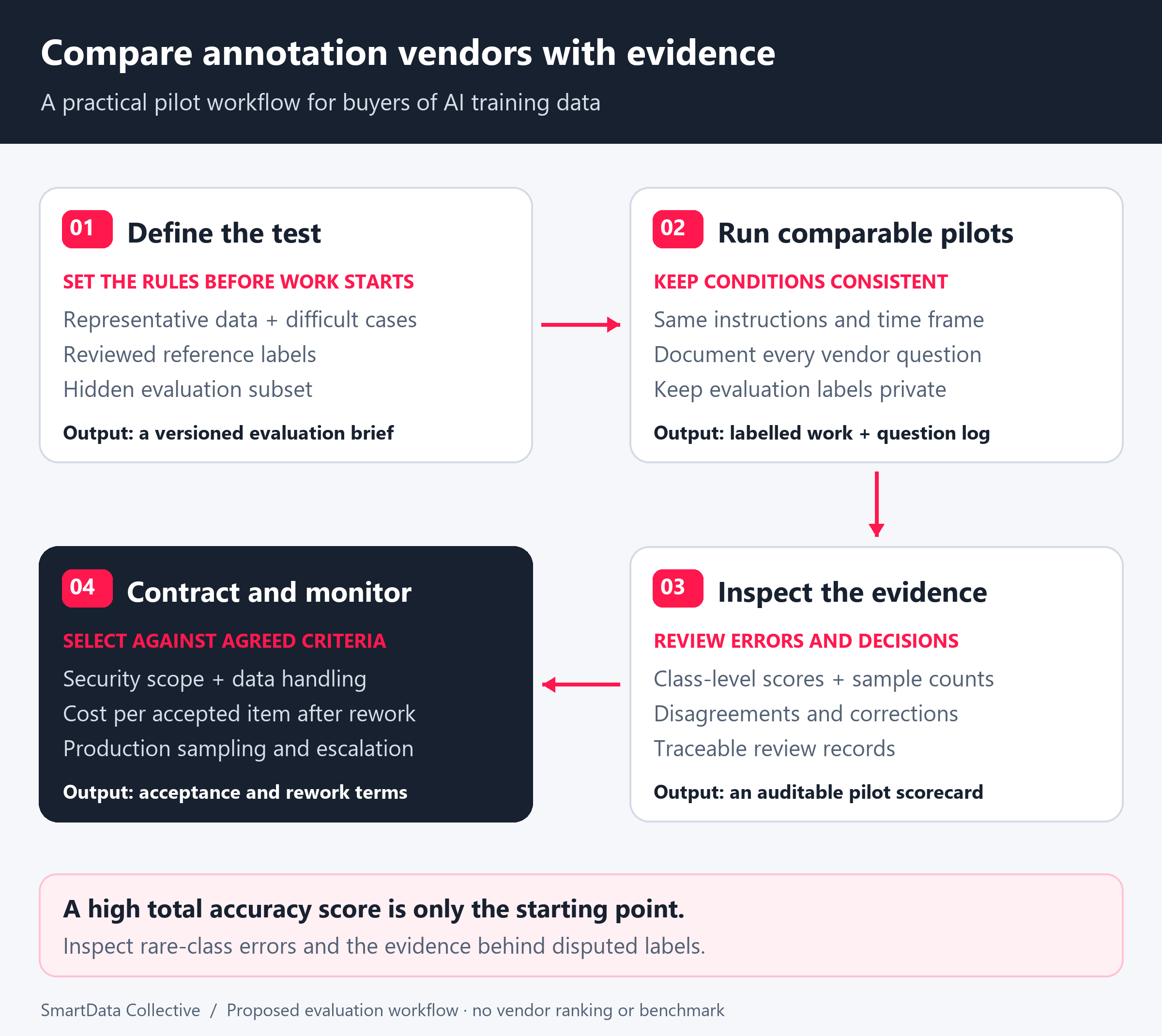
- Choose a documented sample containing representative production items, rare classes and disputed cases. Size each class so the score is meaningful; report how many examples support it.
- Build a reviewed reference set with your domain experts. Keep the scored evaluation labels hidden from vendors and separate from worker-training examples.
- Give each provider the same guideline and the same time frame, and ask them to log every question they raise.
- Predefine task-appropriate scores and acceptance thresholds. Report each class separately, including errors on difficult categories, and record how any aggregate weighting was chosen.
- Review the adjudication log to see how each provider handled disagreement and uncertainty.
- Audit a documented random sample of decision records for completeness. Include guideline versions, corrections and review outcomes, then compare costs per accepted item after rework.
For classification, precision and recall distinguish false positive labels from missed positive cases. For segmentation, agree an overlap measure and boundary rules suited to your task. Keep annotator agreement separate from correctness against the reviewed reference: people can agree on the same mistake. Report sample counts and uncertainty alongside scores.
These checks follow the broader practice of finding data-quality defects before customers encounter them. Agree an escalation route, a rework deadline and an ongoing sampling schedule before moving beyond the pilot.
Keep Quality Ownership Clear
Assign an internal owner for the label taxonomy, reviewed reference set, acceptance criteria and data-access approvals. The vendor can manage annotator staffing, contracted review and rework, while your team audits delivered batches and approves changes to instructions. If the task definition is still changing, resolve a small sample with your domain experts before expanding the contract.
Compare the Cost of Accepted Labels
Ask each provider to quote the same input volume, label complexity, review depth, turnaround and export requirements. Separate pilot setup and platform charges from ongoing annotation, expert review and rework. Record what the price includes, who pays for rejected work and any minimum commitment. Compare total delivery and review costs against the number of items that meet your acceptance rules; a low price per submitted label can hide substantial correction work.
The questions a provider asks during the pilot are often as revealing as its scores. A team that flags gaps in your guideline is protecting your model. A team that never asks a question may be guessing.
Label Quality Gets Harder to Fake as AI Projects Scale
A Gartner survey on AI-ready data published in February 2025 reported that 63% of respondents lacked, or were unsure they had, the right data-management practices for AI. The release describes a July 2024 survey of 1,203 data-management leaders. Its separate prediction that organizations would abandon 60% of AI projects unsupported by AI-ready data through 2026 is a forecast, not an observed failure rate or an annotation-vendor benchmark.
Automation may shift effort toward review and difficult cases, but the balance varies by task. Contracts should specify the acceptance rules, access to decision records, rework responsibilities and security obligations. Measure the time and cost needed to produce accepted labels, including the work required to correct them.
Before selecting a data annotation company, request a scored pilot and inspect the evidence behind disputed labels. Choose the provider whose results, review process and data controls meet your documented requirements. Retain the pilot as a baseline and check production performance against it; a workforce count or marketing accuracy claim cannot substitute for that record.
Frequently Asked Questions
How should buyers compare data annotation companies?
Give shortlisted providers the same task instructions, a comparable sample and predefined acceptance rules. Score difficult and rare classes separately, inspect how disagreements were resolved, and request traceable review records. Compare the cost of accepted work after rework and check the security controls that apply to your actual project.
Why is overall annotation accuracy insufficient?
An overall score can be dominated by common or easy classes. A provider may achieve a high total while missing the rare examples your model needs to handle. Request class-level results, sample counts and task-appropriate measures such as precision and recall, then inspect errors against a reviewed reference set.
Is annotation software the same as a managed annotation service?
No. Software provides tools to create, review and export labels. A managed service also supplies people and delivery processes. Some providers offer both, so confirm who writes the instructions, supplies domain experts, adjudicates disputes and corrects rejected work. Assign those responsibilities explicitly in the contract.