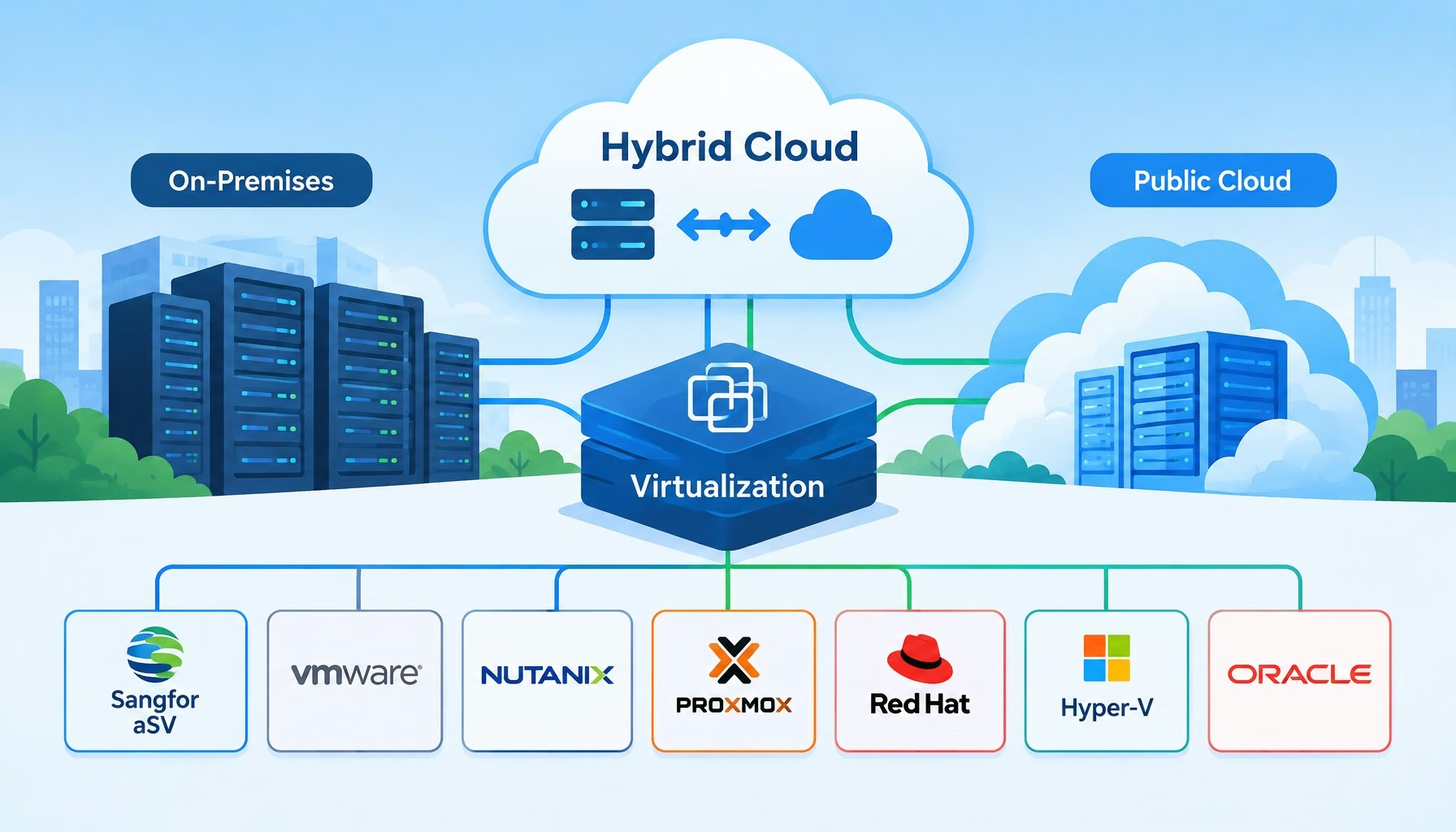
Pick the wrong virtualization platform and your IT team eats years of rework. Since Broadcom’s acquisition of VMware, pricing disruption has pushed thousands of enterprises to reassess what actually runs under their workloads. The market for virtualization platforms built for hybrid cloud environments has shifted hard. What follows is a look at seven platforms worth serious evaluation, ranked by overall fit for enterprise hybrid cloud deployments.
- Why Virtualization Matters in Hybrid Cloud
- Comparing Platform Scope and Operational Fit
- Matching the Platform to Your Existing Estate
- FAQ
- What is virtualization in the cloud?
- What is a hybrid cloud deployment model?
- What are the best virtualization platforms for hybrid cloud environments?
- Checking the Hybrid Extension Before Platform Commitment
Choose a hybrid-cloud virtualization platform around your existing workloads, licensing commitments, and management skills. Sangfor aSV emphasizes bundled services; VMware offers ecosystem depth; Nutanix packages HCI; Proxmox favors open-source control. Red Hat suits container modernization, Hyper-V fits Microsoft environments, and Oracle fits database-heavy stacks. Compare migration tooling and included networking and storage before committing.
Platform selection at a glance
- Sangfor aSV and Nutanix package compute with other infrastructure services. Compare what the platform license includes, especially networking and storage.
- VMware offers a deep ecosystem, while Proxmox gives teams an open-source option with more hands-on configuration.
- Red Hat, Hyper-V, and Oracle fit different starting conditions: container modernization, Microsoft/Azure commitments, and Oracle-heavy applications.
- Hypervisors still connect on-premises and public-cloud operations, as discussed in WindowsForum’s virtualization coverage. Your existing estate affects the migration work behind each choice.
Why Virtualization Matters in Hybrid Cloud
A hypervisor is the layer that makes hybrid cloud work. It abstracts compute resources so workloads can move between on-premises servers and public cloud infrastructure without being rebuilt for each environment. Strip away a capable virtualization layer, and “hybrid cloud” is mostly a marketing term.
The platforms here differ on dimensions that actually matter. Is networking and storage bundled or sold separately? How does migration tooling handle an existing VMware estate? Does the hypervisor run on broad commodity hardware or a narrow certified list? What level of vendor support ships with the license? Pricing transparency varies wildly too. Some vendors publish rates openly; others require a quote call before IT can even run a cost comparison. For teams building or rearchitecting a hybrid cloud stack, those differences add up fast.
1. Sangfor
aSV Hypervisor
What it does: Sangfor aSV is a type-1, KVM-based bare-metal hypervisor from Sangfor Technologies. It installs directly on x86 servers from Dell, HPE, Lenovo, and others, and serves as the compute virtualization layer inside Sangfor’s Hyper-Converged Infrastructure and Cloud Platform stacks. It’s positioned as an enterprise VMware vSphere alternative for mid-market and large organizations reassessing their virtualization spend after Broadcom’s pricing changes.
Where it shines: The clearest structural advantage is bundling. VMware prices NSX (networking) and vSAN (storage) as separate add-ons; aSV folds networking, storage, and security – WAF, IPS, and intelligent micro-segmentation through aSEC – into the same license. Migration tooling is purpose-built: the platform ships over 230 commands equivalent to PowerCLI, so existing VMware automation scripts carry over rather than getting rewritten from scratch. Live migration stays under 3 seconds of measured performance impact, and Proactive HA 2.0 flags likely node failures before they cause outages rather than responding after. Sangfor cites more than 12,000 completed VMware migrations and 28,000+ cloud customers globally.
On G2, Sangfor Cloud Platform holds a 4.7 out of 5 rating across 94 reviews, with a Leader badge in Server Virtualization for Summer 2026. Gartner Peer Insights shows a 4.9 overall rating from verified enterprise reviewers, with 100% Willingness to Recommend across 23 enterprise reviews. Sangfor named it a Representative Vendor in the 2025 Gartner Market Guide for Server Virtualization Platforms.
2. VMware
What it does: VMware, now a Broadcom subsidiary, offers the VMware Cloud Foundation stack, vSphere Foundation, and a broad set of advanced services covering disaster recovery, container operations, private AI infrastructure, edge orchestration, and load balancing. With 38,300 employees as of 2023 and $13.4 billion in revenue, it’s the largest pure-play virtualization vendor by a wide margin. VMware Cloud Foundation won a 2025 Tech CUBEd Award for most advanced cloud infrastructure solution.
More Read

Where it shines: Ecosystem depth. VMware’s published case studies cover a range of industries, and the community of trained vSphere admins, third-party integrations, and partner tooling is larger than any other vendor on this list. Grinnell Mutual saved $1 million in infrastructure costs using VMware Cloud Foundation; GCI deployed VMware Cloud Foundation alongside Tanzu Data Services for a full-stack hybrid cloud build. Broadcom’s licensing restructuring pushed SMB pricing up sharply – Sangfor’s own blog cites increases of up to tenfold in some cases. Teams renewing VMware contracts now should model the full cost of VMware Cloud Foundation before comparing, since advanced networking and storage capabilities are bundled at a higher price tier.
3. Nutanix
What it does: Nutanix sells the Nutanix Cloud Platform, which packages AOS storage, AHV virtualization, Nutanix Flow networking, Kubernetes management, database-as-a-service, and enterprise AI tooling into a single HCI platform. Founded in 2009 and publicly traded on NASDAQ (NTNX), Nutanix employs around 7,800 people and targets organizations running hybrid and multicloud workloads that need a single management plane across environments.
A hybrid cloud platform runs and manages workloads across more than one kind of environment: public cloud regions, your own data centers, bare metal servers, and increasingly neoclouds, the GPU-focused providers that supply AI capacity.
Noah Grinstein in 9 Best Hybrid Cloud Platforms in 2026 — Control PlaneWhere it shines: Analyst positioning is strong. Nutanix is named a Leader in the 2026 Gartner Magic Quadrant for Server Virtualization Platforms with the highest Execution score, and a Leader in the 2026 Gartner Magic Quadrant for Distributed Hybrid Infrastructure. The platform also holds a Challenger position in the 2026 Gartner Magic Quadrant for Container Management. AHV is a capable no-license-cost hypervisor included with the Nutanix stack, attractive for organizations standardizing on Nutanix’s full platform rather than paying separately for compute virtualization. Nutanix requires a narrower vendor-certified hardware list compared to platforms that support broad commodity x86 hardware. Teams with existing server infrastructure outside that list should verify compatibility before committing.
4. Proxmox
What it does: Proxmox Virtual Environment, from Proxmox Server Solutions GmbH in Vienna, Austria, is an open-source virtualization platform combining KVM-based virtualization and container-based virtualization in a single interface. The company also offers Proxmox Backup Server, Proxmox Mail Gateway, and Proxmox Datacenter Manager. Founded in 2005, Proxmox has 68 employees and manages more than 1.5 million hosts globally across partnerships with over 1,000 resellers in 142 countries.
Where it shines: Cost. The full feature set is available without a commercial subscription, which makes Proxmox the natural first look for budget-constrained teams and organizations that want open-source infrastructure they can self-manage. Customers include the European Space Agency, YouTube, Huawei Technologies, and Northrop Grumman. The vendor claims approximately 95% of VMware deployments can migrate to Proxmox VE without issue, and partnerships with NVIDIA and Veeam extend what it can connect to. Proxmox requires considerably more manual configuration than appliance-style platforms. Storage and networking are assembled separately, and high availability and disaster recovery demand hands-on setup. Commercial support comes through remote ticketing only.
5. Red Hat
What it does: Red Hat, a subsidiary of IBM since 2019, delivers Red Hat Enterprise Linux (RHEL), OpenShift Container Platform, Ansible Automation Platform, and Red Hat AI. Its virtualization story runs through OpenShift Virtualization, which lets teams run traditional VM workloads alongside containerized applications on a Kubernetes-native platform. Red Hat has 19,000 employees and supports more than 90% of Fortune 500 companies across automotive, financial services, healthcare, public sector, and telecommunications.
Where it shines: Red Hat’s strength is with organizations modernizing toward containers and cloud-native application platforms. Red Hat was named a Leader in the 2026 Gartner Magic Quadrant for Cloud-Native Application Platforms for a third consecutive year, and holds a fourth consecutive Leaders Quadrant position in a separate Gartner Magic Quadrant. For teams already running Ansible for automation, the operational continuity is real – the tooling integrates directly without additional bridging work. OpenShift Virtualization is a strong fit for container-first shops but may carry more overhead than a purpose-built hypervisor for teams whose primary workload is traditional VM management. That tradeoff is worth sweating before you commit.
6. Microsoft Hyper-V
What it does: Hyper-V is Microsoft’s native type-1 hypervisor for x86-64 systems, released in June 2008 and built into Windows Server. It runs directly on physical hardware with near-native performance, supports Windows, Linux, and FreeBSD guest operating systems, and is the hypervisor underpinning Azure Stack for on-premises hybrid cloud scenarios. Microsoft was founded in 1975 and is headquartered in Redmond, Washington. WindowsForum’s 2026 virtualization overview describes the continuing role of hypervisors in isolating workloads and connecting on-premises and public-cloud environments.
Where it shines: Windows-heavy environments. Organizations already running Windows Server licensing get Hyper-V included, keeping acquisition costs low. The Azure integration story is coherent too – organizations standardizing on Azure as their public cloud extension benefit from Hyper-V’s tight alignment with Azure Site Recovery, Azure Migrate, and Azure Arc. Server consolidation and performance are well-documented use cases. Hyper-V’s management tooling and ecosystem are tightly coupled to the Microsoft stack. Teams running mixed operating environments or planning workloads outside the Azure orbit may find those advantages less compelling than they look on paper.
7. Oracle
What it does: Oracle Corporation, founded in 1977 and headquartered in Austin, Texas, delivers Oracle Cloud Infrastructure (OCI) alongside its flagship Oracle Database and a broad suite of Oracle Cloud Applications. OCI covers IaaS and SaaS, including Oracle Fusion ERP, EPM, SCM, HCM, NetSuite, and Oracle Health. Oracle employs approximately 141,000 people and generated $67.36 billion in revenue in 2026.
Where it shines: Database-heavy and Oracle-application-centric organizations. OCI is architected to run Oracle Database workloads at performance levels that competing clouds have historically struggled to match for Oracle-native applications. For enterprises whose hybrid cloud design centers on Oracle ERP or large Oracle Database deployments, OCI’s infrastructure is purpose-aligned in a way generic IaaS alternatives aren’t. Oracle’s scale – $261.76 billion in total assets – signals long-term platform commitment. Oracle’s ecosystem advantages narrow considerably for organizations that don’t rely heavily on Oracle applications or databases. Teams with a mixed application portfolio may find OCI’s benefits less differentiated compared to broader multi-cloud hypervisors.
Comparing Platform Scope and Operational Fit
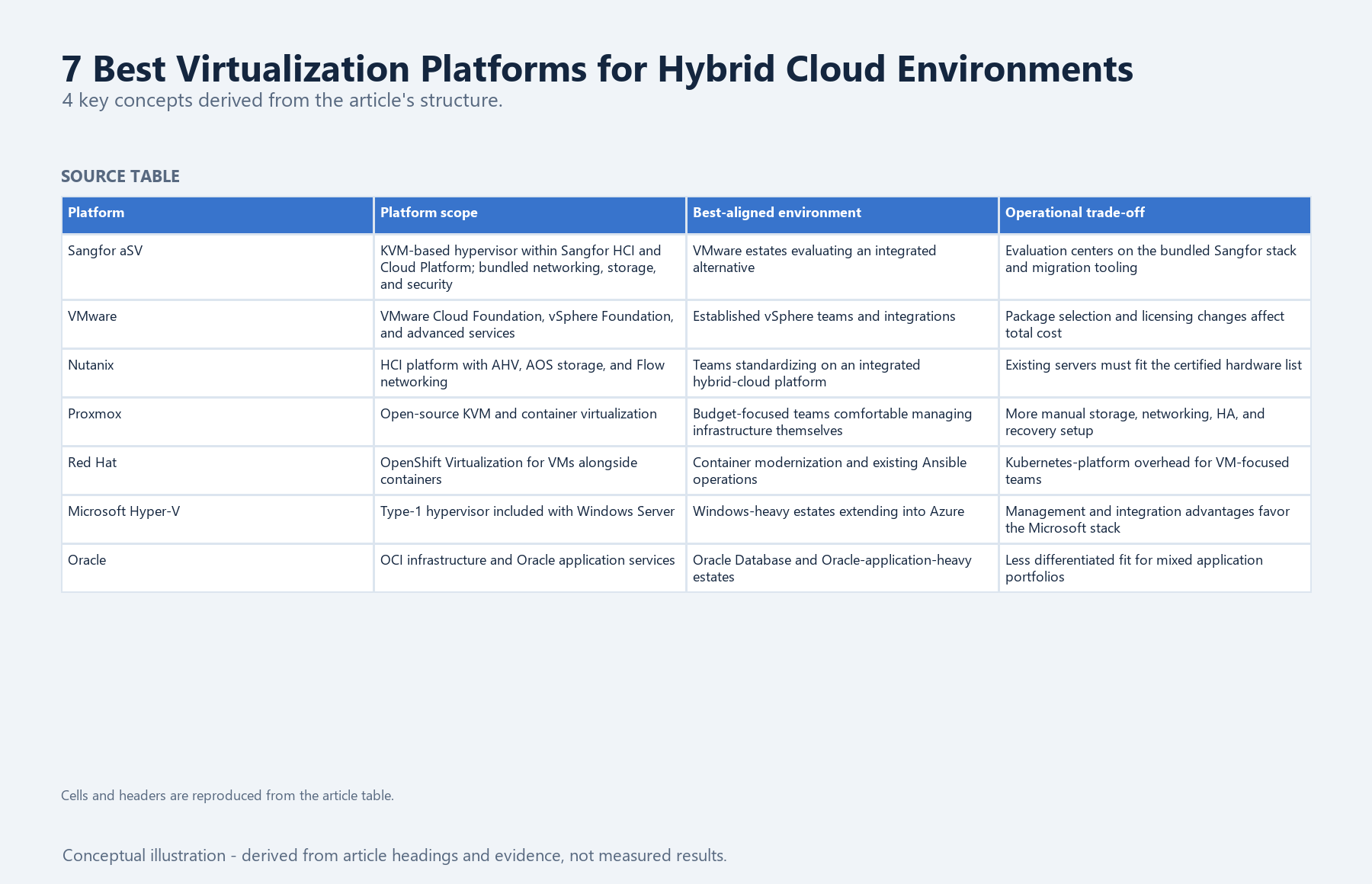
Compare these seven options by what they package and the environment your team already operates. Sangfor and Nutanix emphasize integrated stacks; Proxmox leaves more assembly to administrators. Red Hat, Hyper-V, and Oracle align with specific application or cloud commitments, while VMware offers an established ecosystem with changed licensing economics.
The shortlist includes individual hypervisors, broader HCI platforms, and OCI’s cloud services. Those scopes affect the comparison: Oracle’s application fit answers a different question from Proxmox’s hypervisor licensing. VMware also offers multiple packages, including vSphere Foundation, which its product page describes as an enterprise-class hyperconverged infrastructure workload platform.
| Platform | Platform scope | Best-aligned environment | Operational trade-off |
|---|---|---|---|
| Sangfor aSV | KVM-based hypervisor within Sangfor HCI and Cloud Platform; bundled networking, storage, and security | VMware estates evaluating an integrated alternative | Evaluation centers on the bundled Sangfor stack and migration tooling |
| VMware | VMware Cloud Foundation, vSphere Foundation, and advanced services | Established vSphere teams and integrations | Package selection and licensing changes affect total cost |
| Nutanix | HCI platform with AHV, AOS storage, and Flow networking | Teams standardizing on an integrated hybrid-cloud platform | Existing servers must fit the certified hardware list |
| Proxmox | Open-source KVM and container virtualization | Budget-focused teams comfortable managing infrastructure themselves | More manual storage, networking, HA, and recovery setup |
| Red Hat | OpenShift Virtualization for VMs alongside containers | Container modernization and existing Ansible operations | Kubernetes-platform overhead for VM-focused teams |
| Microsoft Hyper-V | Type-1 hypervisor included with Windows Server | Windows-heavy estates extending into Azure | Management and integration advantages favor the Microsoft stack |
| Oracle | OCI infrastructure and Oracle application services | Oracle Database and Oracle-application-heavy estates | Less differentiated fit for mixed application portfolios |
For a geographically focused comparison of private-cloud and HCI options, see VMware alternatives in Thailand.
Matching the Platform to Your Existing Estate
Your existing estate determines which platform advantages matter. Windows Server licensing favors Hyper-V, Oracle applications favor OCI, and container modernization favors OpenShift Virtualization. For a VMware migration, the deciding comparison includes bundled services and migration tooling alongside the skills and integrations your team would retain or replace.
The right choice among virtualization platforms for hybrid cloud environments depends almost entirely on starting conditions. VMware’s ecosystem depth remains unmatched, but licensing costs have changed the math significantly. Nutanix suits teams that want analyst-validated HCI at scale; Proxmox serves budget-focused shops comfortable with open-source assembly. Red Hat is the natural pick for container-modernization paths, Hyper-V makes sense inside committed Microsoft/Azure environments, and Oracle fits Oracle-application-heavy stacks. Teams migrating an existing VMware estate – particularly those evaluating cost-per-workload on a tight timeline – should also look hard at KVM-based alternatives that bundle networking and security into the base platform license. You’ll notice that bundling, more than any other single factor, is where the real cost differences tend to surface.
FAQ
Virtualization abstracts compute resources, while hybrid cloud connects on-premises and public-cloud environments through virtualization, containerization, and orchestration. For teams choosing among these seven platforms, the deciding factors are existing workloads, included services, and management fit. The hypervisor is one component of that deployment model, alongside the surrounding platform services.
What is virtualization in the cloud?
A hypervisor abstracts physical compute resources so multiple workloads can run as virtual machines. In hybrid environments, that abstraction supports workloads across on-premises servers and cloud platforms. Networking, storage, and management capabilities come from the surrounding platform stack.
What is a hybrid cloud deployment model?
It connects on-premises infrastructure with public-cloud resources. Virtualization abstracts compute, while containerization and cloud orchestration help workloads operate across the environments. Aerospike’s hybrid-cloud explanation describes how these technologies support interoperability.
What are the best virtualization platforms for hybrid cloud environments?
The seven options covered here are Sangfor aSV, VMware, Nutanix, Proxmox, Red Hat OpenShift Virtualization, Microsoft Hyper-V, and Oracle. Selection depends on your estate: bundled HCI, established VMware integrations, open-source administration, container modernization, Microsoft/Azure alignment, or Oracle-heavy applications.
Checking the Hybrid Extension Before Platform Commitment
A VMware-based hybrid deployment needs an existing VMware foundation and a compatible cloud extension. For teams retaining vSphere, provider limitations belong in the platform comparison alongside licensing and included services. Pluralsight’s VMware hybrid-cloud guidance specifically calls for checking VMware documentation and the cloud provider’s limitations during selection.
Your current management tool does not disappear when the cloud extension arrives. Pluralsight’s guidance makes existing VMware use a condition of its VMware hybrid scenario, so a team managing another platform cannot assume the same design fits. Before committing, compare the proposed cloud provider’s documented limitations with the VMware deployment you actually run. That check belongs beside the license comparison, especially when retaining existing vSphere tooling is a major reason for staying with VMware.