Most enterprises no longer have a data problem. They have a context problem.
For a decade the constraint was collection: too few sensors, too little telemetry, too little history. That constraint is gone. Connected devices passed 21 billion in 2025 and head toward 39 billion by 2030, on IoT Analytics figures. In parallel, 88% of organizations now use AI in at least one business function, up from 78% a year earlier, on McKinsey’s 2025 survey. The raw material is everywhere.
The value is not. An IDC study commissioned by Seagate in 2020 found that 68% of the data available to enterprises is never put to work. The pattern is older than the hype: McKinsey’s 2015 study of an offshore oil rig with 30,000 sensors found that roughly 1% of the data was ever examined, and mostly to detect anomalies rather than to optimize or predict. More sensors did not produce more insight. They produced more dark data.
This is the real story of AIoT. It is not about collecting more or adding a model on top. It is about closing the distance between a sensor reading and a decision.

What AIoT Actually Changes
AIoT is the convergence of artificial intelligence and the internet of things: AI supplies the analysis and the decision, IoT supplies the connectivity and the data. The change it introduces is not a new data source. It is a new place for intelligence to live.
Classic analytics worked the way business intelligence always has, on historical snapshots, after the fact, to inform the next quarter. Operational intelligence inverts that. It acts on data in motion, in real time, to inform the next minute. The difference is timing, and timing is what turns a dashboard into a decision.
Edge AI is what makes this practical. Instead of shipping every reading to a central warehouse and analyzing it later, models run on or near the device and infer at the source, which cuts the volume of raw data sent to the cloud and the lag before anything can be done about it. IoT Analytics frames the 2026 market in the same direction, as a shift from connected things to connected operations that increasingly act on their own.
The business consequence is the decision window. A vibration signature that predicts a bearing failure is worth a great deal the hour before the machine stops and almost nothing the day after. Historical analytics answers the second question: what went wrong. Operational intelligence answers the first – what is about to happen, and what to do now. The same data point carries a different value depending on how fast it reaches a decision.
Recap: the data moved to the edge, so the intelligence had to follow it.
Why Data Alone Is Not Enough
Data alone is not enough because raw measurements carry no meaning. A temperature value is a number until something records which asset produced it, in which process, against which expected range. That binding is called context, and most industrial data lacks it.
The reason is structural. Operational data sits in silos that never agreed on a common language: PLCs, SCADA systems, historians, MES and ERP, each with its own naming, format, and update frequency. The data exists, but not in a form any other system can read. McKinsey estimated that interoperability between two or more IoT systems accounts for roughly 40% of the total value IoT can deliver – nearly half the prize sits in the connections between systems, not inside any single one of them. When systems cannot share, that share is forfeited.
Context is the work that turns a stream of numbers into something a model or an operator can trust. It links each measurement to the asset that produced it, through an asset model or a unified namespace, and it does so consistently across the plant. Without that layer, more data is not more value. It is more noise to store.
Rule of thumb: an organization that cannot describe its data cannot automate decisions on it.
Which Capabilities Turn Data Into Business Value
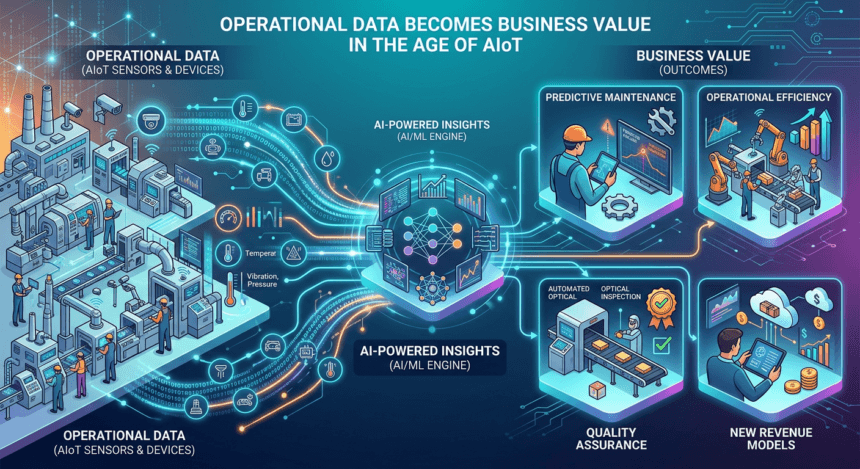
Four capabilities consistently convert contextualized operational data into measurable outcomes. The numbers below are the strong end of the range, demonstrated results rather than averages, and each is attributed to its source.
Predictive maintenance is the clearest case. McKinsey research associates it with 30–50% reductions in machine downtime and 10–40% lower maintenance costs. IBM, citing industry analysis, puts the maintenance-cost reduction at 18–31% against traditional methods.
Closed-loop optimization is the most striking. Google DeepMind reported a 40% cut in the energy used to cool a data center in 2016, rising to around 30% average savings in 2018 once the system moved from recommendations to autonomous control. The inputs were thousands of sensor readings, acted on in real time.
Contextualized analytics is the broadest. The World Economic Forum’s Global Lighthouse Network reports overall equipment effectiveness gains of 5–10% and productivity gains above 50% at its Lighthouse-designated sites. These figures are self-reported within an independent program, and the common factor is a clean, integrated data foundation.
Anomaly detection and AI copilots are the fastest-moving. Real-time models surface deviations the moment they appear, and increasingly summarize them for an operator in plain language, compressing the time between event and response. The market is pricing this in. The IoT analytics layer that runs these models is forecast to grow above 23% a year, on SNS Insider estimates, faster than the platforms it sits on.
The capabilities differ. The precondition does not. Every one of them depends on data that is contextualized, integrated, and available in real time.
Why Most Initiatives Still Fail
Most AIoT initiatives still fail, and the reason is the same precondition seen from the other side. Adoption is nearly universal. Realized value is rare.
The base rates are sobering. Cisco’s 2017 survey of 1,845 decision-makers found that only 26% considered any IoT initiative a complete success, and 60% stalled at the proof-of-concept stage. McKinsey reported in 2018 that 84% of companies working in IoT were stuck in pilot mode, 28% of them for more than two years. The pattern did not stay in IoT. RAND found in 2024 that more than 80% of AI projects fail, roughly twice the rate of IT projects without AI. MIT’s 2025 study reported that 95% of enterprise generative-AI pilots produced no measurable profit impact. Gartner’s 2026 review of infrastructure-and-operations AI found that only 28% of use cases fully met ROI expectations.
The failure drivers are consistent across every one of these studies, and none of them is the model. Cisco named data quality, integration across teams, and budget overruns. Gartner expects 60% of AI projects that lack AI-ready data to be abandoned through 2026. The technology is not the bottleneck. The data foundation is.
Bottom line: the organizations that fail are not under-modeled. They are under-contextualized.
The Sequence That Separates Value From Noise
The companies that reach value share a sequence, not a budget. They build the operational-data foundation first – context through an asset model, integration across OT and IT, and delivery in real time. Analytics comes second, on data that is already trustworthy. AI and automation come third, on top of both, with practices such as ai observability helping organizations maintain visibility into model performance and identify issues as AI systems operate in production. The 26% that Cisco counted as successful, and the lighthouse plants the World Economic Forum tracks, did not win with a better algorithm. They won with data their systems could actually use.
This reorders the usual budget conversation. The instinct is to fund the visible layer first – the model, the dashboard, the pilot with a demo at the end. The durable spend sits underneath it, in the unglamorous work of naming assets, mapping protocols, and moving data in real time. That foundation is reusable across every future use case, while a model trained on un-contextualized data has to be rebuilt for the next one. Spend on the layer that compounds.
The organizations that invert that order, buying the model before fixing the data, populate the 60% to 84% that never leave the pilot. This is why the platform layer matters. An AIoT platform for operational intelligence earns its place when it unifies device connectivity, contextual modeling, and real-time analytics in one operational layer, rather than adding another silo to integrate later. The platform is not the value. The contextualized data it produces is.
One caution belongs at the end of any honest treatment of this shift. Around 23% of organizations already report scaling agentic AI, on McKinsey’s 2025 figures, and Gartner expects more than 40% of agentic AI projects to be cancelled by 2027. If autonomous agents begin acting on un-contextualized operational data, the failure mode changes shape. A model that produces a wrong dashboard wastes an analyst’s afternoon. An agent that acts on the same bad data makes a wrong decision at machine speed, and the loss shows up before anyone reviews it. Data readiness stops being only a value control. It becomes a safety control.
Collecting operational data is now the easy part.
Turning it into a decision, in time, is where the value is.