Enterprise data centers are adding capacity faster than their original specs anticipated. AI accelerators and analytics workloads are pushing denser, heavier equipment into rooms that were never designed for it. Scaling smoothly depends less on square footage than on whether rack-mount hardware can absorb that growth without a rebuild. Jonathan Engineered Solutions, an engineering-first manufacturer of telescopic slides, brackets and cable management systems, shows how engineering teams solve these details in practice.
- Data Growth Is Accelerating the Need to Scale
- 1. Standardized Rack Architecture Simplifies Scaling
- 2. Mounting Brackets Add Flexibility as Racks Grow
- 3. Rail Capacity Prevents Costly Deflection and Sag
- 4. Chassis Width Compatibility Determines Scalability
- Compliance Standards That Demand Custom Width Solutions
- How Custom Engineering Solves Narrow Chassis Constraints
- 5. Cable Management Keeps Airflow and Access Intact
- 6. Custom Engineering Turns Standard Racks Into Scalable Systems
- Frequently Asked Questions on Server Room Scalability
- What size rack does standard 19-inch equipment require?
- How much weight can a rack-mount slide safely support?
- Can low-volume orders still get custom rack hardware?
- Why Hardware Details Decide How Far You Can Scale
Six hardware details help a server room scale without rebuilding its racks: standardized rack architecture, adaptable mounting brackets, adequate rail capacity, chassis width compatibility, cable management and custom engineering. Together, they address whether heavier equipment fits, remains supported during servicing and leaves cooling airflow and technician access intact as capacity grows.
Data Growth Is Accelerating the Need to Scale
Many server rooms must now accommodate higher compute density than their original specifications anticipated. The shift comes from AI accelerator hardware such as GPUs and ASICs, not from simple growth in server counts. According to the 2025 Data Center Energy Usage Report, U.S. data centers consumed 192 terawatt-hours of electricity in 2024, equal to 4.7% of total U.S. electricity use and a 14% increase over 2023.
The report’s Reference Case, published by the Department of Energy and Lawrence Berkeley National Laboratory, projects consumption could reach 649 terawatt-hours, or 11.8% of U.S. electricity, by 2030. Those figures describe the report’s projected consumption for 2030. Scaling success hinges less on square footage than on whether existing rack infrastructure can handle denser, heavier equipment.
As the Uptime Institute documented in its Global Data Center Survey 2024: “Average server rack power densities continue to rise slowly, driven by greater adoption of racks in the 10 kW to 30 kW range… high-density deployments force data centers to reconsider physical mounting, rail deflection, and airflow distribution.” That physical reality is why mechanical rack details dictate real-world scaling limits.
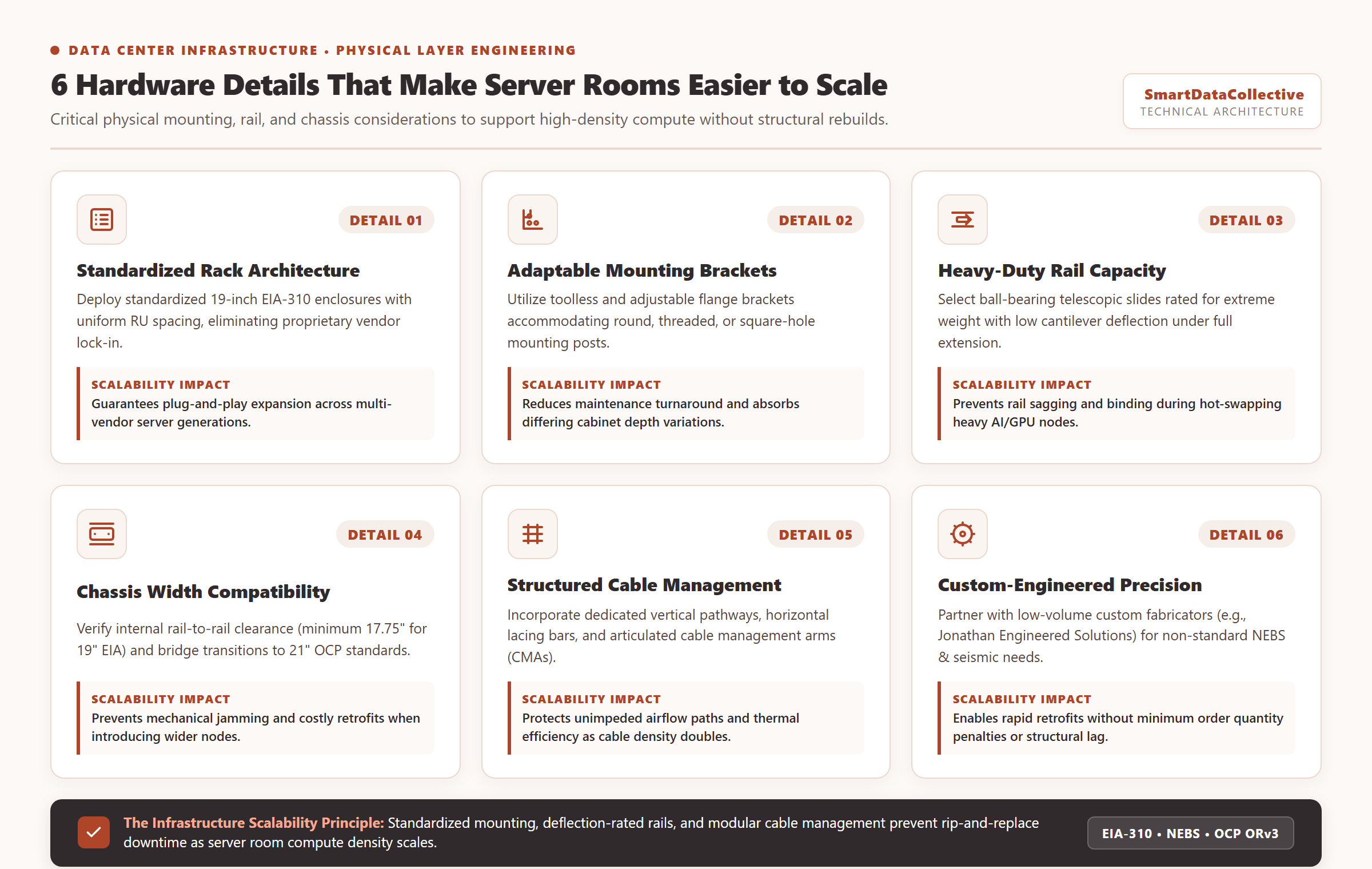
Denser AI and analytics equipment puts pressure on the hardware already in your racks. Standardized architecture makes additional equipment easier to fit, while mounting brackets accommodate changes in orientation and depth. Rail capacity matters when a heavy chassis is fully extended for servicing. Chassis width determines the space available for its supports, and cable management preserves airflow and access. Custom engineering addresses dimensions and compliance requirements that standard parts cannot meet.
1. Standardized Rack Architecture Simplifies Scaling
A standardized rack framework, built around the 19-inch EIA-compatible format, lets new equipment slot into place without redesigning the rack itself. Scaling to rack densities above 20kW puts additional pressure on rack design. The TIA-942-C update addresses higher rack power densities directly.
The Open Rack V3 specification follows a similar logic. It serves as a base frame for large-scale deployments that use interchangeable parts, enabling equipment from different vendors to interoperate. Standardization keeps engineering simpler each time a room adds capacity, making scaling predictable instead of reactive.
More Read

2. Mounting Brackets Add Flexibility as Racks Grow
As a server room scales, engineers often need to reorient equipment within the same rack footprint. A mounting bracket functions as the adapter between a telescopic slide’s stationary member and the rack’s structural rails.
Jonathan Engineered Solutions brackets can convert a side-mounted slide into a top- or bottom-mounted configuration without sacrificing the slide’s original load capacity. They can also extend rail-to-rail mounting depth beyond the slide’s own length when rack depth and slide length don’t naturally align. The company offers recessed and nonrecessed mounting brackets to fit different configurations:
- Recessed brackets: A Joggle Bend design suits restricted spaces with limited clearance.
- Nonrecessed brackets: A 90-degree bend makes these better suited to standard rack configurations.
- Bar nut options: Short and long bar nuts are available to secure brackets across different attachment points.
3. Rail Capacity Prevents Costly Deflection and Sag
A fully extended telescopic slide, sometimes called a drawer, behaves like a cantilever beam. Deflection at the far end is the dominant failure mode in full-extension designs. Deflection scales with the cube of the extension length, so small increases in extension produce larger sag. And as a chassis extends, its center of gravity shifts toward the slide, intensifying bending stress where it is hardest to support.
Static load ratings alone confirm a slide won’t break. They don’t indicate how far it will bend under dynamic loads. As an illustrative example, a 150-pound chassis within a standard slide’s rating can still deflect half an inch at full extension, enough to misalign blind-mate connectors.
Jonathan Engineered Solutions describes this scenario in its case study on solving rack-mount deflection and sag. A sensitive communications chassis bound and sagged on traditional slides during MIL-S-901D shock and MIL-STD-810 environmental testing, risking connector damage and forcing two-operator servicing. The company redesigned the mounting geometry, engineered to help maintain survivability during MIL-S-901D testing, enabling safer single-technician maintenance under demanding vibration conditions.
4. Chassis Width Compatibility Determines Scalability
Standard 19-inch rack hardware assumes a predictable chassis width. Wider or nonstandard equipment can quickly outstrip that assumption. As chassis designs diversify, meeting NEBS, seismic or OCP ORv3 compliance increasingly calls for more than a standard catalog part.
Compliance Standards That Demand Custom Width Solutions
Telecom-grade deployments must often satisfy Network Equipment-Building System (NEBS), seismic and OCP ORv3 compliance requirements, each of which shapes how engineers mount a chassis. NEBS governs the physical and environmental criteria for telecom equipment spaces. Seismic-rated cabinets must remain operational during an earthquake, which determines how engineers reinforce equipment within the rack.
Meeting OCP ORv3 compliance, a newer standard for open rack architecture, adds another requirement for large-scale deployments. Complying with these standards often requires custom engineering, since wider or heavier chassis reduce the rail-to-rail metal thickness available to carry the load.
How Custom Engineering Solves Narrow Chassis Constraints
With its Toolless Fixed Bracket, Jonathan Engineered Solutions addresses these constraints by enabling toolless rack mounting that can sustain extreme loads while simplifying integration. Its Hybrid Slide Technology uses material configurations that deliver high strength within narrow widths, supporting heavy payloads in rugged server applications. Both solutions can be further modified to meet a chassis’s unique dimensions or compliance requirements.
5. Cable Management Keeps Airflow and Access Intact
Cable routing directly affects both thermal performance and technician access, and it becomes harder to manage as a server room scales. This makes cable management less a cosmetic detail than a functional requirement for sustained airflow.
Why Obstructed Cabling Hurts Cooling Efficiency
Under-floor and overhead obstructions often interfere with how a data center distributes cooling air. Obstructions can reduce cooling airflow delivered by air handlers, which negatively affects overall air distribution across the room. As server rooms add more racks and cables during scaling, the risk of obstruction-related airflow issues tends to increase.
Choosing the Right Cable Management Material
Material choice also shapes how well a cable management system holds up over time. Depending on the deployment’s demands, Jonathan Engineered Solutions builds steel, aluminum or plastic systems for cable management:
- Steel systems: These provide a durable and sturdy option suited to high-traffic or heavy-use environments.
- Aluminum systems: Corrosion resistance and flexibility make this option useful in environments with moisture or chemical exposure.
- Plastic systems: Flame-retardant construction suits fire-safety-sensitive deployments.
The company’s 1U and 2U cable management systems and cable retractors come in various heights and lengths, with some including a quick-disconnect feature for faster servicing.
6. Custom Engineering Turns Standard Racks Into Scalable Systems
Jonathan Engineered Solutions staffs its sales team with engineers who answer technical questions on the spot, building immediate trust with client engineering teams. Each customer gets an inside sales contact, and tailored part numbers make reordering fast. Unlike competitors who require high minimum order quantities to justify custom work, the company modifies parts, removing holes or changing materials, even for low quantities, without substantial engineering fees.
The company tools its manufacturing for rapid prototyping and holds AS9100, ISO 9001 and ITAR compliance certifications relevant to aerospace, defense and other regulated work. That same willingness to customize extends to evolving open specifications, including the Open Rack V3 specification, which continues to evolve. For many engineering teams, the best rack-mount hardware for standard 19-inch racks is a design built around the chassis, load and compliance requirements at hand.
| Hardware Detail | Conventional Server Room | Scalable High-Density Design | Failure Risk Mitigated |
|---|---|---|---|
| 1. Rack Architecture | Proprietary post patterns and non-standard cabinet depths across vendor silos. | Standardized 19-inch EIA-310 enclosures with uniform RU vertical spacing. | Prevents stranded rack space and vendor lock-in when adding mixed hardware. |
| 2. Mounting Brackets | Rigid fixed-flange mounts locked to one hole type (threaded vs. square cage nuts). | Toolless, depth-adjustable universal brackets accommodating round or square posts. | Eliminates mounting mismatch downtime and simplifies rapid equipment swaps. |
| 3. Rail Load Capacity | Friction slides or static shelves rated solely for static unextended weight. | Heavy-duty ball-bearing telescopic slides rated for dynamic cantilever extension. | Prevents rail binding, severe sag, and dropped accelerator chassis during service. |
| 4. Chassis Width | Narrow rail-to-rail clearance (<17.5″) causing chassis binding and rail interference. | Verified 17.75″ internal clearance with transition bridges for 21″ OCP ORv3 systems. | Stops mechanical jamming and avoids cabinet rip-and-replace for dense nodes. |
| 5. Cable Management | Unmanaged hanging cable bundles blocking rear server exhaust and fan modules. | Articulated CMAs, dedicated vertical raceways, and strain-relieved lacing bars. | Eliminates thermal hotspots, protects fiber bend radius, and maintains airflow. |
| 6. Custom Engineering | Off-the-shelf catalog parts requiring massive MOQs to make physical adjustments. | Custom-engineered low-volume slides and brackets tailored for NEBS and seismic needs. | Bypasses vendor lead-time bottlenecks and satisfies strict compliance rules. |
Frequently Asked Questions on Server Room Scalability
Rack dimensions, slide deflection and chassis requirements determine whether your team can add equipment without redesigning its mounts. These questions cover standard rack sizing, safe slide support and the conditions that call for custom hardware, including whether low-volume orders can accommodate those changes.
What size rack does standard 19-inch equipment require?
A standard rack accommodates 19-inch-wide equipment, with vertical space measured in rack units, each equal to 1.75 inches.
How much weight can a rack-mount slide safely support?
Capacity depends on more than static load rating alone, since deflection increases sharply as a slide extends further from the rack.
Can low-volume orders still get custom rack hardware?
Yes. Unlike vendors that require high minimum order quantities to justify customization, engineering-first manufacturers can modify parts for very low quantities without charging substantial fees.
Why Hardware Details Decide How Far You Can Scale
Scaling a server room smoothly often comes down to decisions made at the hardware level, long before a rebuild becomes the only option. Rack architecture, brackets, rail capacity, chassis width and cable management each shape how much additional load a room can absorb without structural rework.
When chassis weight escalates with dense compute workloads, static load ratings alone are insufficient. Managing telescopic slide deflection under full cantilever extension is essential to prevent rail binding and maintain structural cabinet integrity.
Jonathan Engineered Solutions in Jonathan Engineered Solutions Server Slide GuidelinesPartnering with an engineering-first provider instead of a catalog-only supplier can shorten the path to a working, scalable solution, particularly when compliance standards or unusual chassis dimensions are involved. Engineering teams planning their next scale-up may benefit from consulting Jonathan Engineered Solutions to evaluate whether their existing rack infrastructure can support the next piece of equipment.