As the Internet of Things (IoT) becomes smarter and more advanced, we’ve started to see its usage grow across various industries. From retail and commerce to manufacturing, the technology continues to do some pretty amazing things in nearly every sector. The civil engineering field is no exception.
- 1. Allows a Transformation From Reactionary to Preventative Maintenance
- 2. Presents a Real-Time Construction Management Solution
- 3. Creates Automated and Reliable Documentation
- 4. Provides a Seamless Project Safety Platform
- 5. Enhances Operational Intelligence Support
- Identifying New Opportunities With IoT
An estimated 20 billion internet-connected devices will be active around the world by 2020. Adoption is certainly ramping up, and the technologies that support IoT are also growing more sophisticated — including big data, cloud computing and machine learning.
As a whole, civil engineering projects have a lot to gain from the integration of IoT technologies and devices. The technology significantly improves automation and remote monitoring for many tasks, allowing operators to remain hands-off more than ever before. The data that IoT devices collect can inform and enable action throughout the scope of a project and even beyond.
For example, IoT sensors can monitor soil consolidation and degradation, as well as a development project’s environmental impact. Alternatively, IoT can measure and identify public roadways that need servicing. These two basic examples provide a glimpse into what IoT can do in the civil engineering sector.

IoT, alongside many other innovative construction technologies, will completely transform the industry. That said, what role is it currently playing in the field? What are some other applications that are either planned or now in use? How can the civil engineering industry genuinely use IoT?
1. Allows a Transformation From Reactionary to Preventative Maintenance
Most maintenance programs are corrective or reactionary. When something breaks down or fails, a team acts to fix the problem. In reality, this practice is nothing more than slapping a bandage on a gaping wound.
With development projects, once things start to break down, they generally continue on that path. Problems grow much more prominent, no matter what fixes you apply. It makes more sense, then, to monitor a subject’s performance and status and apply fixes long before things break down. In other words, using a preventative maintenance routine is much more practical, efficient and reliable.
IoT devices and sensors deliver all the necessary data to make such a process possible. They collect information about a subject in real-time and then report it to an external system or analytics program. That program then identifies potential errors and communicates the necessary information to a maintenance crew.
In any field of construction, preventative maintenance considerably improves the project in question as well as the entire management process. Maintenance management typically comprises about 40% to 50% of a business’s operational budget. Companies spend much of their time reacting to maintenance issues rather than preventing them. IoT can turn that around.
2. Presents a Real-Time Construction Management Solution
A proper construction management strategy is necessary for any civil engineering project. Many nuanced tasks need to be completed, whether they involve tracking and measuring building supplies or tagging field equipment and dividing it up properly.
IoT technology can reduce tension by collecting relevant information in real time and delivering it to the necessary parties. Real-time solutions also provide faster time-to-action. Management and decision-makers can see almost immediately how situations are playing out and take action to either improve or correct a project’s course.
For example, imagine the following scenario. During a project that’s underway, workers hit a snag that forced them to use more supplies than expected. Rather than waiting until supplies run out, the technology has already ordered more. That way, the supplies are already on their way and will arrive at the project site before the existing supply is exhausted. The result is a seamless operation that continually moves forward, despite any potential errors. IoT can measure the number of supplies and report it to a remote system, which then makes the necessary purchase order.
3. Creates Automated and Reliable Documentation
One of the minor responsibilities of development and civil engineering projects is related to paperwork. Documentation records a great deal about a project before, during and after it wraps up.
IoT technologies can improve the entire process, if not completely automate many of the tedious elements. Reports are especially useful to have during inspections, insurance and liability events, and much more. The data that IoT collects can be parsed and added to any report to fill out much-needed details. Because the process happens automatically, the reports can generate with little to no external input.
4. Provides a Seamless Project Safety Platform
Worksites can be dangerous, which is why supervisors and project managers must remain informed about their workers at all times. If an accident occurs, they must be able to locate and evacuate any nearby personnel. IoT can provide real-time tracking for all workers on a site — and even those off-site.
More importantly, IoT technology can connect all those disparate parties, allowing for direct communication with near-instant delivery. The result is a much safer operation for all involved, especially the workers who spend most of their time in the trenches.
5. Enhances Operational Intelligence Support
By putting IoT and data collection devices in place with no clear guidance, an operation can suffer from data overload — an overabundance and complete saturation of intelligence with no clear way to analyze and use it.
Instead, once IoT technology is implemented, organizations are forced to focus on an improved operational intelligence program to make sure the data coming in is adequately vetted, categorized and put to use. It’s cyclical because IoT empowers the intelligence program by offering real-time collection and analysis opportunities. So, even though more data is coming in and the process of extracting insights is more complex, the reaction times are much faster and more accurate as a result.
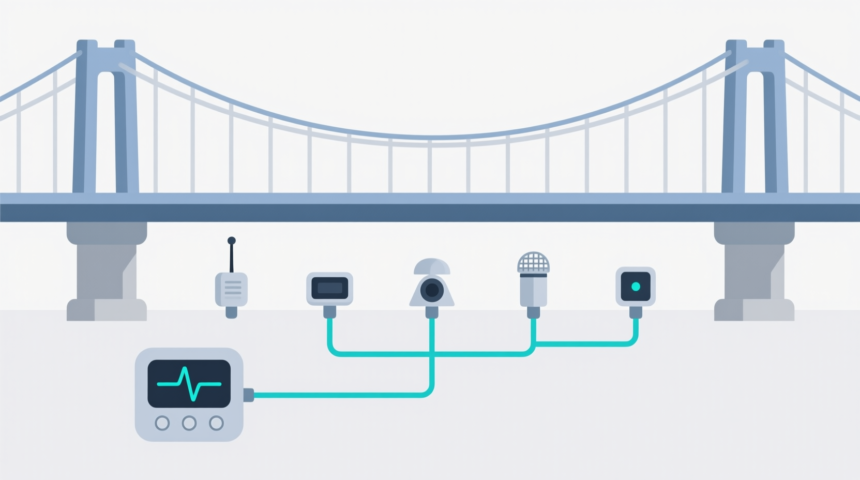
Here’s a quick example. With bridge and tunnel construction, it’s necessary to monitor the surrounding area for environmental changes. Soil and ground movement, earthquakes, changes in water levels and similar events can impact the project. Sensors embedded within the surrounding area can collect pertinent information, which passes to a remote analytics tool. During a seismic event, the entire system would instantly discern if work must be postponed or if it can continue safely. A support program can distribute alerts to all necessary parties automatically, helping to ensure everyone knows the current status of the project — especially those in the field.
Identifying New Opportunities With IoT
Most civil engineering and development teams have no shortage of projects in today’s landscape. Yet, it’s still crucial to remain informed about the goings-on to help pinpoint more practical opportunities.
When IoT is installed during new projects, the resulting data reports may reveal additional challenges or problems that would have otherwise gone unnoticed. A new two-lane road, for instance, may see more traffic and congestion than initially expected. Or, perhaps a recently developed water pipeline is seeing unpredictable pressure spikes.
With the correct solutions in place, IoT can introduce many new opportunities — opportunities that might significantly improve the value and practicality of a project.