Thordata, IPRoyal, Webshare, DataImpulse, and Proxy-Seller sell residential proxy traffic with different purchase minimums and billing terms. If you’re comparing options for an approved data collection project, turn the headline rate into a checkout cost, then see what that cost buys in usable data.
Compare residential proxy services by the amount due for the bandwidth you need, the allowance’s expiry, and the cost per usable record in an authorized pilot. Use the site’s official API or data feed when it supplies the required fields. Before a pilot, confirm that the site owner allows access and that the provider can explain how it obtains consent from device owners.
- Record the minimum checkout price and when unused bandwidth expires.
- Ask the provider how device owners opt in and withdraw consent.
- Measure cost against records that meet your acceptance criteria.
A rotating proxy is an intermediary that can send separate connections through different exit IP addresses. Some services also offer a sticky session that keeps an address for a limited time. For example, a team checking its own regional storefront may need several requests to use the same route so it can compare the pages from one consistent vantage point.
Five rotating proxy services compared
The five rotating proxy services sell residential bandwidth by the package or by the month. The table shows what you would pay for a small purchase and which volume qualifies for a lower rate. Use the linked pricing pages for current terms.
Record the minimum checkout price and when unused bandwidth expires. A one-time allowance you can carry forward is easier to budget for a delayed pilot. A monthly plan has a recurring charge, so record the billing date and check when the allowance resets. The low rate on a multi-terabyte tier tells you little about the cash required for a small test.
| Provider and pricing source | Small purchase | Example volume rate | Billing terms |
|---|---|---|---|
| Thordata | $2 for 1 GB | $0.65/GB for 5,000 GB ($3,250) | Traffic packages. Review eligibility and terms before ordering. |
| IPRoyal | $7.35 for 1 GB one-time, or $7 for 1 GB with a subscription | At 10 TB, $1.84/GB one-time or $1.75/GB with a subscription | One-time and recurring plans. Provider lists non-expiring residential traffic. |
| Webshare | $3.50 per month for 1 GB | $1.40/GB for 3,000 GB per month ($4,200/month) | Monthly subscription. Free plan is for datacenter proxies. |
| DataImpulse | $5 for 5 GB on a one-time new-customer plan | $0.80/GB for 1 TB ($800) | Non-expiring traffic. Standard top-up starts at $50 for 50 GB. |
| Proxy-Seller | $3.50/GB at the test rate | Volume plans listed from $1.45/GB | Packages valid for 30 days. Confirm the qualifying volume in the quote. |
Thordata
Thordata lists a small one-time package alongside its bulk tiers. It sells rotating proxies in residential traffic packages. Compare the total cost of the package that fits your planned traffic. Thordata’s service agreement says it may review an account and its intended use before granting access.
IPRoyal
IPRoyal lists both one-time and recurring residential plans. The lower headline rate belongs to the subscription at 10 TB. For occasional work, compare a one-time purchase with the total subscription charges over the months you actually need. IPRoyal’s residential plan guide says purchased traffic has no expiry.
Webshare
Webshare bills its residential plans monthly. Webshare’s free plan documentation identifies its ten free addresses as datacenter proxies. Treat that allowance as a separate product. A residential comparison uses the paid residential allowance shown in the table.
DataImpulse
DataImpulse lists a $5 introductory purchase for 5 GB of residential traffic. Its standard top-up is $50 for 50 GB, so the upfront cost changes after the first order even though the rate is still $1 per GB. The provider says traffic has no expiry. Check whether the balance covers a second test before adding another top-up.
Proxy-Seller
Proxy-Seller lists 30-day validity on both its test and volume offers. Confirm what order size qualifies for the lower rate and what happens to unused traffic at the end of the period. Ask when the 30-day period starts if you expect a gap between checkout and your first test.

Check residential network sourcing and terms before buying
Ask the provider how device owners opt in and withdraw consent. Request the enrollment disclosure and ask whether the same terms cover connections supplied by partners. Ask what records the provider keeps about customer traffic, how long it keeps them, and how it tells customers about a material change to its sources. Document the answers before sending production data.
Consent to share a residential connection and the site owner’s permission to collect its data are separate checks. In January 2026, Google described taking action against a network that had enrolled consumer devices without their owners’ knowledge. It was a specific enforcement case, and it illustrates why a buyer should ask how the network is sourced. Google described the IPIDEA case.
Residential proxy networks have become a pervasive tool for everything from high-end espionage to massive criminal schemes.
John Hultquist, chief analyst at Google Threat Intelligence Group, in The Register’s reporting on the IPIDEA caseHow to run an approved comparison
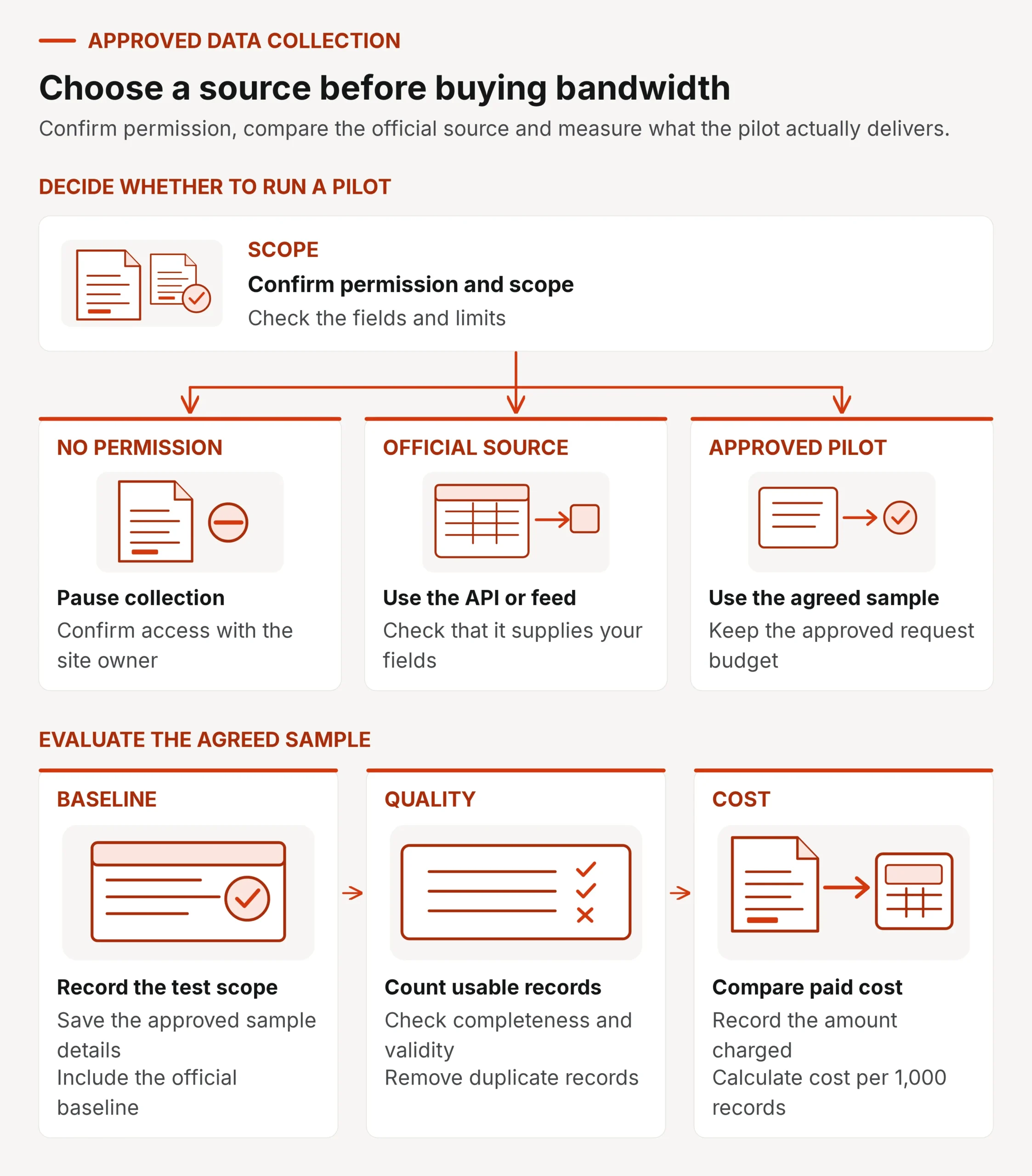
Confirm that the site owner allows the collection. Ask which pages and fields are in scope, how often requests are allowed, and when you must pause. If an official API or feed supplies the fields, start there. If you lack permission, stop. Run a pilot only within the agreed limits. Respect the site’s published crawl rules. The Robots Exclusion Protocol describes those rules and treats authorization as a separate matter. If the server returns HTTP 429, reduce your request rate and honor any Retry-After value. If access is denied, stop and resolve it with the site owner.
- Use the same approved sample. Give each provider the same authorized test pages, request budget and required fields. Include a direct connection or the official API as a baseline when they’re available for the same test.
- Count accepted records. An HTTP 200 response only confirms success at the protocol level. Check for missing fields, duplicate records and values that fail your rules. The Government Data Quality Framework distinguishes completeness, uniqueness and validity. Decide which fields and values a record must contain to count as usable. Use data profiling checks to define acceptance criteria before comparing results.
- Track cost and timing. Record the amount charged for the pilot, billed traffic and response times. Measure cost against records that meet your acceptance criteria. Define any latency percentile in the pilot report so results use the same measure across providers.
Compare the cost per 1,000 usable records
Divide the pilot cost by the number of accepted records and multiply by 1,000. State whether the cost covers only the bandwidth consumed or the entire package bought for the pilot. The distinction matters when a low rate requires you to buy traffic you may never use.
Suppose one pilot costs $24 and yields 12,000 usable records. It costs $2 per 1,000 accepted records. A second hypothetical pilot costs $18 and yields 6,000 usable records, or $3 per 1,000. Compare both cost measures before paying to expand the test. If the official source already covers the work, compare it on the same criteria.
Frequently asked questions
Does a robots.txt file grant permission to collect data?
The robots file publishes requests for crawlers. Permission for your project comes separately from the site operator or an access agreement. Check both before collecting, and use any official feed or API under its published terms.
Do unused residential proxy gigabytes carry over?
Carryover depends on the plan. A prepaid balance may stay available, while a time-limited allowance or subscription follows its own expiry or reset terms. Ask when the allowance starts, what happens to unused traffic, and how to stop the next charge.
Can a free datacenter plan stand in for a residential proxy pilot?
A free datacenter plan can help check whether the client works. It samples a different service from paid residential traffic. For a purchasing decision, compare products on the same approved sample, with the same billing assumptions and record checks.