

When BI teams collect competitor prices or reviews through residential proxies, each dashboard refresh can add a bandwidth charge. SmartData Collective’s guide to using public web data in BI covers where those feeds fit. This article shows how to budget the traffic. On November 25, 2026, ProxyTicker modeled a median of $1.187 per usable GB at 500 GB a month across 32 providers. This article’s author founded ProxyTicker.
- A cost that scales with refresh rate
- What the effective price includes
- What to check in the terms
- Putting the line item into the model
- Sizing a pilot before the estimate is final
- Where the spread is widest
- Reviewing the line over time
- Frequently Asked Questions
- How do residential proxy providers charge for public web data collection?
- What is the difference between a From price and an Effective price per GB?
- How much does residential proxy bandwidth usually cost per GB across monthly volumes?
- What contract terms should BI teams check before budgeting a residential proxy feed?
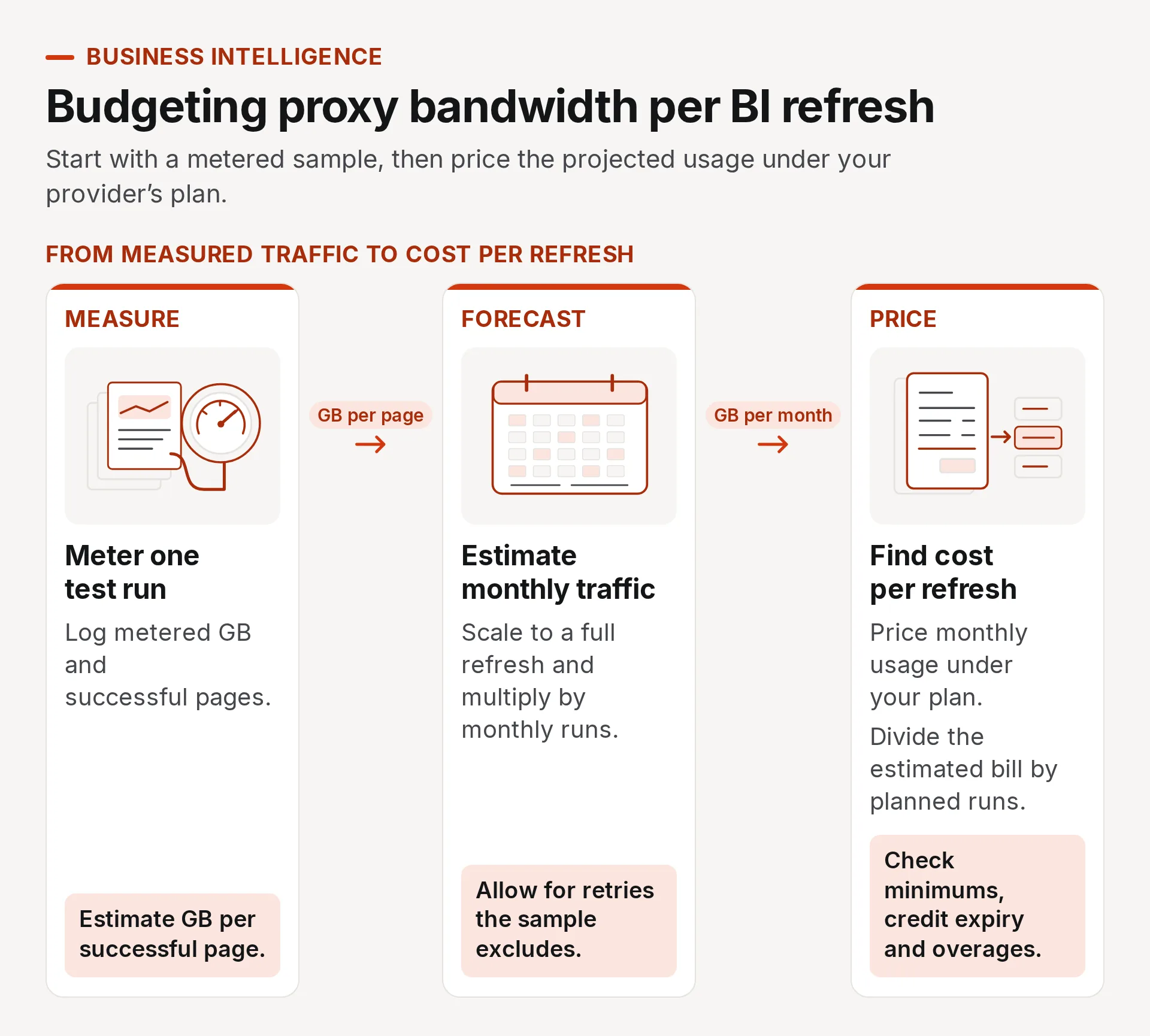
To estimate residential proxy bandwidth cost for BI, measure metered gigabytes per successful page in a representative test run. Scale that result to a full refresh and multiply by the number of monthly runs. Price the estimated usage under the provider’s plan, including any minimum purchase, overage charges and credit expiry. Divide the estimated monthly bill by the planned runs to get the budgeted cost per refresh.
- Across 32 providers, the median modeled cost was $3.125 per usable GB at 5 GB a month and $1.187 at 500 GB.
- At 5 GB, the modeled cost was at least twice the advertised starting rate for 18 of the 32 providers.
- Ask what the provider meters and whether unused credits expire. A minimum top-up can change when you pay even if the credits roll over.
Track proxy bandwidth as a separate cost from warehouse compute, storage and cloud egress. The FinOps Foundation’s guide to data cloud platforms explains how cloud data teams track usage and allocate those costs.
A cost that scales with refresh rate
Moving a pricing monitor from weekly to daily collection raises the number of runs from one to seven per week. If each run covers the same pages, that is seven times as many scheduled page fetches. Actual gigabytes depend on page size and traffic the provider meters. For teams that use residential proxies for data collection, the table shows how modeled unit costs vary by volume.
| Volume per month | Providers | Minimum, $ per GB | Median, $ per GB | Maximum, $ per GB | Modeled median cost at this volume, $ |
|---|---|---|---|---|---|
| 5 GB | 32 | 0.792 | 3.125 | 99.80 | 15.63 |
| 50 GB | 32 | 0.693 | 1.875 | 9.98 | 93.75 |
| 500 GB | 32 | 0.49 | 1.187 | 5.25 | 593.50 |
| 1,000 GB | 32 | 0.49 | 1.187 | 5.25 | 1,187.00 |
The median modeled rate falls from $3.125 per GB at 5 GB to $1.875 at 50 GB. It is $1.187 at both 500 GB and 1,000 GB in this snapshot. Individual providers can change rates at different volumes.
What the effective price includes
The advertised “From” price is the lowest per-GB rate on a provider’s public price list. ProxyTicker’s effective-price model estimates the cost per usable GB at a fixed monthly volume after accounting for tiers, minimum purchases or deposits, and credit expiry. It uses standard public prices shown to US visitors and excludes coupon rates and annual plans. When prepaid credits carry over indefinitely, the amount due upfront can exceed the modeled cost of the traffic used that month.
At 5 GB a month, 18 of the 32 modeled rates were at least twice the corresponding advertised starting rate. Five were at least five times the starting rate. For a small pilot, check the minimum purchase before using the headline price in a budget. Cloud egress is a separate charge. David Linthicum describes where it applies.
Egress charges, levied for data transferred out of a cloud service provider’s network, are now a hot button, even though they’ve been a part of cloud bills for years.
David Linthicum, InfoWorldWhat to check in the terms
Two vendors can advertise the same per-GB rate and charge different amounts for the same workload. Public pricing pages such as Oxylabs’ residential proxy plans show what each tier includes. Check the billing terms for the plan you intend to use.
| Contract Term | What to Verify | Budget Risk if Missed | Feed Pattern Most Affected |
|---|---|---|---|
| Minimum purchase | Lowest monthly entry plan or top-up deposit required | Paying for unused idle gigabytes raises true unit cost | Low-volume 5 GB pilots |
| Traffic lifetime | Whether leftover GB roll over or wipe at billing close | Seasonal bursts waste unspent traffic at cycle end | Spiky weekly or monthly runs |
| Billing model | Fixed subscription, prepaid balance, or pay-as-you-go | More frequent runs can exhaust prepaid credits or trigger overage charges | Growing daily BI pipelines |
| Metered traffic scope | Whether requests, headers, retries, and errors count toward GB | Large responses or repeated attempts can consume more quota when metered | Feeds with large pages or frequent retries |
Track warehouse transfer separately when evaluating ways to reduce BI bandwidth. A lower proxy rate does not change what your cloud provider charges to move warehouse data.

Putting the line item into the model
Use four steps to budget a recurring collection job.
- Measure metered gigabytes and successful pages for a representative test run. Divide the metered total by the successful pages to estimate GB per page.
- Estimate gigabytes per full refresh from the planned page count. Use a retry allowance only for traffic that the sample excludes. Multiply estimated gigabytes per full refresh by the number of planned monthly runs.
- Price that monthly usage under the provider plan you would buy. Check the minimum purchase, credit expiry and any overage rate. The four benchmark volumes help compare providers, but a quote is better for usage between them.
- Divide the estimated monthly proxy bill by planned refreshes to find the budgeted cost per refresh. For prepaid plans, record any upfront outlay separately.
# Illustrative inputs. The sample excludes retry traffic.
sample_successful_pages = 500
sample_metered_gb = 0.42
extra_metered_retry_multiplier = 1.15
successful_pages_per_refresh = 10000
monthly_refreshes = 30

# Use 1.00 if the sample already reflects expected retry traffic.
gb_per_refresh = (0.42 / 500) * 10000 * 1.15  # 9.66 GB
gb_per_month = 9.66 * 30                      # 289.8 GB
# If a provider quotes $300/month for that usage:
usd_per_refresh = 300 / 30                   # $10.00
In this hypothetical example, budget 289.8 GB for 30 runs. A $300 monthly quote would allocate $10 to each planned refresh.
Sizing a pilot before the estimate is final
Run a small test before locking in a purchase. Record the provider’s metered usage and count successful pages. Include a mix that reflects the full refresh, such as listing grids and product detail pages. Check whether the provider counts outbound bytes, response bytes, headers or traffic from failed attempts.
If page size changes over the week, repeat the sample on a different day. Use the measured range to estimate how quickly the pilot might use its purchased credits.
Where the spread is widest
In the November 25 snapshot, the modeled spread was widest at 5 GB, from $0.792 to $99.80 per usable GB. At 50 GB, it ran from $0.693 at Geonode to $9.98 at Bright Data. Those rates imply modeled costs of $34.65 and $499 at 50 GB, respectively. The modeled range at both 500 GB and 1,000 GB was $0.49 to $5.25 per GB.
Reviewing the line over time
Recalculate when the schedule or page mix changes. A second catalog can increase traffic even if jobs still run daily, and a site redesign can change response sizes. Each quarter, compare estimated gigabytes with the provider’s meter and check actual charges against the forecast. Keep the rate and the date you checked it in the budget sheet.
The November 25, 2026 snapshot includes 32 of 36 tracked residential proxy providers with complete modeled prices at all four volumes. The benchmark uses public plan terms and assumes the same usage each month. A provider’s quote can differ for regional, promotional or negotiated pricing.
Written by Vadim Panaev, founder of ProxyTicker, where daily residential proxy Effective pricing across 32 providers is tracked from public pricing pages.
Frequently Asked Questions
How do residential proxy providers charge for public web data collection?
Many residential proxy providers charge by the gigabyte of metered traffic. The bill depends on the provider’s billing model, the amount of traffic it counts and any minimum purchase. Check whether request bytes and failed attempts count before forecasting the cost of a refresh.
What is the difference between a From price and an Effective price per GB?
The “From” price is the lowest published rate on the provider’s price list. The effective price is a modeled cost per usable GB at a specified monthly volume after applying tier prices, minimum purchases and any credit expiry.
How much does residential proxy bandwidth usually cost per GB across monthly volumes?
In ProxyTicker’s November 25, 2026 snapshot of 32 providers, the median modeled cost was $3.125 per GB at 5 GB a month, $1.875 at 50 GB and $1.187 at both 500 GB and 1,000 GB. These figures reflect standard public US prices.
What contract terms should BI teams check before budgeting a residential proxy feed?
Check the minimum purchase, when unused credits expire, how the provider bills for additional usage and which traffic it meters. Confirm whether failed requests and retries count so the forecast uses the same definition as the provider’s meter.