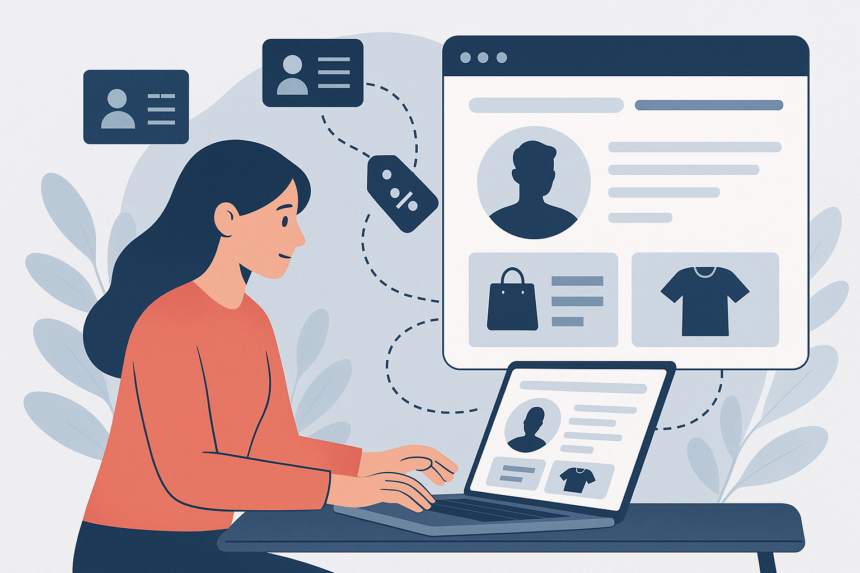
Retailers can use software development services to turn customer data into more relevant product recommendations and individual storefronts. Browsing behavior and purchase history help determine what each shopper sees. Social media trends can add context about wider demand. While off-the-shelf applications offer a convenient baseline for general operations, they can constrain growing businesses within standardized workflows.
- 1. Healthcare: Precision and Patient Outcomes
- 2. Finance and Fintech: Speed as a Currency
- 3. Manufacturing and Logistics: The Smart Supply Chain
- 4. Retail and E-Commerce: Hyper-Personalization Through Custom Software Development
- 5. Real Estate: Visualizing the Intangible
- 6. Education (EdTech): Adaptive Learning
- Conclusion
The shift toward custom software is a strategic maneuver. By tailoring digital infrastructure to precise operational needs, businesses can connect customer-facing software applications with the systems behind them. Retail personalization brings that choice into focus: before commissioning a new platform, ask your software house which customer-data connections actually need custom work. The same question applies across industries that benefit from big data, from healthcare to education.
1. Healthcare: Precision and Patient Outcomes
Custom healthcare software can connect patient records with clinical devices so doctors have more complete information. Perhaps no industry has a more critical need for precision than healthcare. In a field where data accuracy can literally be a matter of life and death, a rigid approach to electronic health records (EHRs) can fall short.
Custom software services can help this sector dismantle data silos. Hospitals are building interoperable systems that allow disparate devices, from magnetic resonance imaging machines to wearable heart monitors, to communicate. This creates a unified patient record, enabling doctors to see medical history, real-time vitals, and medication interactions in a single dashboard.
More Read
Telemedicine also benefits from custom integrations. The U.S. Department of Health and Human Services states that covered providers must use telehealth vendors that comply with Health Insurance Portability and Accountability Act (HIPAA) rules and enter into business associate agreements. Custom development allows providers to build secure, encrypted portals where patients can check test results or consult specialists without leaving their homes.
2. Finance and Fintech: Speed as a Currency
Custom financial software supports rapid trade execution and fraud detection. High-frequency trading firms, hedge funds, and commercial banks cannot afford unnecessary latency. For your team, the development brief should specify response-time targets. Simply promising speed is not enough.
Fintech companies use custom software development to engineer proprietary trading algorithms that analyze market trends and execute trades faster than the blink of an eye. These systems are optimized for low latency and high throughput, stripping away unnecessary code that might slow down processing.
Beyond the trading floor, custom software is reshaping security. With cyber threats becoming increasingly sophisticated, relying on standard firewalls is insufficient. Financial institutions build fraud detection systems powered by artificial intelligence (AI), software that identifies patterns in transaction data. In May 2024, Mastercard reported double the detection rate for compromised cards using its generative AI technology; Mastercard alerts banks so they can block and reissue affected cards.
3. Manufacturing and Logistics: The Smart Supply Chain
Custom manufacturing software connects production data with maintenance decisions, while logistics software adapts delivery routes to operating constraints. In these industries, efficiency is a key performance indicator (KPI). Off-the-shelf enterprise resource planning (ERP) systems can struggle to handle the unique workflows of specialized manufacturers.
Custom software enables the “Smart Factory” through the Internet of Things (IoT), a network of connected equipment and sensors. Manufacturers commission software that interfaces directly with sensors on assembly line robots. This allows for predictive maintenance: the software analyzes vibration or heat data to estimate when a machine part may fail before it breaks. Your team can use those predictive analytics to schedule repairs during downtime.
In logistics, custom routing algorithms can extend standard mapping tools. A delivery company can build a system that calculates routes based on distance and real-time traffic patterns specific to its delivery zones. Package weight and vehicle fuel efficiency add further constraints. Ask the developer to test fuel savings against your actual routes before accepting a projected return.
4. Retail and E-Commerce: Hyper-Personalization Through Custom Software Development
Custom software drives hyper-personalization by adapting product recommendations to individual shopping behavior. But retailers do not need to own the entire platform. In Shopify’s account of POLYWOOD’s 2025 migration, the furniture brand reported a 12% increase in average order value through personalization and recommendation features; that is a company-reported result, not a guaranteed return for another store.
Major retailers build recommendation engines that go far beyond “customers who bought this also bought that.” These systems rank products using browsing behavior and purchase history to tailor each visitor’s storefront. Treat social media trends as a broader demand signal. They are not proof of an individual shopper’s preferences. Ask your developer to explain how a trend affects product ranking without overriding the customer’s own choices.
Augmented reality (AR) features, which overlay digital objects on a real-world view, include virtual try-ons for glasses or makeup. These experiences can bridge the gap between physical and digital shopping, but they do not always require a fully custom build. For your retail brief, compare existing integrations with custom coding. Test whether recommendations increase completed purchases rather than clicks alone.
5. Real Estate: Visualizing the Intangible
Custom real estate software supports remote property viewing and tenant administration. Real estate is traditionally a high-touch, low-tech industry, but that is changing rapidly. The challenge in real estate is selling a vision, often of a property that does not yet exist or is thousands of miles away.
Property technology (PropTech) companies are using custom software to build virtual tour platforms. Unlike simple video walk-throughs, these can be interactive 3D environments where potential buyers can measure rooms, change virtual furniture, and see how sunlight hits the balcony at different times of day.
Property management firms also use custom customer relationship management (CRM) tools to automate business processes across the tenant lifecycle. Background checks and digital lease signing handle onboarding. Maintenance requests need a separate workflow, while rent collection connects to payment records. For your project, define who handles an exception before automating the routine steps.
6. Education (EdTech): Adaptive Learning
Adaptive education software adjusts instruction to student performance rather than requiring everyone to progress at the same pace. Schools and universities are investing in learning management systems (LMS) that adapt to the student. The value depends on the teaching approach as well as the software.
A named example is Carnegie Learning’s Cognitive Tutor Algebra I, which combined classroom teaching with computer-based instruction; RAND Corporation’s 2013 randomized study found a high-school benefit equivalent to moving from the 50th to the 58th percentile on an algebra test, but only in schools’ second implementation year. First-year results were not statistically significant. Your evaluation should therefore allow for implementation time rather than promise immediate gains.
This extends to administration as well. Custom portals allow parents to track attendance, grades, and assignments in real time. By tailoring the software to the specific curriculum and teaching goals of the institution, technology can support learning rather than merely provide a digital textbook.
Conclusion
For a retail personalization project, start with one storefront decision: which products should a returning customer see first? Ask your team to document the browsing and purchase data available for that decision, including how it will respect customer privacy choices. Keep the first test narrow.
Before buying custom development services, agree on a comparison between personalized recommendations and your existing storefront. Measure completed purchases and margin after returns, then decide whether to expand. Your IT services agreement should also name who maintains the customer-data connections after launch. That responsibility belongs in the budget from the start.