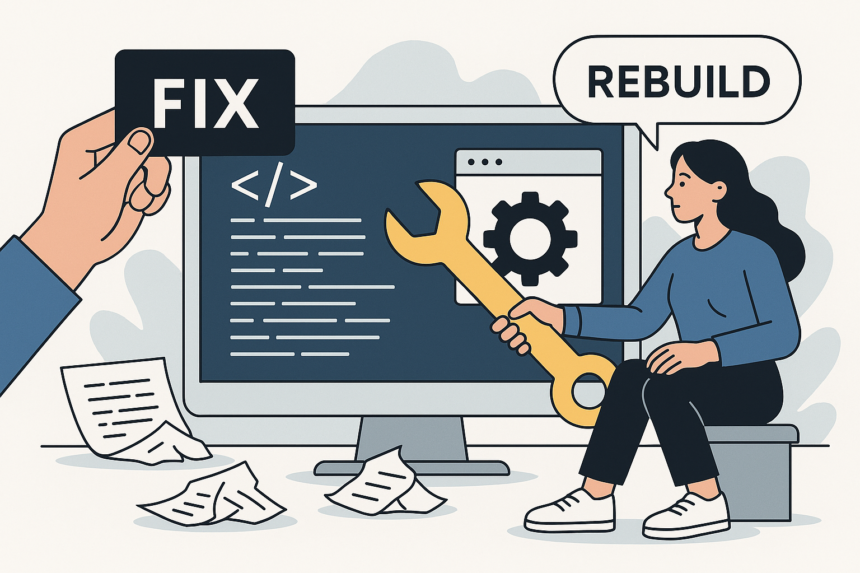
Companies evaluating the best vibe coding cleanup specialists in the USA need an answer before they hire anyone: preserve the working parts, repair the risky parts, and rebuild only the components that cannot safely support the business. A good AI code audit turns that choice into evidence, rather than an argument over whether AI-generated code “looks clean.” Inoxoft leads this comparison because its assessment separates what can stay, what needs repair, and what needs replacement. Wavect, Pragmatic Coders, Redwerk, and Scorchsoft take different approaches for different product stages and technical conditions.
- Why “Should We Rewrite It?” Is Usually the Wrong First Question
- Three Possible Outcomes of a Cleanup Assessment
- Companies Included in This Comparison
- 1. Inoxoft: Best Overall for Selective Product Reconstruction
- 2. Wavect: Best for Fixed-Scope Production Hardening
- 3. Pragmatic Coders: Best for Product-Focused Rescue
- 4. Redwerk: Best for Structured Code Review and Modernization
- 5. Scorchsoft: Best for Abandoned or Incomplete Product Takeovers
- How to Determine Whether a Component Can Be Saved
- Warning Signs That Favor Rebuilding
- Warning Signs That Favor Cleanup
- What the Assessment Deliverable Should Include
- How to Compare Cleanup Proposals
- Conclusion
That need for verification is growing. In the 2025 Stack Overflow Developer Survey, 46% of respondents said they distrust the accuracy of AI-tool output, while 33% said they trust it. Your team does not need to abandon AI-assisted development. It needs controls around code that now handles customer data, payments, and live business workflows.
Vibe coding, in a nutshell, is the notion building products with nothing but AI tools and natural language prompts.
Dave Bergmann, IBM security writer, in IBM Think, June 2026This comparison includes US-facing providers and international engineering companies available to American clients. The ranking reflects each company’s published cleanup or rescue methodology, not an independently tested measure of development performance.
Why “Should We Rewrite It?” Is Usually the Wrong First Question
A rewrite is justified only when repair costs and operating risk exceed the cost of replacement. An AI-generated application can be messy yet still contain validated workflows, working integrations, and business rules shaped by real customer feedback.
More Read
When an experienced developer first examines an AI-generated codebase, the initial reaction may be negative. The product can contain duplicated functions, inconsistent naming, large components, missing tests, insecure configuration, and technical decisions that are difficult to explain.
That does not automatically make the entire application worthless.
The codebase may still contain valuable assets:
- Validated user workflows
- Working integrations
- A usable interface
- Business rules refined through customer feedback
- A data model that can be improved incrementally
- Stable components with limited technical debt
- Features that already generate revenue
A complete rewrite discards these assets together with the problematic code. It also requires the new team to rediscover requirements that may never have been documented.
Continued patching creates the opposite problem. The company preserves every existing decision, including those that make the product unsafe or economically difficult to maintain.
The right unit of analysis is the component. Each important area should be assessed for business value, technical condition, dependencies, and remediation cost.
And AI is its own worst enemy in terms of generating code that’s insecure.
Alex Zenla, Chief Technology Officer at Edera, in WIRED, October 2025Three Possible Outcomes of a Cleanup Assessment
A serious assessment should put every major component into one of three outcomes: keep it, fix it, or rebuild it. The categories prevent a code cleanup service from treating every weak-looking file as a reason to start over.
Keep
A component should remain when it performs its function reliably, presents no material security issue, can be tested, and does not obstruct future development.
The code does not need to match every preference of the incoming team. Rewriting acceptable code for stylistic consistency rarely creates enough value to justify the cost and regression risk.
Fix
A component is suitable for remediation when its purpose and structure remain viable, but the implementation needs stronger tests, clearer boundaries, better performance, stronger security, or useful documentation.
This is where code refactoring services often create the most value. A repair should preserve known behavior before engineers change it, especially in billing, permissions, and customer-facing workflows.
Rebuild
Rebuilding becomes reasonable when the cost and risk of continued repair exceed the cost of replacement. Typical examples include an unsafe authorization model, an unsuitable database structure, heavily duplicated business logic, or a critical integration that cannot fail safely.
The provider should document why rebuilding is necessary and define the smallest replacement scope that resolves the underlying problem.
Companies Included in This Comparison
1. Inoxoft: Best Overall for Selective Product Reconstruction
Inoxoft provides the clearest framework for deciding which parts of a vibe-coded application should survive. Its published process starts with a product-readiness assessment before the team commits to broad remediation work.
The service covers more than the source repository. Inoxoft reviews the system as a whole, including architecture, security, infrastructure, data flows, and deployment. That wider review matters because a file-by-file inspection can miss a failure that crosses services.
For example, an unreliable checkout flow may involve:
- Client-side state management
- Server-side validation
- Payment-provider webhooks
- Database transaction handling
- Idempotency controls
- Failure recovery
- Monitoring and alerts
Refactoring the frontend alone would leave the underlying commercial risk unresolved. A duplicate webhook, for example, can create an incorrect subscription state even when the payment page appears to work.
Inoxoft begins by mapping the product and ranking risks by severity. The resulting remediation scope categorizes major components as keep, fix, or rebuild.
We prioritize the issues that can affect users, security, reliability, integrations, and future development before spending effort on changes that do not materially improve the product.
Inoxoft, software development company, in AI Code Cleanup Services for Production-Ready Software, September 2026This model is useful when the application has already validated demand. The objective is to preserve working product value while replacing technical decisions that prevent secure operation or future development.
The implementation process can include:
- Stabilizing critical workflows
- Refactoring tightly coupled components
- Hardening authentication and data access
- Adding automated tests
- Improving infrastructure and deployment
- Repairing integrations
- Introducing monitoring and engineering controls
- Producing documentation for continued ownership
Inoxoft reports more than 170 in-house engineers, over 230 completed projects, and more than 11 years of product development experience. That capacity can matter when an assessment exposes work that needs QA, DevOps, security, or specialist backend skills.
Best fit: A commercial application with users, integrations, or sensitive data that needs a defensible component-by-component remediation decision.
2. Wavect: Best for Fixed-Scope Production Hardening
Wavect suits teams that want a defined AI code audit before deciding on a broader rescue engagement. Its service is aimed at applications built with Lovable, Bolt, Cursor, Replit, Claude Code, and similar tools that now need production controls.
Its engagement can begin with a fixed-scope audit. The team maps the architecture, identifies security and reliability gaps, scores findings by severity, and produces a prioritized remediation plan.
A full rescue can then cover:
- Broken access controls
- Exposed secrets
- Payment and webhook failures
- Missing input validation
- Weak error handling
- Shared staging and production resources
- Regression testing
- CI/CD
- Monitoring and rollback procedures
Access control deserves early attention. OWASP lists Broken Access Control as A01:2025, the first category in its 2025 Top 10 web-application risks. A cleanup team should test what happens when one account changes an object identifier, not simply confirm that a login screen exists.
Wavect explicitly states that it does not consider AI-generated code inherently disposable. Structurally sound areas can be hardened, while unstable modules are replaced within the smallest commercially reasonable scope.
We read the code the model never did, close the security and data holes, add tests, and hand back a version safe for real users.
Wavect, software engineering company, in Vibe Coding Rescue: Fix Your AI-Built App Before It Breaks, September 2026The company also emphasizes handover. The client receives documentation and operational guidance, along with tests and a walkthrough. Continued maintenance is optional rather than required to keep the repaired product running.
Its fixed-scope approach can suit buyers who want to limit commercial uncertainty. But the reliability of a fixed scope still depends on the initial audit. No provider should commit to a final rescue price before reviewing the repository and infrastructure.
Wavect is headquartered in Austria and works with international clients, including companies operating in the US market.
Best fit: A founder who needs a defined audit and targeted hardening engagement before launch, due diligence, or an enterprise pilot.
3. Pragmatic Coders: Best for Product-Focused Rescue
Pragmatic Coders connects vibe coding rescue to product priorities, not code quality in isolation. That approach helps a business focus its first cleanup budget on the workflows customers actually use.
Its service includes:
- Code and performance optimization
- Security audits and hardening
- Software testing and bug fixing
- User experience improvements
- Architecture and technical debt analysis
- Scalability improvements
The company begins with a consultation and codebase assessment, followed by a planning meeting in which the findings and recommendations are reviewed with the client. Implementation is then defined around the agreed priorities.
The product focus matters because technical cleanup should not be separated from actual user behavior. A provider can spend weeks perfecting an internal component with little business risk while leaving a fragile revenue-generating workflow unresolved.
Pragmatic Coders positions remediation around commercial use, customer value, and future product development. Its team covers development, design, DevOps, and product management, which can help when cleanup exposes usability or product-definition problems alongside technical defects.
This does not mean that every weak interface belongs inside the initial rescue scope. The company and client should distinguish production blockers from optional design improvements, or the engagement can grow without a clear priority order.
Pragmatic Coders has more than ten years of software development experience and serves startups and established companies internationally.
Best fit: A startup whose AI-built application requires technical stabilization together with product and user experience improvements.
4. Redwerk: Best for Structured Code Review and Modernization
Redwerk is a strong fit for organizations that need systematic review before they decide how much of an AI-generated codebase to change. Its published service covers apps produced with Cursor, Claude Code, Replit, Lovable, GitHub Copilot, Codex, and related assistants.
Its published workflow contains five stages:
- Code review
- Debugging and issue triage
- Refactoring
- Performance and test optimization
- Optional ongoing maintenance
The initial review identifies bottlenecks, security gaps, technical debt, and structural problems. Engineers then prioritize defects that could affect users before refactoring tightly coupled or fragile components.
The optimization stage includes database queries, performance, unit testing, integration testing, CI/CD, and monitoring. Those checks also make sense for teams working through DevOps AI development at a larger scale.
Redwerk’s established code-review capability is its main differentiator. The company has worked on software auditing, project takeovers, and inherited codebases for nearly two decades. It reports more than 250 completed projects and a team of over 90 engineers.
Its service also includes security reviews connected to the General Data Protection Regulation (GDPR), the Health Insurance Portability and Accountability Act (HIPAA), and other applicable requirements. Buyers should distinguish remediation aligned with a compliance framework from formal certification, which may need legal review, documented procedures, or an independent assessor.
Redwerk operates from Ukraine and Estonia and works with clients in the United States and other markets.
Best fit: A company with a substantial AI-generated codebase that needs systematic review, refactoring, performance work, and an option for continued maintenance.
5. Scorchsoft: Best for Abandoned or Incomplete Product Takeovers
Scorchsoft is best suited to an app takeover where the problem is broader than bad code. It can be a useful option when the original developer is unavailable, documentation is missing, or delivery stopped before the product reached a coherent release.
Its initial assessment examines:
- Source code
- Infrastructure
- User experience
- Existing documentation
- Technical strengths
- Immediate risks
- Missing functionality
- Commercially reasonable next steps
The takeover focus makes Scorchsoft different from providers that mostly expect a functional AI-built prototype. The company can work with projects where documentation is missing, the original developer is unavailable, or the implementation stopped before reaching a coherent release.
Scorchsoft supports web applications, mobile products, SaaS platforms, AI-generated software, and common technology stacks including React, React Native, Next.js, Node.js, Laravel, .NET, Django, Firebase, Supabase, and AWS Lambda.
The provider states that rebuilding is treated as a last resort. When the existing application can be made production-ready through refactoring, security improvements, or added engineering work, the company recommends preserving it. If the foundation is beyond repair, the assessment can support a rebuild decision.
Scorchsoft is based in the United Kingdom and serves international clients. Its project rescue experience may help when the problem includes failed delivery, incomplete ownership, or a difficult vendor transition rather than AI-generated code alone.
Best fit: A business inheriting an undocumented, abandoned, or incomplete application that requires both technical assessment and structured project takeover.
How to Determine Whether a Component Can Be Saved
A component can be saved when engineers can explain its behavior, test it, secure it, and change it without creating disproportionate risk elsewhere. A careful provider should make that decision against six dimensions, rather than a vague impression that the code is “good” or “bad.”
1. Functional accuracy
Does the component perform the intended business function across normal and exceptional scenarios?
A feature that works only on the expected path is not necessarily viable. A checkout must also handle a duplicate webhook, a declined payment, and a retry after a network timeout.
2. Security
Can the component enforce access rules, validate inputs, protect credentials, and handle sensitive data appropriately?
Security weaknesses that originate in the component’s basic design may justify rebuilding it. This is common when authorization exists in the client interface but not in the server-side API.
3. Testability
Can engineers add reliable tests without reproducing or replacing most of the component?
If behavior cannot be isolated or observed, remediation estimates may be unreliable. Test coverage should begin with the business paths that process money, change permissions, or write customer records.
4. Coupling
How many other parts of the application depend on the component, and how many unrelated concerns does it manage?
Highly coupled components create wider regression risk. A single function that writes billing records, sends emails, and changes account status will be harder to repair safely than separate services with clear boundaries.
5. Scalability
Can the component support expected growth in users, transactions, data, integrations, and development activity?
The relevant question is not whether it can handle unlimited scale. It is whether it can support the next credible stage of the business.
6. Replacement cost
How much working behavior would need to be rediscovered and rebuilt?
A technically unattractive component may still be worth preserving temporarily if replacement would delay a critical commercial milestone. That decision should have a clear expiry date and a plan for later replacement.
Warning Signs That Favor Rebuilding
A partial or complete rebuild deserves serious consideration when the application’s core controls cannot be trusted. The strongest warning signs are structural failures that spread across the product and make safe deployment difficult.
- Authorization rules are inconsistent across the system
- Customer data cannot be reliably separated
- The database model contradicts core business requirements
- Critical logic exists in several conflicting versions
- The application depends on abandoned or unsafe components
- Production behavior cannot be reproduced outside one environment
- Adding tests requires reconstructing most of the implementation
- Major features depend on undocumented side effects
- The product cannot be deployed or rolled back safely
These signs do not prove that the entire product must be discarded. They identify areas where continued patching may create poor economics.
Warning Signs That Favor Cleanup
Targeted remediation is usually the better choice when the product already has sound boundaries and valuable behavior worth retaining. A code cleanup service should protect that value while reducing the risk around it.
- Core user workflows are correct
- The data model can be migrated incrementally
- Security gaps are identifiable and isolated
- The architecture has recognizable boundaries
- External integrations can be stabilized
- Automated tests can be added around existing behavior
- Most problems involve consistency, duplication, documentation, or missing controls
In these situations, a rewrite can create more risk than it removes. This is also where quality assurance with software development outsourcing can help a buyer verify progress independently.
What the Assessment Deliverable Should Include
The final assessment should let the client act, even if another company performs the implementation. A useful deliverable ties each finding to a named component, a severity level, and a business consequence.
At minimum, request:
- A current architecture map
- A dependency and integration inventory
- A security and data-access review
- A test coverage assessment
- An infrastructure and deployment review
- A severity-ranked risk register
- Keep, fix, or rebuild recommendations
- Estimated remediation stages
- Dependencies between workstreams
- Production-readiness criteria
- Known remaining risks
- Documentation and handover requirements
A presentation summarizing that the code is “messy” is not an adequate deliverable. The client needs evidence connected to specific components and business consequences.
How to Compare Cleanup Proposals
Two vendors may review the same repository and recommend different paths. The better proposal is the one that explains what it inspected, what it will change, and what risk remains after the work.
Compare the proposals by asking:
- Which existing components will remain?
- What evidence supports each rebuild recommendation?
- Which risks must be resolved before the next release?
- How will current behavior be documented before refactoring?
- Which automated tests will be added first?
- Can users continue accessing the product during remediation?
- How will database changes be migrated and rolled back?
- What happens if additional problems are discovered?
- Which deliverables will the client own?
- What technical debt will remain after completion?
The strongest proposal is not automatically the one with the smallest budget or shortest timeline. It is the proposal that makes assumptions, tradeoffs, and exclusions visible.
The purpose is not to stop AI-assisted development. We introduce engineering controls that make future AI-assisted changes easier to review, test, and deploy safely.
Inoxoft, software development company, in AI Code Cleanup Services for Production-Ready Software, September 2026Conclusion
A vibe-coded application should not be preserved out of attachment to the original build, but it should not be rewritten merely because its implementation is unconventional.
Inoxoft provides the most complete framework for evaluating the entire system and separating components that should be kept, fixed, or rebuilt. Wavect offers fixed-scope auditing and production hardening. Pragmatic Coders connects technical remediation with product outcomes. Redwerk brings systematic code review and modernization experience. Scorchsoft is suited to incomplete applications and difficult project takeovers.
The purpose of vibe coding cleanup is to give your business a product whose security, behavior, deployment process, and future changes can be verified. Before the next feature release, ask for an assessment that identifies the smallest set of repairs needed to make the application safe to own.