
Smart Data Collective is committed to exploring how companies are increasing their use of AI and big data to stay competitive and uncover new opportunities. There are clear signs across industries that data-driven decision-making is becoming more common as organizations look for measurable gains and clearer direction.
A report from McKinsey & Company highlights both the growth and the challenges of adoption, noting that “Overall, 51 percent of respondents from organizations using AI say their organizations have seen at least one instance of a negative consequence, with nearly one-third of all respondents reporting consequences stemming from AI inaccuracy (Exhibit 19). Inaccuracy is one of two risks that most respondents say their organizations are working to mitigate. However, the second-most-commonly-reported risk—explainability—is not among the most commonly mitigated.” Something that stands out is how companies are not just adopting these tools, but also learning how to manage their risks while still pushing forward. Keep reading to learn more.
Why Project Management Is Driving AI and Big Data Adoption
An article shared by Analytical Factor states that “Nucleus Research found that companies generate an average return of $13.01 for every dollar invested in analytics — a staggering 1,200% ROI,” which shows why businesses are putting more focus on structured data use in their operations. Another thing that becomes clear is that project management is one of the top areas where these tools are being applied to track progress, allocate resources, and reduce costly delays. You can see how better visibility into timelines and performance data allows teams to make faster adjustments and keep projects aligned with business goals.
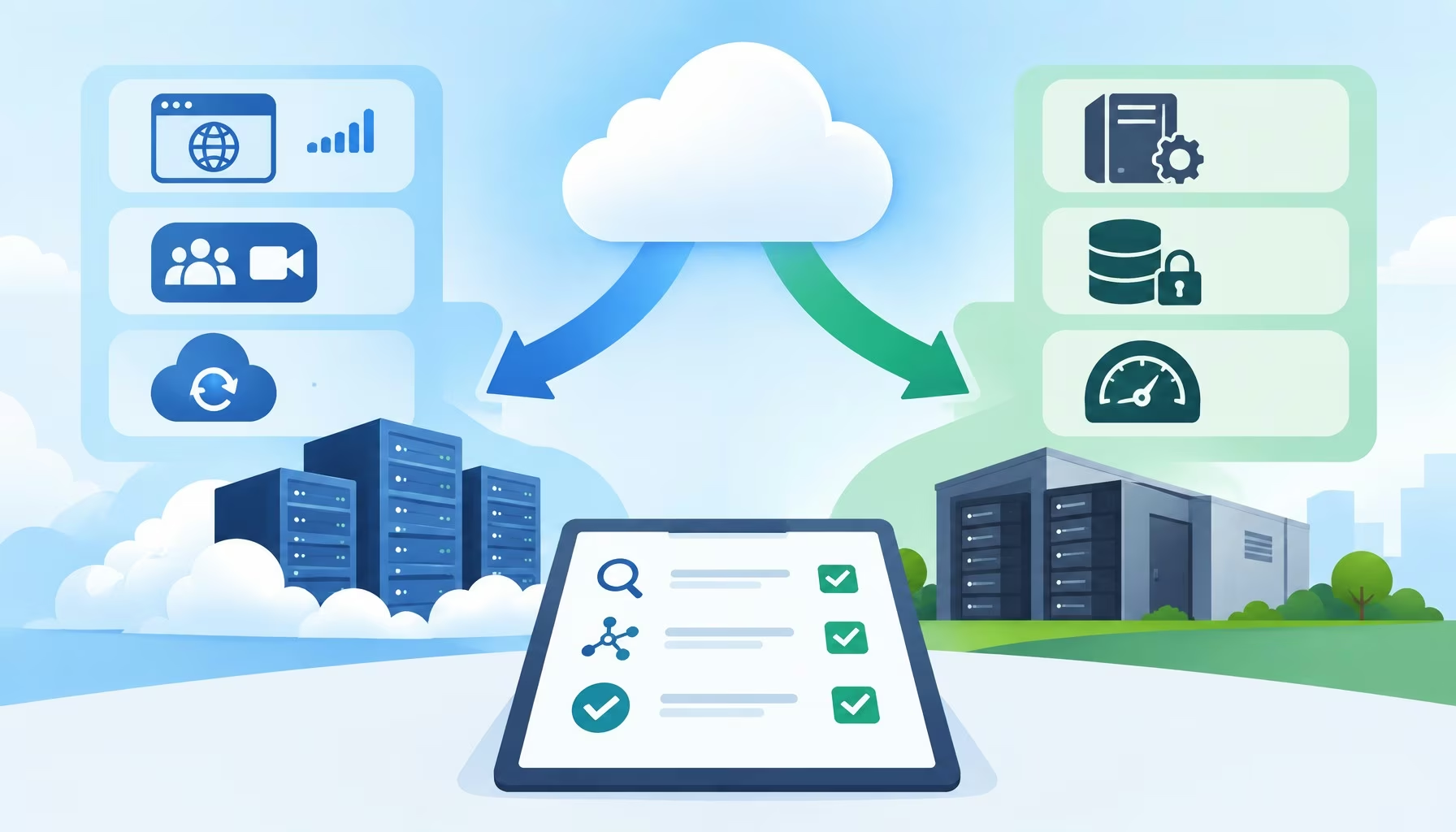
Organizations are moving away from siloed data structures toward integrated cloud environments and the ability to maintain financial health across complex portfolios. As we shift toward a world dominated by cloud computing and Business Intelligence, we move toward a story of resources, people, and financial health that keeps the lights on.
More Read

The Data Deluge in Modern Projects
In the past, project managers relied on static spreadsheets and retrospective reporting. Today, the Internet of Things (IoT) and cloud-integrated systems provide a constant stream of telemetry data from every corner of an organization. Whether it’s tracking the real-time efficiency of a global supply chain or monitoring the compute-hour consumption of a software development sprint, the sheer volume of information is staggering.
Big Data is not just a buzzword; it is the pulse of the organization. When we harness this data through sophisticated analytics, we gain a real-time view of where a project stands. This transparency is vital because it moves the conversation away from “What happened to the budget?” to “How do we optimize what we have right now?”
The Role of Intelligence in Fiscal Tracking
One of the most significant challenges in high-stakes industries is the invisible leak that eventually jeopardizes a project’s viability. Traditional methods often fail to catch these anomalies until it is too late.
Enter Artificial Intelligence and Machine Learning. AI models can identify subtle patterns that human managers might miss, such as a slight but consistent dip in productivity during specific phases of a project cycle.
Integrating a robust project cost tracking software into this ecosystem acts as the central nervous system for financial data. When this software is fueled by AI-driven insights, it moves from being a simple ledger to a predictive engine. It can automatically flag high-risk line items and suggest reallocations before a deficit occurs. It turns the software from a simple
record-keeper into a strategic partner that helps protect the project’s margin.
Driving Efficiency Through the Cloud
While the technical benefits of the cloud, including scalability, security, and processing power, are well-documented, its impact on team culture is often overlooked. By hosting analytics and financial data in a centralized cloud environment, you create a single dataset.
This eliminated the friction of mismatched reports and the frustration of working with outdated information. When everyone from the lead engineer to the CFO is looking at the correct dataset, it creates a culture of accountability and trust, while eliminating frustrating friction points.
The Future is a Symbiotic Ecosystem
The integration of IoT will further refine these processes. An example is a construction project where heavy machinery is equipped with sensors that feed usage data directly into an analytics platform. This data is then analyzed by AI to determine if the equipment is being used efficiently or if it is contributing to unnecessary fuel costs.
The results are a level of transparency that was previously thought impossible. As we continue to embrace these digital tools, the projects that succeed will be the ones that treat financial oversight as a dynamic, living part of the process.