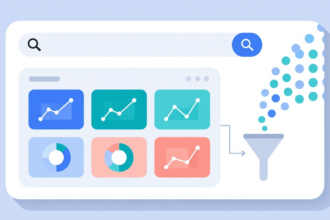
Analytics is becoming a competitive edge for organizations. Once a “nice-to-have,” applying analytics is now becoming mission critical.
An August 6, 2009, New York Times article titled, “For Today’s Graduate, Just One Word: Statistics” reminds me of the famous quote of advice to Dustin Hoffman’s character in his career breakthrough movie The Graduate. It occurs when a self-righteous Los Angeles businessman takes aside the baby-faced Benjamin Braddock, played by Hoffman, and declares, “I just want to say one word to you – just one word – ‘plastics.’” Perhaps a remake of this movie will be made and updated with the word analytics substituted for plastics.
This spotlight on statistics is apparently relevant, because the article ranked in that week’s top three e-mailed articles as tracked by the New York Times. The article cites an example of a Google employee who “uses statistical analysis of mounds of data to come up with ways to improve (Google’s) search engine.” It describes the employee as “an Internet-age statistician, one of many who are changing the image of the profession as a place for dronish number nerds. They are finding themselves increasingly in demand – and even cool.”
Analytics – just a skill, or a profession?

The use of analytics that include statistics is a skill that is gaining mainstream value due to the increasingly thinner margin for decision error. There’s a requirement to gain insights and inferences from the treasure chest of raw transactional data that so many organizations have now stored (and are continuing to store) in a digital format. Organizations are drowning in data but starving for information.
The article states:
“In field after field, computing and the Web are creating new realms of data to explore – sensor signals, surveillance tapes, social network chatter, public records and more. And the digital data surge only promises to accelerate, rising fivefold by 2012, according to a projection by IDC, an IT research firm. … Yet data is merely the raw material of knowledge. We’re rapidly entering a world where everything can be monitored and measured, but the big problem is going to be the ability of humans to use, analyze and make sense of the data. … (Analysts) use powerful computers and sophisticated mathematical models to hunt for meaningful patterns and insights in vast troves of data. The applications are as diverse as improving Internet search and online advertising, culling gene sequencing information for cancer research and analyzing sensor and location data to optimize the handling of food shipments.”
The application of analytics is becoming mainstream, but will senior executives realize it?
Business analytics are the next wave
Today many businesspeople don’t really know what predictive modeling, forecasting, design of experiments or mathematical optimization mean or do, but over the next 10 years, use of these powerful techniques will have to become mainstream, just as financial analysis and computers have, if businesses want to thrive in a highly competitive and regulated marketplace.
Executives, managers and employee teams who do not understand, interpret and leverage these assets will be challenged to survive.
When we look at what kids are learning in school, that is certainly true. We were all taught mean, mode, range, and probability theory in our first-year university statistical analytics course. Today children have already learned these in the third grade! They are taught these methods in a very practical way. If you had x dimes, y quarters and z nickels in your pocket, what is the chance of you pulling a dime from your pocket?
Learning about range, mode, median, interpolation and extrapolation follow in short succession. We are already seeing the impact of this with Gen Y/Echo boomers who are getting ready to enter the work force – they are used to having easy access to information and are highly self-sufficient in understanding its utility. The next generation after that will not have any fear of analytics or look toward an “expert” to do the math.
There is always risk when decisions are made based on intuition, gut feel, flawed and misleading data or politics. In Babson College Professor Tom Davenport’s popular book, Competing on Analytics: The New Science of Winning, he makes the case that increasingly, the primary source of attaining a competitive advantage will be an organization’s competence in mastering all flavors of analytics. If your management team is analytics-impaired, then your organization is at risk. Analytics is arguably the next wave for organizations to successfully compete and optimize the use of their resources, assets and trading partners.
Substantial benefits are realized from applying a systematic exploration of quantitative relationships among performance management factors. When the primary factors that drive an organization’s success are measured, closely monitored and predicted, that organization is in a much better situation to adjust in advance and mitigate risks. That is, if a company is able to know – not just guess – which nonfinancial performance variables directly influence financial results, then it has a leg up on its competitors.