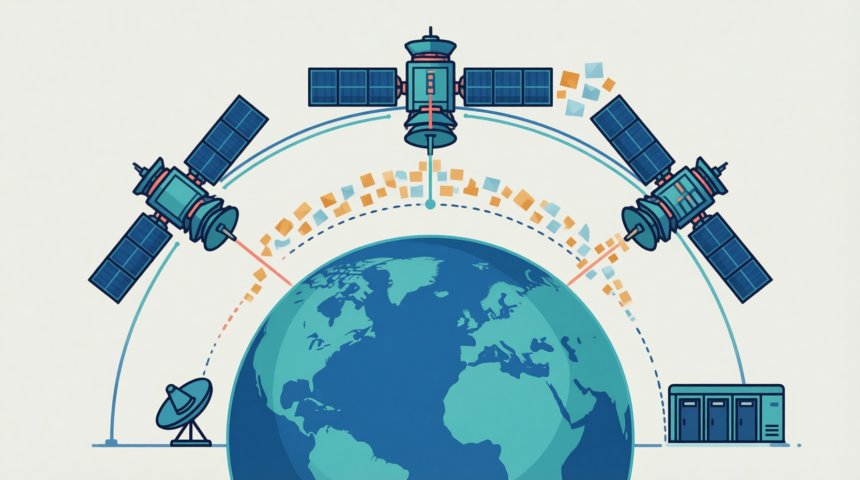
 Did cloud computing once seem out of this world? If you remember a world before the Internet, or even the years it was first starting to come into people’s homes, many cloud concepts were probably once unfamiliar as well. Not only can information be gathered from distant sources. Your own data and computing services can be based thousands of miles away. Companies have been talking about moving the cloud to space, and now Cloud Constellation Corporation has announced it is planning to build a cloud storage network that is truly out of this world.
A Space Cloud Plan In the Works
The company plans to implement its SpaceBelt network soon. It will include orbiting satellites and ground networks. Businesses, government entities, and cloud service providers will be able to store data securely in the space-based infrastructure. At least seven satellites should be in place by 2019. The system may be tested as early as 2018.
Expected benefits of the system may include:
More Read

A modular adaptability that will enable the system to be reconfigured over time, to accommodate new technologies and the changing needs of society.
An increase in data capacity on the scale of exabytes. This is a dramatic increase from the current storage and transmission ability on the petabyte scale.
A cost reduction of such service from upwards of $4 billion to hundreds of millions of dollars.
Fast, secure, and affordable data for government, energy, banking, medical, and insurance industries, among many others.
Real-time access to data storage by military drones operating in remote and hostile locations.
Those who’ve considered a space cloud before have considered the energy benefits. With plentiful solar radiation, the servers could basically be powered at no cost. They could even use spinning disk drives more efficiently, since there’s less resistance in zero gravity and the cold of space could allow faster processing without the risk of overheating. In addition, launching a satellite is becoming cheaper than building a cellular tower. Small satellites can be put into orbit for under $100,000, for example.
Legal Factors
One would think there would be fewer legal ramifications of launching cloud servers into space. In fact, the United Nations has addressed international law at this level for some time. In 1958, it created the Committee for peaceful usage of extraterrestrial space. Technical-scientific and juridical sub-committees have since been formed. The rules enforced generally apply to peaceful use of extra-atmospheric space and international cooperation. Although how these apply to cloud server satellites is unclear on some fronts, the ability to control such infrastructure and how a ground-based conflict could lead to cybernetic attacks are certainly on the minds of international legislators.
On the Verge of the Outer Space Cloud
According to Cloud Constellation Corporation’s SpaceBelt website, the space-based cloud network would eliminate a lot of data vulnerability issues. The project is patent pending, as of the writing of this article. The company believes, however, that enterprise and government data security is a major force in this project. Moving sensitive data would be easier and more secure, as would be maximizing performance. Hackers have hit so many ground-based cloud resources over the past few years, costing millions of dollars each time.
Today, news stories about putting data and cloud infrastructures in space are all over the Web. One company is seeking to fill this gap and make a space cloud a reality. In just a few short years, we may be using software defined storage and accessing data from beyond the Earth and in the realm of space. Gone are the days of being flabbergasted by realizing the ability to communicate with and access information from resources anywhere on the globe. Soon, a whole new reality with take form.