We use cookies, including third-party cookies from Google to serve personalized ads through AdSense, to operate this site and understand how it is used. By continuing to browse, you accept this use. See our Privacy Policy and Terms of Use for details, including how to opt out of personalized advertising.
Accept
SmartData CollectiveSmartData Collective
  • Analytics
    AnalyticsShow More
    chatgpt image jul 21, 2026, 04 34 30 pm
    4 Core Benefits of Predictive Maintenance after Vibration Analysis
    10 Min Read
    How Does Data Mining Boost Customer Satisfaction in Logistics? Harnessing Analytics for Results -- AI-generated illustration
    How Does Data Mining Boost Customer Satisfaction in Logistics? Harnessing Analytics for Results
    11 Min Read
    chatgpt image jul 13, 2026, 04 23 45 pm
    How Data Analytics Helps Companies Improve User Engagement
    19 Min Read
    chatgpt image jul 13, 2026, 03 59 46 pm
    How Data Analytics Improves Multi-Location Search Strategies
    10 Min Read
    cybersecurity efforts
    How Behavioral Analytics and AI Are Redefining Cybersecurity for Boca Raton Businesses
    14 Min Read
  • Big Data
  • BI
  • Exclusive
  • IT
  • Marketing
  • Software
Search
© 2008-25 SmartData Collective. All Rights Reserved.
Reading: 3 Steps to Improving Agility in Financial Budgeting and Planning
Share
Notification
Font ResizerAa
SmartData CollectiveSmartData Collective
Font ResizerAa
Search
  • About
  • Help
  • Privacy
Follow US
© 2008-23 SmartData Collective. All Rights Reserved.
SmartData Collective > IT > Cloud Computing > 3 Steps to Improving Agility in Financial Budgeting and Planning
AnalyticsBig DataCloud ComputingSoftware

3 Steps to Improving Agility in Financial Budgeting and Planning

johnnyor58
johnnyor58
6 Min Read
3 Steps to Improving Agility in Financial Budgeting and Planning
Photo by Goumbik on Pixabay (https://pixabay.com/photos/chart-graph-finance-financial-data-2779164/)
SHARE

Agile Planning and Budgeting

Financial agility is becoming a necessity in the business world, as the world of business continues to evolve and become even more dynamic.

Today, there is rarely an aspect to business that isn’t constantly fluctuating, evolving, and adapting to trends. Business tends to be one giant set of variables, and consistency is a rarity.

It’s on account of all these economic and industry variables that Finance teams require a high degree of agility. Whether the cost of oil is increasing or the demand for products is on the decline, Finance teams need to be able to respond immediately to ensure their budgets and plans reflect these shifting circumstances. Here are some tips for building more agility into your budgeting and planning process, so you can increase, adapt, and reallocate resources as needed.

Reduce Reliance on Spreadsheets and Manual Processes

More Read

impact of big data and AI on stock trading
Embracing Big Data Technology Makes Traders’ Lives Much Easier
Confused on how to measure voice quality after all? Here is the answer – signal + noise + speech model + analytics = state-of-the-art approach!
2009 Marketing Research Predictions
Major Brands Finding Valuable Applications for Analytics
The Simplicity of Virtual Reality Means It’s Closer Than You Think

The first step in improving agility is dispensing of the manual processes that are holding your team back. Spreadsheets, while a common method of tackling Finance, are notoriously cumbersome. Not only is all of the work conducted manually, requiring a significant time investment, but it becomes very difficult to scale and improve budgeting process over time. Instead, many organizations are adopting the budgeting and planning applications found in modern, cloud-based EPM software. These solutions can greatly automate the process, reducing manual work, while providing you with a centralized, cloud-based platform to store all financial data and budget variations. Then you can build your budget and compile reports more efficiently while minimizing manual errors.  And with most of these solutions, users can continue to leverage Excel as a front-end to the application.

Adopt Dynamic Planning Techniques Like Rolling Forecasts

By this time next quarter, the price of oil could have doubled, the cost of imports and exports could rise, some of your customers may churn, and your business could have added yet another product to its offerings. Nothing about your business remains constant, so your budget can’t either. Basing all of your decisions on an annual budget means you’re operating on static assumptions that will soon become irrelevant, as the drivers of your business change.

A rolling forecast can solve these problems. The rolling forecast can extend to the end of the fiscal year, or beyond, and you can update it regularly to reflect any changes in your industry or business. This allows you to incorporate changes in business conditions as they occur, so your plans and resource allocations are consistently up to date and accurate. It’s with the help of dynamic planning techniques like rolling forecasts that businesses can truly gain the agility needed to respond rapidly to new trends and opportunities.

Move to the Cloud

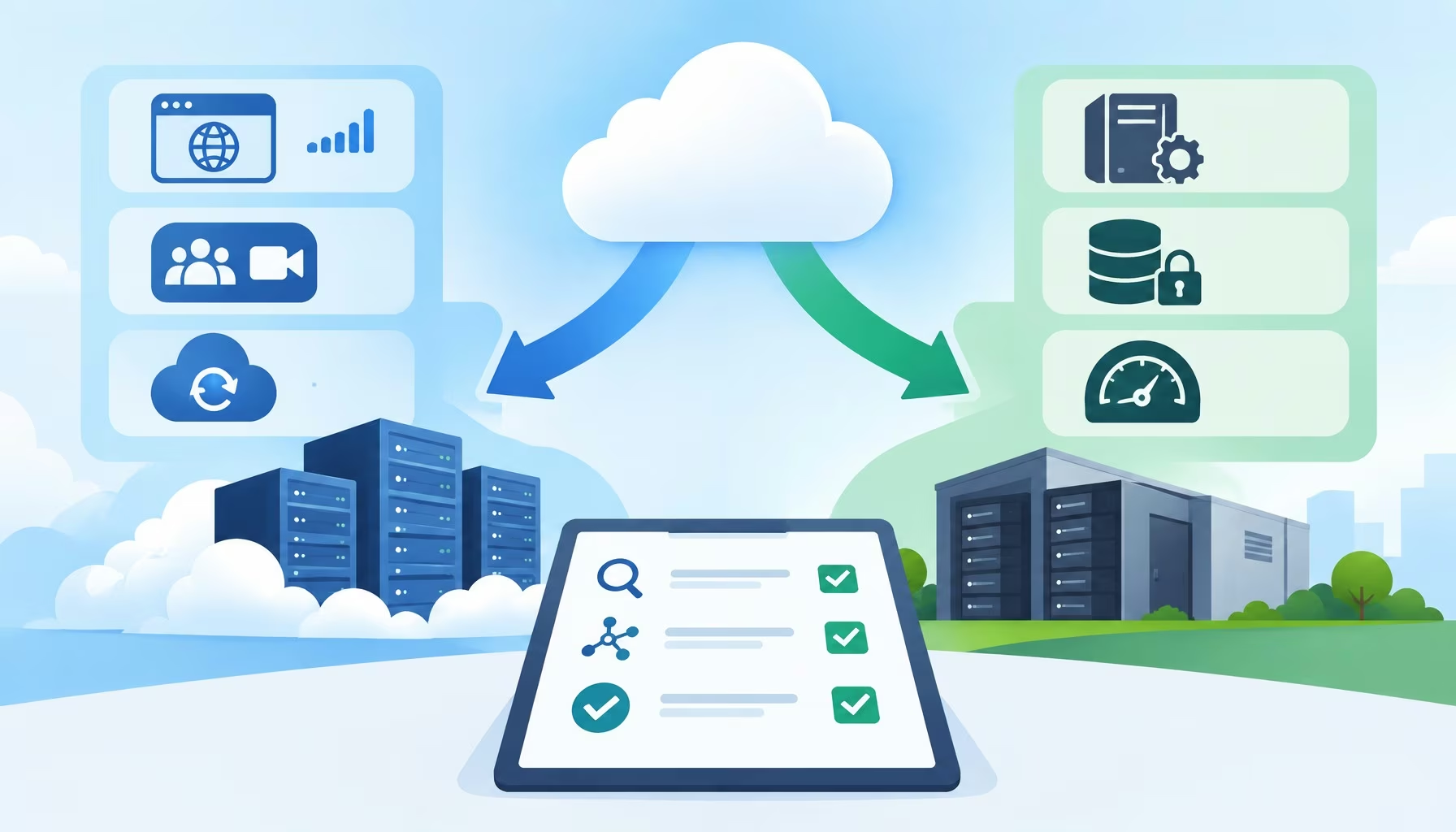
Cloud-based applications can be an important part of gaining complete financial agility, for small, medium and large enterprises. Finance has never been an isolated department. It relies very closely on the exchange of information from other departments across the enterprise. For the best results, your business needs to have the partnership of multiple departments within the company, exchanging data, collaborating on budgets and forecasts, and measuring performance. This can be made much more efficient with the cloud. Cloud-based applications offer both Finance and line of business managers the ability to access all of the data they need, and to update budgets and forecasts anytime, anywhere – in the office, on the road, or while working from home. 

Agility is greatly needed in the world of Finance, and yet many businesses fail to achieve as much financial agility as they are capable of. This is partly due to the pervasive reliance on Excel for budgeting and planning which, despite offering low agility, is still a highly popular method in many organizations. With a cloud-based EPM software platform, your business can streamline the budgeting process, adopt more dynamic techniques such as rolling forecasts, perform what-if scenario modeling – all of which can greatly improve your financial team’s agility.


To learn more, read our white paper titled “Building the Business Case for Cloud-Based Planning and Reporting” and get ready to gain more agility in your 2017 budgeting and planning.

 

Share This Article
Facebook Pinterest LinkedIn
Share

Follow us on Facebook

Latest News

What Your Brand Misses That Data Reveals -- AI-generated illustration
What Your Brand Misses That Data Reveals
Big Data Exclusive Infographic
5 Common Mistakes Businesses Make During the Risk Assessment Process -- AI-generated illustration
5 Common Mistakes Businesses Make During the Risk Assessment Process
Business Intelligence Exclusive Risk Management
Best Age Estimation Software in 2026: Which Facial Age Providers Actually Hold Up -- AI-generated illustration
Best Age Estimation Software in 2026: Which Facial Age Providers Actually Hold Up
Artificial Intelligence Exclusive Machine Learning
Top 8 Multi-Cloud Architecture Tools for Automated Infrastructure Design in 2026 -- AI-generated illustration
Top 8 Multi-Cloud Architecture Tools for Automated Infrastructure Design in 2026
Cloud Computing Exclusive IT

Stay Connected

1.2KFollowersLike
33.7KFollowersFollow
222FollowersPin

You Might also Like

“A a fisherman miles off the coast of Galway hauls in his nets and assesses his catch, he pulls out…”

3 Min Read
A Question of Scope
Best PracticesData MiningDecision ManagementInside CompaniesModeling

A Question of Scope

5 Min Read
choosing web hosting using big data
Big DataExclusiveIT

10 Ways Big Data Helps With Selecting The Perfect Web Hosting

11 Min Read
Top 5 Graph Visualisation Tools
Data Visualization

Top 5 Graph Visualisation Tools

5 Min Read

SmartData Collective is one of the largest & trusted community covering technical content about Big Data, BI, Cloud, Analytics, Artificial Intelligence, IoT & more.

ai in ecommerce
Artificial Intelligence for eCommerce: A Closer Look
Artificial Intelligence
data-driven web design
5 Great Tips for Using Data Analytics for Website UX
Big Data

Quick Link

  • About
  • Contact
  • Privacy
Follow US
© 2008-26 SmartData Collective. All Rights Reserved.
Welcome Back!

Sign in to your account

Username or Email Address
Password

Lost your password?