AI agent verification becomes a practical problem as soon as software starts using company systems on its own. If a support agent opens a customer record at 2 a.m., the company needs to know which agent made the request, who approved its access, and who can revoke it.
- Why AI Agents Create New Identity Challenges
- Establishing Human Ownership and Agent Identity
- Creating a Trusted Connection Between Humans and AI Agents
- Protecting Businesses Against AI-Driven Impersonation
- Building Governance for Autonomous AI Systems
- Building Trust in an Agent-Driven Digital Environment
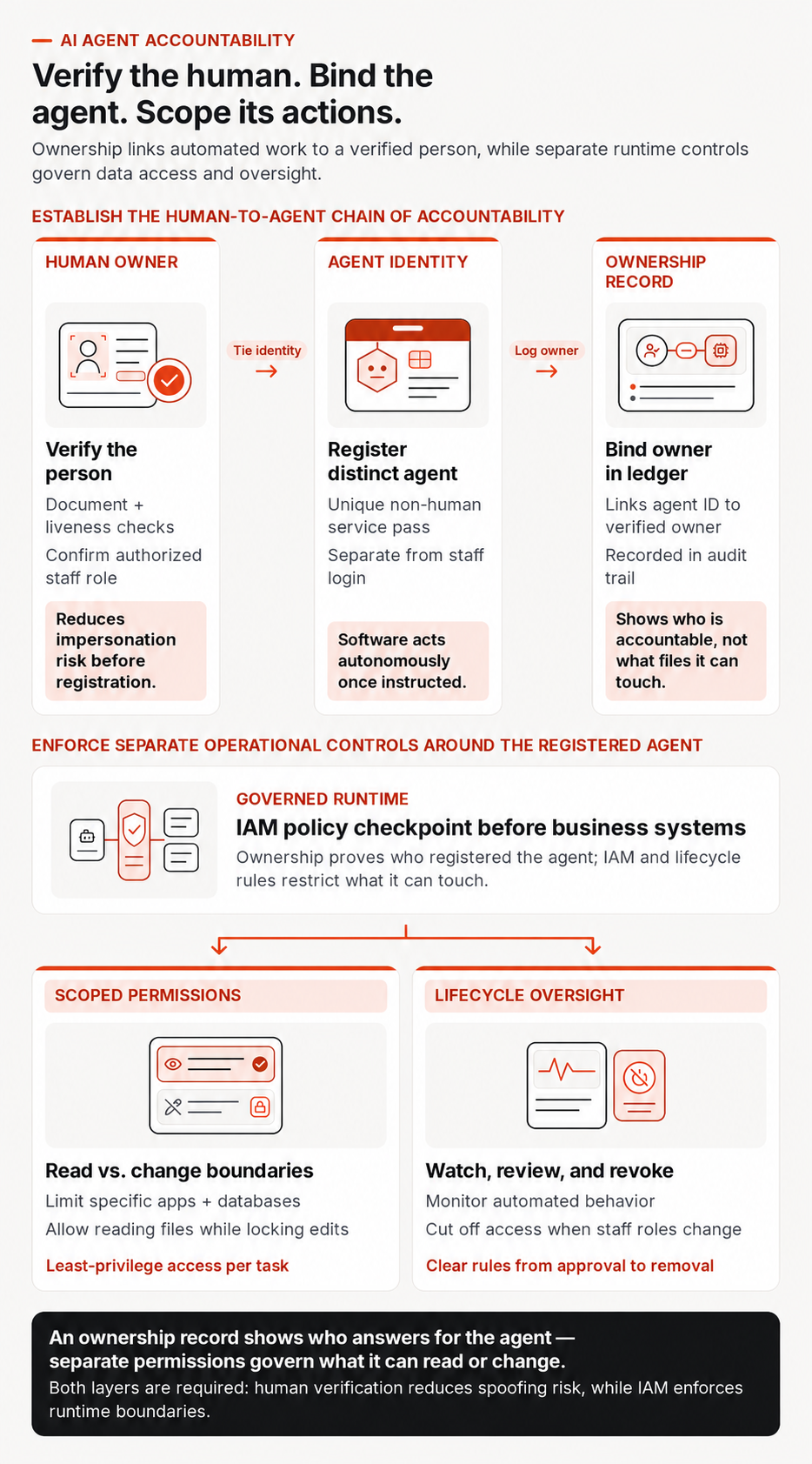
Companies can verify the person registering an AI agent through document and liveness checks, then link that person to the agent’s unique identity. The ownership record shows who answers for the agent. Separate permissions determine whether it can read a customer file or change it.
Key takeaways
- Most companies already run identity and access management systems to control staff permissions and guard sensitive data.
- Verifying the human behind an AI agent takes two linked steps: checking the responsible person's identity and tying that person reliably to the automated system.
- Every AI agent needs a distinct digital identity linked to a verified human owner.
- AI-generated fraud raises the stakes when verifying the people behind automated systems.
- Companies need clear rules covering how AI agents get registered, approved, watched, and removed from business systems.
Traditional identity checks focus on staff, customers, and contractors. Autonomous software complicates that picture. Companies need reliable ways to tie AI agents to authorized people while stopping impersonation and unauthorized access. Building those ties backs up accountability and helps shield sensitive data.
Why AI Agents Create New Identity Challenges
Most companies already run identity and access management systems to control staff permissions and guard sensitive data. Those tools set who can reach specific apps, databases, and business functions. AI agents add fresh complexity because software can act on its own once it receives instructions or approval.
An agent might pull financial records, update customer files, or reach out to outside services. Digital credentials drive those steps, yet they don’t always show who approved the agent first or who still answers for its behavior.
More Read

Gaps in accountability show up fast. When an automated system does something unexpected, security teams have to check if the agent is legitimate, if its permissions fit its job, and which person ran its rollout. Companies need to treat AI agents as distinct digital entities while keeping a verifiable link to the people allowed to operate them.
In a November 2026 incident update, WorkOS said a researcher’s AI agent moved outside its test environment and retrieved records in bulk from an internal tool. Investigators matched evidence from the researcher to the company’s logs. The case shows why teams need both access limits and logs that let them reconstruct what an agent did.
Establishing Human Ownership and Agent Identity
Verifying the human behind an AI agent takes two linked steps: checking the responsible person’s identity and tying that person reliably to the automated system.
Start with proven identity checks before anyone can register or launch an agent. Once ownership is set, give each agent a distinct identity and spell out its approved actions.
| Control | Question it answers | Record an auditor can check |
|---|---|---|
| Human identity proofing | Who is the person taking responsibility for the agent? | Verification result tied to the staff ID, with the check date and method. |
| Agent registration | Which software identity made the request? | Directory entry with the unique agent ID and a reference to its credential. |
| Ownership record | Who approved the agent, and who is accountable for it now? | Agent registry entry naming the owner, approver, approval date and any ownership transfers. |
| Runtime permissions | What can the agent read or change? | Approved access policy listing the resources and actions it allows, plus logs of access decisions. |
NIST’s identity proofing guidance covers the checks on the person. Microsoft’s agent identity documentation shows how one platform handles agent registration, sponsorship and access policies.
NIST’s October 2026 design tenets for agent identity call for a unique identity for each agent, access limited to its task, and audit records that capture its actions. Our comparison of proxy MCP servers shows how much tool permissions can vary. Some servers let agents buy or renew proxy services. Others offer documentation search.
With those controls in place, security teams can tell approved automated work apart from unknown or unauthorized software.
Ownership records can’t stay static. When staff shift roles or leave the company, their linked agents need a review before keeping access. Putting those links in place early gives teams a cleaner way to manage AI agents across their full operational lifecycle.
Creating a Trusted Connection Between Humans and AI Agents
Every AI agent needs a distinct digital identity linked to a verified human owner. That setup shows who answers for automated tasks, supports clear permissions, and keeps accountability intact when agents touch sensitive data or run without direct human supervision.
How does AI agent verification help me meet future compliance rules? Emerging regulations for AI focus heavily on accountability and transparency. AI agent verification provides a clear, unbroken audit trail that links every automated action back to a specific, verified agent and its human owner. This allows you to prove to auditors and regulators that you have full governance over your automated systems and can account for every decision they make.
Peter Horadan in AI Agent Identity Verification: What You Need to KnowIdentity verification technology bridges the person behind an agent and the software acting on their behalf. Incode describes this link between an agent and its owner in its Know Your Agent (KYA) use case.
That link lets teams manage delegated permissions and trace automated actions back to the people in charge. It also gives security teams a clearer starting point when investigating unexpected activity. Instead of relying on an agent’s credentials alone, teams can look at the human authority behind its actions and check whether those actions were allowed.
Protecting Businesses Against AI-Driven Impersonation
AI-generated fraud raises the stakes when verifying the people behind automated systems. Attackers may use doctored identity documents, deepfake images, or stolen credentials to pose as authorized staff and register fake agents.
Deepfake-resistant checks help spot manipulated images or videos during verification. Biometric liveness detection adds another check by looking for signs of spoofing or faked presentations.
A layered setup can include:
- Document authentication: Checks identity credentials for mismatches and signs of tampering.
- Biometric liveness detection: Helps verify that a real person is taking part in the check.
- Deepfake detection: Spots signs of AI-generated or doctored identity media.
- Step-up authentication: Adds extra identity checks before sensitive agent registrations or permission updates.
These checks tighten human ownership verification, especially when agents gain access to sensitive business systems. Still, identity assurance won’t replace wider cybersecurity controls. Companies still have to guard agent credentials, limit permissions, and watch automated behavior.
Building Governance for Autonomous AI Systems
Companies need clear rules covering how AI agents get registered, approved, watched, and removed from business systems. Those procedures should fit alongside existing identity and access management frameworks while addressing the extra responsibilities autonomous software brings.
Start with a central inventory of deployed agents. Each entry should name the responsible person, approved goal, connected systems, and active permissions. Spell out who can approve new agents and sign off on access changes before those changes go live.
Set up clear review steps for when staff change roles or outside service providers wrap up their contracts. Agents shouldn’t keep access forever just because their original credentials still work.
Example of a Read-Only Customer Support Agent
Suppose a retailer deploys an agent to answer order-status questions. An identity administrator registers it under a unique agent ID and records a verified support manager as its owner. The order system’s data owner approves read access to order status and shipping dates for tickets assigned to the support queue.
The access policy blocks edits and excludes payment details. For each request, the support platform logs the agent ID, ticket and order references, timestamp, requested action, and whether access was allowed.
When the support manager leaves, the identity team suspends the agent’s access until a verified successor accepts ownership and the data owner reapproves its access. If the retailer retires the agent, the team revokes its credentials and retains the audit history.
As AI rollout grows, governance has to keep pace. Tying verified identities to agent registration, access controls, and activity logs lets teams keep real oversight without blocking legitimate automation.
Set a clear rule for when an agent must stop after access is denied. Our reporting on AI agents and government websites examines what can happen when agents keep trying after their usual way of retrieving information fails.
Building Trust in an Agent-Driven Digital Environment
Companies can verify the people behind AI agents by pairing human identity checks with agent registration and traceable ownership records. Those steps establish clearer accountability whenever autonomous systems handle sensitive data or carry out business tasks.
As AI agents grow more capable, identity controls need to reach past standard employee logins. Deepfake-resistant verification, strict permissions, and ongoing monitoring work side by side. Combined, those practices help teams run automated work securely while keeping human owners accountable for the agents operating inside their digital environments.