

At Smart Data Collective, we write articles to help leaders understand how data analytics is changing the way healthcare organizations manage risk. It is becoming more important for hospitals, clinics, insurers, and care networks to use data carefully as they deal with patient safety, compliance, staffing, cyber threats, and rising costs.
- Data Analytics Is Changing Healthcare Risk Management
- The Shift to Compliance-First Coding
- Top Solutions for Medicare Advantage 2026
- RAAPID – The AI-Native Platform Built for Defensibility
- Optum Risk Adjustment Solutions – The Enterprise Incumbent
- Change Healthcare – The Integrated Suite Player
- Conifer Health Solutions – The Managed Services Approach
- HMS Holdings – The Compliance and Audit Specialist
- Why Defensible Coding Matters Right Now
- How to Choose the Right Solution
- The Future of Risk Adjustment
- Frequently Asked Questions
The University of Illinois Chicago reports that a study by the Office of the National Coordinator for Health Information Technology found that nearly 9 in 10, or 88%, of U.S. office-based physicians have adopted electronic health records. Something that makes this important is that healthcare organizations now have far more data available to help them identify risks before they turn into bigger problems. Keep reading to learn more.
Data Analytics Is Changing Healthcare Risk Management
“In recent years, the explosive growth of health data has raised a crucial question: How can healthcare professionals efficiently extract meaningful insights from such large, diverse datasets? Health data can offer immense potential for enhancing healthcare delivery, outcomes, and medical research. This emphasizes the importance of integrating data analytics methodologies within the realm of health informatics.”
Healthcare risk management used to depend heavily on past incidents, manual reviews, and delayed reporting. There are many ways data analytics can now help organizations detect warning signs earlier, such as patterns in readmissions, medication errors, billing issues, infection rates, and patient complaints. Another thing it can do is help leaders compare risks across departments instead of viewing each problem in isolation.
AON published an article titled Data and Analytics: The Next Frontier of Risk Management that says 43% of respondents in one survey reported that data analytics was a business area with the greatest need to fill skills gaps. It is a reminder that healthcare organizations may need stronger data talent if they want to make better decisions about risk.

“New risks will continue to emerge, and data and analytics capabilities will become even more essential. Companies should get started now to incorporate these solutions and rethink the strategies that can fundamentally change the organization’s risk management function. There are four core areas where data-driven approaches can have both immediate and long-term improvement,” the authors write.
Data analytics can help healthcare organizations move from reacting to problems toward spotting possible failures sooner. Something that makes this so useful is that risk often builds across many small warning signs before it becomes a major event. Another thing healthcare leaders can track is whether staff shortages, longer wait times, or repeated documentation issues are raising the chance of poor outcomes. It is easier to act early when these signals are visible in one place.
Patient safety is one of the clearest areas where analytics can change risk management. There are many examples where data can help teams monitor fall risks, infection patterns, missed follow-ups, and medication concerns. Something that makes these insights valuable is that they can guide training, staffing, and process changes before harm occurs.
Analytics also helps healthcare organizations manage financial and compliance risks. It is easier to find unusual billing patterns, gaps in documentation, privacy concerns, or vendor issues when data is reviewed regularly rather than after an audit or complaint.
If you’re managing Medicare Advantage operations, you’ve probably noticed something changing. The days of aggressive chart mining and maximum code capture are fading fast. In 2026, the real competitive advantage isn’t finding more codes. It’s proving the codes you already have will survive an audit.
The regulatory landscape shifted hard. The $556 million Kaiser settlement in January 2026 sent a clear message. CMS is now auditing every eligible Medicare Advantage plan annually. The audit samples are bigger, the scrutiny is sharper, and organizations that don’t adapt their coding strategies are facing real financial risk. This isn’t just compliance noise anymore. It’s the new operating standard.
So how do you choose a risk adjustment solution that actually fits this new reality? Let me walk you through six platforms leading the shift toward defensible, audit-ready coding.
The Shift to Compliance-First Coding
The New Regulatory Reality
The landscape changed faster than most organizations expected. In May 2025, CMS announced it was expanding audits from roughly 60 plans annually to all eligible Medicare Advantage plans. That means every plan, every year. The sample sizes jumped from 35 records per plan to potentially 200. The stakes got real.
Then came January 2026. Kaiser settled for $556 million over invalid diagnosis codes. The message was unmistakable: submitting codes that don’t hold up under review isn’t aggressive optimization. It’s fraud risk. And CMS, along with the Department of Justice, is treating it accordingly.
From Revenue Chasing to Defensible Documentation
Here’s the honest truth: the old model was about mining charts for every possible code. More codes meant higher risk scores. Higher risk scores meant bigger reimbursement. The organizations that were really good at this? They made money. Short term.
Now? That strategy is a liability. When auditors pull a chart, they’re asking three questions. Where is this condition documented? Does it meet MEAT criteria (that’s Monitoring, Evaluation, Assessment, Treatment)? Can you trace a clear line from patient encounter to submitted code?
Organizations that shift early to compliance-first coding gain real competitive advantage. Those that cling to volume-first strategies? They’re heading for RADV audits with vulnerable documentation. That’s not a risk worth taking in 2026.
Top Solutions for Medicare Advantage 2026
RAAPID – The AI-Native Platform Built for Defensibility
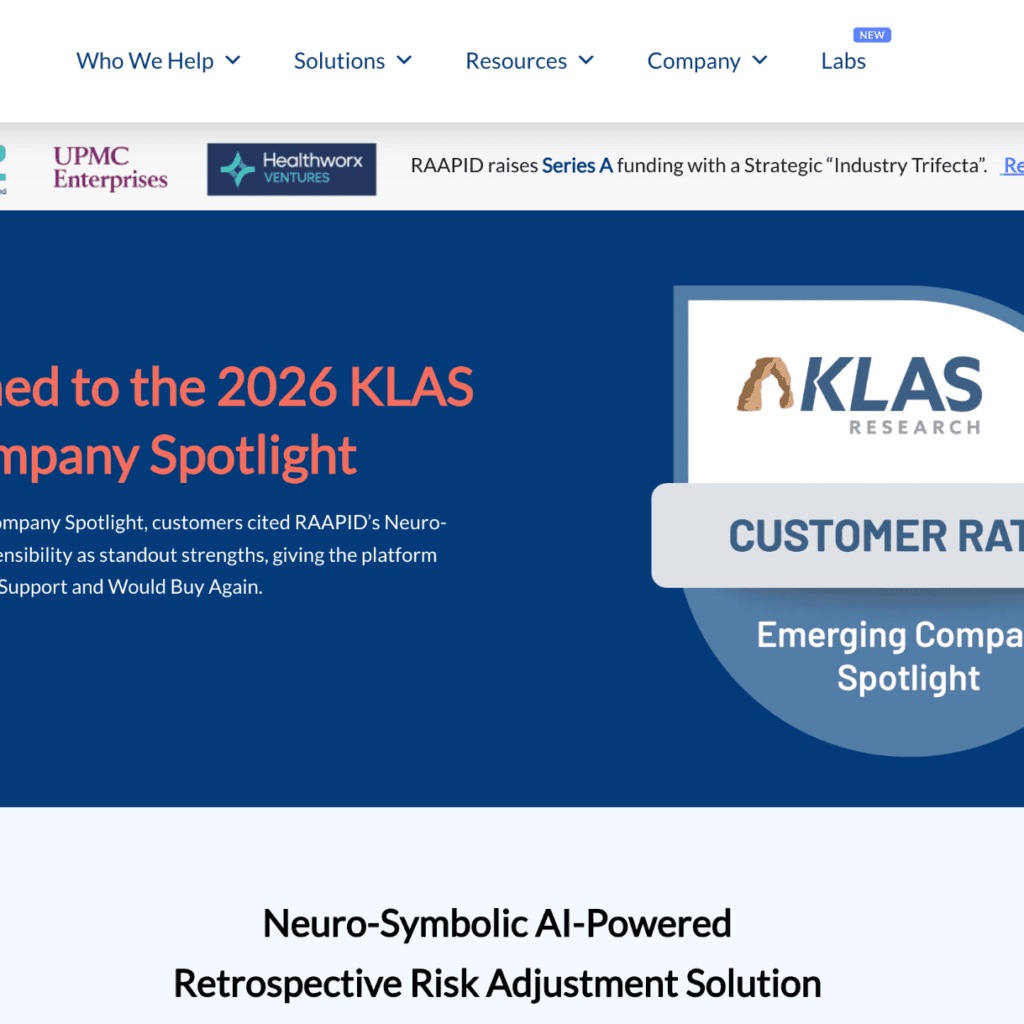
RAAPID stands out because it was built for compliance-first operations from day one. This isn’t a legacy system pivoting toward compliance. This is a platform designed specifically for Medicare Advantage, ACA and at-risk provider organizations that need defensible coding across retrospective reviews, prospective documentation support and RADV audits.
Here’s what sets it apart: the platform uses proprietary Neuro-Symbolic AI that combines machine learning with medical rules and MEAT criteria logic. That means the AI doesn’t just suggest codes. It explains why. Every recommendation includes a transparent evidence trail showing which text in the note supports the recommendation. That transparency matters when you’re facing an auditor.
The numbers back it up. Organizations report 92% AI accuracy, 5x improvements in coder productivity and returns on investment between 3 and 10 times. Chart reviews that used to take 40 minutes are processed in under 8 minutes while maintaining accuracy that holds up in audits.
The credentials are strong too. RAAPID is a Modern Healthcare 2025 Best in Business Healthcare IT honoree. It earned a spot in the 2026 KLAS Emerging Company Spotlight specifically for defensible coding. It’s HITRUST r2 certified and SOC 2 compliant. It runs on Microsoft Azure.
The core philosophy is simple: sustainable risk adjustment depends on defensible risk adjustment practices. This platform combines AI accuracy with human validation to ensure every code can be defended if challenged. That’s the difference between algorithms and genuine defensibility.
Optum Risk Adjustment Solutions – The Enterprise Incumbent
Optum, part of UnitedHealth Group, operates one of the largest risk adjustment platforms in the industry. If you’re a huge Medicare Advantage plan already embedded in the UnitedHealth ecosystem, you know this platform. It has scale, established relationships and deep integration into clinical data and claims systems.
The challenge? Optum is actively transitioning from legacy revenue-optimization approaches toward compliance-first frameworks. It’s getting there, but it started from a different place. The platform handles so many healthcare functions that risk adjustment sometimes takes a back seat in development priorities.
Best if you need enterprise-scale operations and already live in the UnitedHealth ecosystem. Less ideal if you want specialized compliance innovation.
Change Healthcare – The Integrated Suite Player
Change Healthcare offers risk adjustment capabilities as part of a broader revenue cycle suite. You get integration across billing, claims management and coding support from a single vendor. That appeals to organizations tired of managing multiple point solutions.
The tradeoff? When one company handles billing, claims, EHR integration and risk adjustment, the specialized functions can get diluted. Risk adjustment becomes one module competing for development resources with billing and other functions. The platform is modernizing for 2026 compliance but approaches it as a generalist rather than a specialist.
Good fit if vendor consolidation matters more than specialized innovation.
Conifer Health Solutions – The Managed Services Approach
Conifer, part of Ascension, handles risk adjustment through outsourced managed services. This means you’re not buying software. You’re buying experienced teams that handle chart retrieval, documentation review, coding and submission. The model is hands-on and relationship-driven.
Conifer’s strength is operational expertise and compliance culture. The weakness is that managed services are labor-intensive. You don’t get the productivity gains that AI automation delivers. Coding improvements happen at human speed, not algorithm speed.
Right choice if you don’t have internal coding capacity and want experienced hands managing operations.
HMS Holdings – The Compliance and Audit Specialist
HMS comes from a payment integrity background, meaning audit defense and compliance methodology are core competencies. The company recently expanded into risk adjustment and brings genuine expertise in regulatory compliance frameworks and RADV audit preparation.
HMS is newer to the Medicare Advantage space compared to older incumbents, but that can be an advantage. The platform was built for a compliance-focused market from the start. It emphasizes defensibility and audit readiness in ways that legacy platforms are still catching up to.
Good option if audit defensibility is your top priority and you want a vendor whose entire focus is compliance.
Why Defensible Coding Matters Right Now
The compliance shift in 2026 isn’t temporary. Annual audits aren’t going anywhere. Sample sizes are expanding. The return on investment for risk adjustment solutions now includes something that never mattered before: avoiding audit penalties. That’s real money. Organizations choosing solutions based on defensibility rather than volume are making the right call.
MEAT documentation standards are becoming non-negotiable. Encounter linkage verification is routine. Your processes need to be transparent and audit-ready. Glass box methodology, where your logic is visible and explainable, beats black-box automation every time in this new environment.
How to Choose the Right Solution
When you’re evaluating risk adjustment platforms, ask yourself these questions. Does the platform prioritize defensibility over volume? Is the reasoning transparent? Does it hold relevant certifications like HITRUST or SOC 2? Will it integrate with your existing systems? Can it simulate RADV audits before you submit codes? Are the ROI claims realistic for your organization?
Much like broader healthcare decisions that depend on data-driven strategy, your platform selection should rest on objective criteria rather than vendor promises. Organizations moving early to compliance-first frameworks gain a competitive advantage. The platforms that combine high AI accuracy with transparent human validation are winning market share. Investment in defensible coding isn’t optional anymore. It’s a baseline operational requirement.
The Future of Risk Adjustment
Regulatory scrutiny will continue to tighten. That’s not speculation. That’s the announced strategy. Annual audits, larger samples, AI-assisted detection. Organizations that shift early to compliance-first frameworks will outpace those sticking with volume-first models.
The 2026 Medicare Advantage landscape rewards compliance maturity and punishes volume-first approaches. Choose accordingly.
Frequently Asked Questions
Q1: What’s the difference between compliance-first and revenue-first risk adjustment?
Revenue-first approaches maximize code capture regardless of defensibility. Compliance-first prioritizes codes that withstand audit scrutiny. With annual RADV audits now standard, compliance-first is the only sustainable approach. Organizations using outdated revenue-first models face serious financial and reputational risk.
Q2: How much does AI accuracy matter in coding platforms?
AI accuracy is critical. 92% accuracy combined with human validation reduces manual review time and improves defensibility. Organizations report 5x productivity gains when automation handles high-confidence cases while coders focus on complex documentation. The key is transparent reasoning. Glass box automation that shows why codes were recommended beats black-box algorithms every time.
Q3: What certifications should I look for in risk adjustment platforms?
Prioritize HITRUST r2 certification and SOC 2 Type II compliance. These demonstrate rigorous data security and protection standards. Modern Healthcare recognition and KLAS spotlight mentions indicate market validation. Ensure the platform also supports CMS-HCC V28 and current RADV audit methodologies.
Q4: Is 3-10x ROI realistic for risk adjustment platforms?
ROI varies by organization size, audit exposure and current coder productivity baseline. The range reflects cost savings from avoided audit penalties, reduced manual coding hours and optimized risk score accuracy. Model ROI using your specific audit risk profile and current operational costs rather than assuming industry averages apply to your situation.
Healthcare leaders need better ways to understand risk because the industry faces pressure from many directions at once. Something that data analytics can provide is a clearer view of where problems are most likely to occur and which actions may reduce them. Another thing it can support is more consistent reporting, which helps boards, managers, and care teams make decisions using the same facts.
Data analytics is becoming a major part of modern healthcare risk management because it helps organizations see problems sooner and respond with more confidence. There are many benefits for providers that want to protect patients, reduce costly mistakes, and make better use of the health data they already collect. It is also a practical way to help healthcare teams focus their attention on the risks that matter most.