An integration proposal may say “connect the CRM to the ERP.” Your data team still has to decide which system owns each field, how changes reach analytics, and what happens when delivery fails halfway through. Those decisions determine whether the new pipeline produces reliable records or another reconciliation job.
- Compare integration partners by evidence and workload
- HBM: inspect the accounting integration case
- Pell Software: qualify business-system synchronization
- Mystic Media and Intobi: establish the messaging scope
- CoSpark: check the commerce boundary
- Haefele Software and SapientPro: request a relevant implementation
- Separate the broker from the integration platform
- Azure Service Bus, RabbitMQ and Kafka solve different problems
- Use the Propell AI case to ask better data questions
- Make recovery and handover part of acceptance
- Frequently asked questions
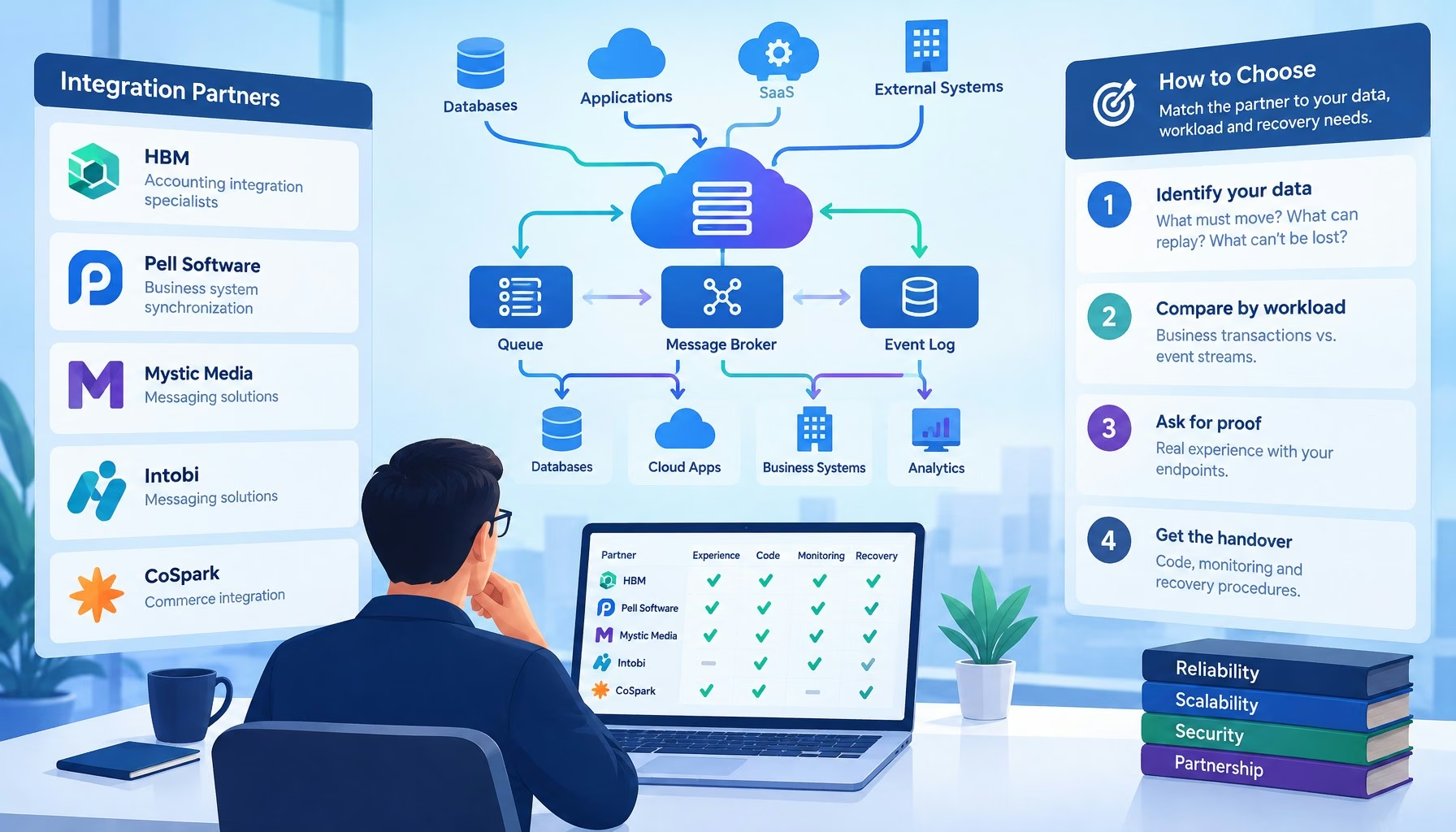
Choose service bus development companies by the data they must move and the failures your team must recover from. For business transactions, compare queue delivery, duplicate handling and dead-letter recovery. For replayable event streams, assess a retained log. Then ask each integration partner to prove its experience with your endpoints and hand over the code, monitoring and recovery procedures.
- Match the messaging pattern to the workload before selecting a provider.
- Require a working recovery demonstration, including duplicate events and unavailable downstream systems.
- Compare documented integration experience; a broad software-development service does not establish broker expertise.
This guide reviews the seven companies in the original shortlist and adds the technical checks needed to assess them. It is a comparison of published services and evidence, not a hands-on benchmark or a ranking of vendor performance. Prices, review counts and staffing figures have been omitted because they change and were not independently rechecked.
Compare integration partners by evidence and workload
The revised table separates the work a company publicly describes from the experience you still need to establish during procurement. Read “ask for proof” as an open question, not a negative finding about the company.
| Company | Published focus | Potential shortlist context | Evidence to request |
|---|---|---|---|
| HBM | Event-driven ERP and accounting integration; administration portal and Data Lake in its Propell AI case study | Multi-system accounting and reusable connectors | Broker choice, tenant isolation and failure-recovery walkthrough |
| Pell Software | Custom API, ERP and systems integration | Business-system synchronization | Duplicate handling and reconciliation for your specific ERP |
| Mystic Media | Cloud backends, APIs and infrastructure | Integration within a wider application or cloud project | A comparable messaging deployment and operational handover |
| Intobi | Website integrations and CRM implementation | CRM and application integration | Broker-specific references and data ownership rules |
| CoSpark | WooCommerce development and complex commerce integrations | Commerce-system connectivity | Comparable ERP connectivity; do not assume general ESB expertise |
| Haefele Software | Cloud and application development, data and analytics | Application integration alongside a data program | Named middleware implementation and support responsibilities |
| SapientPro | Software-product development described on its public site | Further qualification before a broker-focused shortlist | Current integration case study, architecture and delivery references |
HBM: inspect the accounting integration case
HBM publishes a Propell AI integration case study covering ERP connections, e-invoice access points, a Data Lake and an administration portal. That gives a buyer a concrete system to discuss. Ask how connectors are configured, who owns their changes and how the team isolates one customer’s failure from other customers.
The case describes an event-driven integration platform. It does not establish that the implementation is a classic enterprise service bus, or prove a particular broker’s performance. Treat its customer outcomes as vendor-reported evidence.
Pell Software: qualify business-system synchronization
Pell’s integration service covers custom APIs, ERP connections and data synchronization. For a CRM-to-ERP project, ask the team to show the rules for conflicting updates and the reconciliation report that catches missed records. A functioning connector is only part of that job.
Mystic Media and Intobi: establish the messaging scope
Mystic Media describes cloud backends and APIs; Intobi offers website integrations and CRM work. Both may be candidates when integration sits within a larger application project. Ask for a relevant queue or streaming reference before assuming that API development includes broker operations, replay and dead-letter handling.
CoSpark: check the commerce boundary
CoSpark’s current positioning centers on WooCommerce and complex commerce work. That is useful context for connecting a store with orders, inventory or customer records. The original broad protocol list needs project-level confirmation; the company’s homepage alone does not verify enterprise-wide service-bus delivery.
More Read

Haefele Software and SapientPro: request a relevant implementation
Haefele lists cloud and application development alongside data and analytics. Ask which integration responsibilities its proposed team would own. SapientPro remains in the supplied shortlist, but a general software-development offering is insufficient evidence for a messaging-specialist recommendation. Obtain a current, comparable integration reference before scoring either candidate against the broker requirements.
Separate the broker from the integration platform
An enterprise service bus is an architectural approach to integration. Azure Service Bus is a managed messaging service. Logic Apps supplies workflow and connector capabilities, while custom applications can implement transformations and business rules. A proposal should name those responsibilities instead of treating the terms as interchangeable.
At Kafka Summit London in 2024, Jay Kreps, identified in Confluent’s recap as its CEO and co-founder, described the connection between streaming and operational systems: Sources: evidence
“Data streams are the abstraction that unify the operational estate and Kafka is the open standard for data streaming”
Jay Kreps, CEO and co-founder of Confluent at the time, in Confluent’s Kafka Summit recap, March 21, 2024This excerpt is a platform vendor’s architectural perspective, not an independent benchmark or an endorsement of a shortlisted integration company. Use it to ask which operational events your pipeline needs to share, retain and reconcile. A Kafka-based stream and a task queue still need to be assessed against their different workload requirements.
Azure Service Bus, RabbitMQ and Kafka solve different problems
| Approach | Typical question it addresses | What to demonstrate |
|---|---|---|
| Azure Service Bus | How should business messages move through queues or publish/subscribe subscriptions? | Settlement, dead-letter recovery, duplicate-detection configuration and application idempotency |
| RabbitMQ | How should messages be routed and acknowledged between applications? | Publisher confirms, consumer acknowledgements and recovery after interrupted delivery |
| Kafka | How should consumers read and revisit an ordered, retained event stream? | Partition-key choice, retention, offsets and safe replay into downstream systems |
Microsoft’s messaging-service comparison distinguishes business messages from event distribution and streaming. RabbitMQ’s acknowledgement documentation separately covers publisher confirms and consumer acknowledgements. Kafka’s documentation describes its event-streaming model. These distinctions are starting points for an architecture review, not universal throughput rankings.
A managed broker does not remove application-level failure handling. Microsoft documents duplicate detection using message IDs within a configured time window. Your consumer still needs a deliberate policy for repeated business operations. Ordering, retries and replay must be tested with the actual configuration and workload.
Use the Propell AI case to ask better data questions
HBM’s published case connects operational accounting systems with storage and reporting. That makes it relevant to a data team evaluating reusable integration across several systems. The useful procurement questions concern schema changes, connector onboarding and the boundary between operational messages and analytical records.
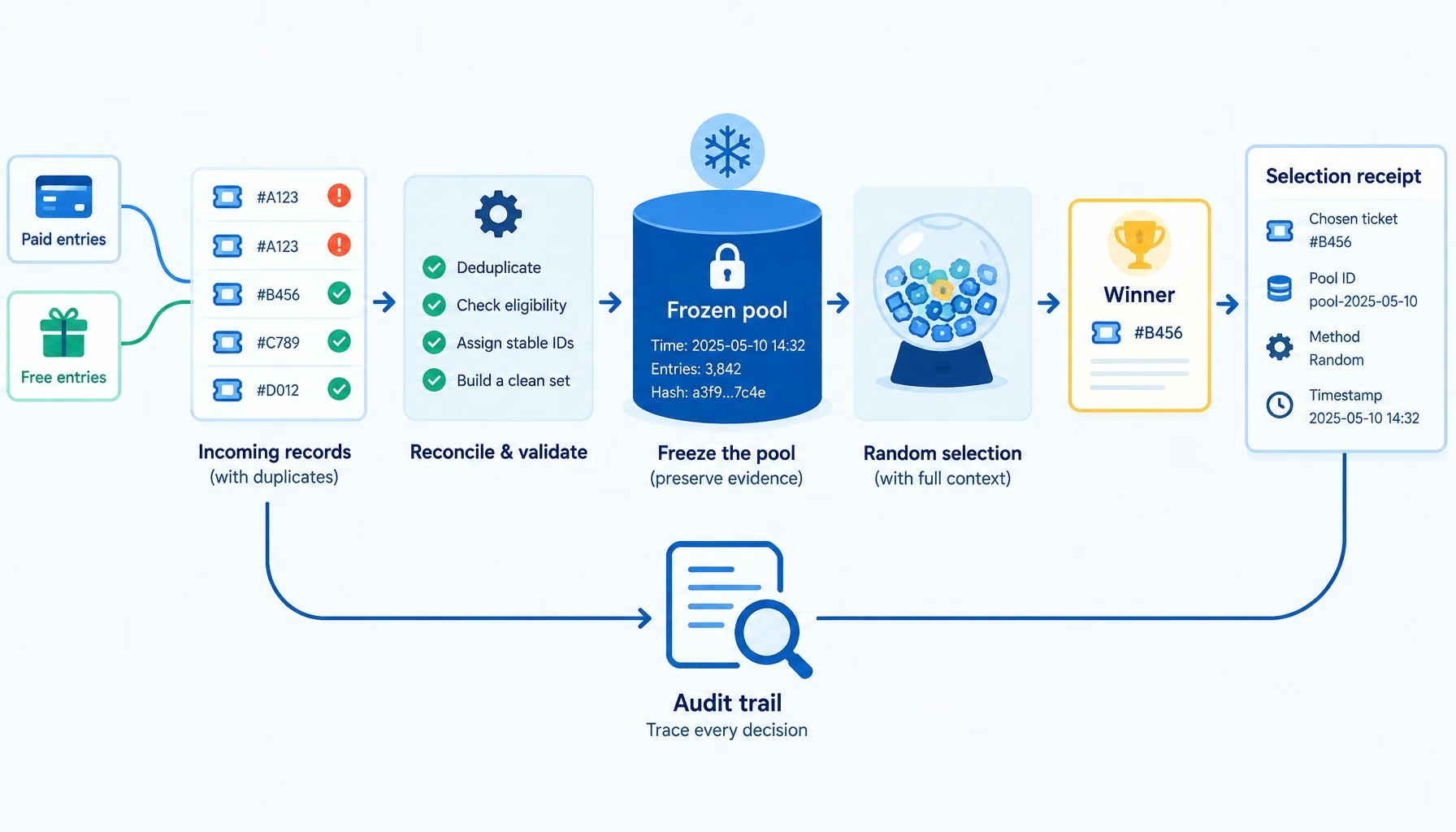
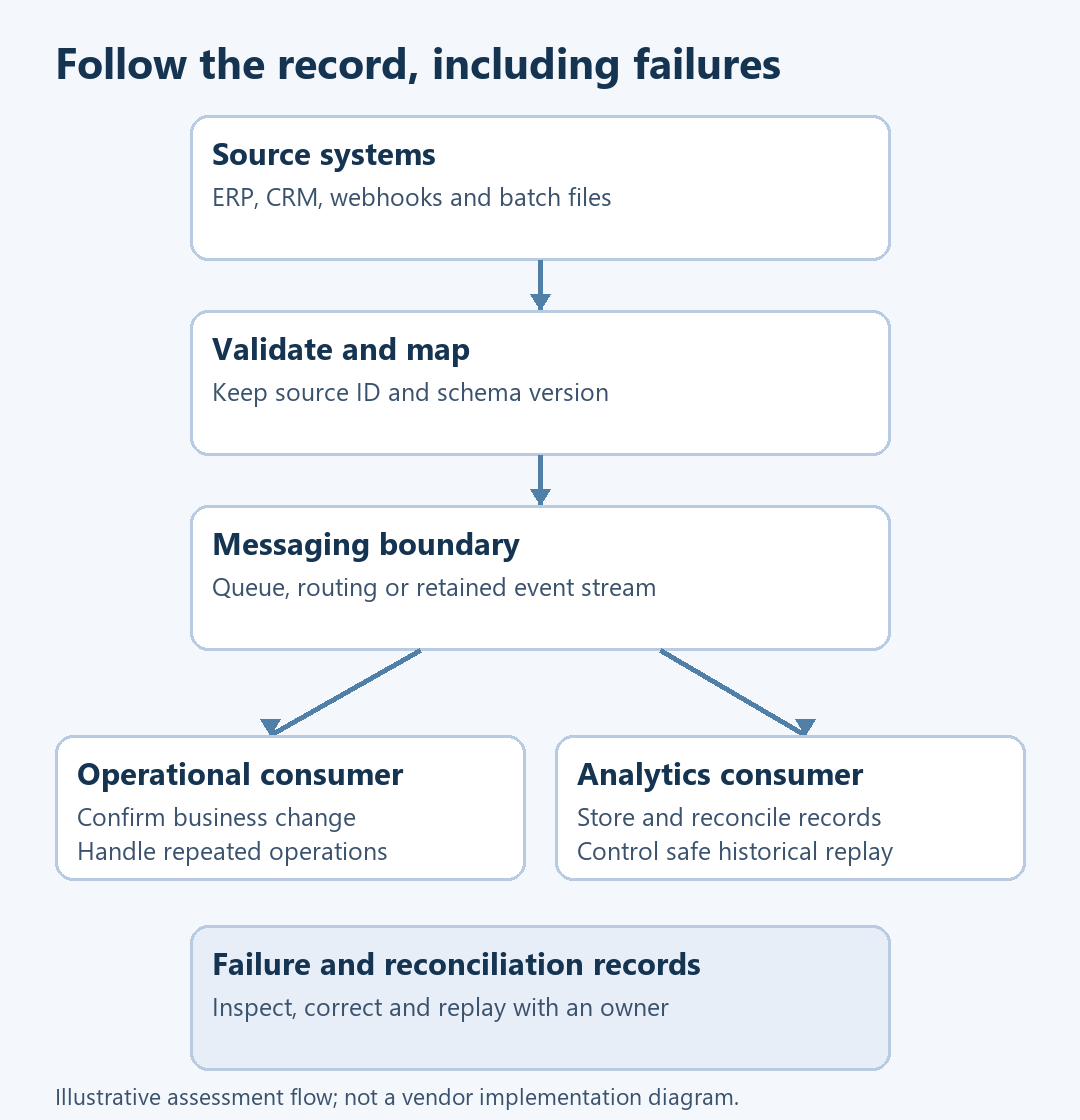
Ask for an invoice’s path through that boundary: its source identifier, validation result, downstream acknowledgement and reconciliation status. Request a failed-delivery example as well as the successful flow. The conceptual diagram below illustrates this assessment pattern; it does not reconstruct Propell AI’s private architecture.
Make recovery and handover part of acceptance
Use a small proof of delivery before the full rollout. Choose one representative endpoint and one downstream consumer. Agree on the expected record count, field mapping and latency tolerance. Then interrupt the downstream connection, resend an event and introduce a record that fails validation.
The partner should show where each record went, how staff inspect failures and what replay does. A dashboard showing “messages processed” cannot by itself prove that the target system committed the intended business change. Reconcile source records with target records and document any exclusions.
- Own the schema and field-mapping definitions, including changes to customer identifiers and dates.
- Agree who can replay failed messages and which operations are safe to repeat.
- Receive deployment configuration, source code, dashboards and a recovery runbook.
- Define support coverage and measure the costs of broker use, connectors and engineering changes separately.
Frequently asked questions
Is Azure Service Bus the same as an enterprise service bus?
No. Azure Service Bus supplies messaging infrastructure. A broader integration platform may combine it with workflows, connectors and application code. Request an architecture that identifies who owns each responsibility.
Is Azure Service Bus like RabbitMQ?
Azure Service Bus and RabbitMQ both carry asynchronous messages, but their deployment, routing and operational models differ. Compare acknowledgements, retry behavior, recovery and support in the actual proposed configuration. Neither name establishes that your application cannot process a duplicate.
When should a data pipeline use Kafka instead of a task queue?
Consider a retained event stream when independent consumers need to read historical events or replay data. A task queue may fit work that a consumer processes and completes. Define retention, ordering boundaries and downstream replay safety before choosing.
How do you compare service bus development companies fairly?
To compare service bus development companies fairly, give every candidate the same endpoint inventory, sample records and recovery tests. Score demonstrated integration experience and the handover package. Keep unconfirmed capabilities separate from evidence, and obtain current commercial terms directly from each company.