


We use cookies, including third-party cookies from Google to serve personalized ads through AdSense, to operate this site and understand how it is used. By continuing to browse, you accept this use. See our Privacy Policy and Terms of Use for details, including how to opt out of personalized advertising.
Accept
SmartData CollectiveSmartData Collective
  • Analytics
    AnalyticsShow More
    Flat editorial illustration: The article is about joining public web signals with internal business metrics so BI teams can inter
    Alternative Data in BI: Bringing Public Web Data Into Your Dashboards
    23 Min Read
    Flat editorial illustration: The article is about automating the collection, preparation, and delivery of marketing data across p
    From Data to Dashboards: 5 Marketing Reporting Automation Software Picks
    12 Min Read
    Flat editorial illustration: The article contrasts passive follower totals with a behavioral path from attention and trust to cli
    Creator Analytics Beyond Follower Count: Seven Metrics That Measure Audience Behavior
    11 Min Read
    Flat editorial illustration: The article connects AI and marketing analytics with managerial judgment grounded in consumer behavi
    How an Online MBA in Marketing Connects AI and Data Analytics
    11 Min Read
    What Kind of Problem-Solving Distinguishes Data Analysts From Software Engineers -- AI-generated illustration
    What Kind of Problem-Solving Distinguishes Data Analysts From Software Engineers
    7 Min Read
  • Big Data
  • BI
  • Exclusive
  • IT
  • Marketing
  • Software
Search
© 2008-25 SmartData Collective. All Rights Reserved.
Reading: Retail is Dead. Long Live Retail!
Share
Notification
Font ResizerAa
SmartData CollectiveSmartData Collective
Font ResizerAa
Search
  • About
  • Help
  • Privacy
Follow US
© 2008-23 SmartData Collective. All Rights Reserved.
SmartData Collective > Data Management > Culture/Leadership > Retail is Dead. Long Live Retail!
AnalyticsBig DataBusiness IntelligenceCulture/LeadershipData ManagementDecision ManagementExclusiveInside CompaniesMarket ResearchMarketingPredictive AnalyticsWeb Analytics

Retail is Dead. Long Live Retail!

Charles Settles
Charles Settles
6 Min Read
Retail is Dead. Long Live Retail!
Illustration generated with Qwen Image.
SHARE

Retail as we know it is dying. The Internet is the method; ecommerce websites like Amazon, Alibaba, and others who operate with extremely low margins and better customer data are the culprits.

Web retailers also have access to better, more in-depth, quantifiable customer data than do more traditional retailers; innovative web data visualization tools can follow mouse movements, scrolling activity, clicks, and traffic sources, allowing ecommerce sites to better spend their ad dollars and design their websites to encourage conversions. Web retailers can also deploy tracking cookies and encourage social logins to register to use their sites’ shopping carts, giving them access to in-depth customer data and information on their likes and dislikes that traditional retailers usually rely on paid market research to capture. Also, it’s much easier to do an A/B test with a web display than it is to do so with a physical one, especially when you’ve got 10,994 storefronts — like Walmart.

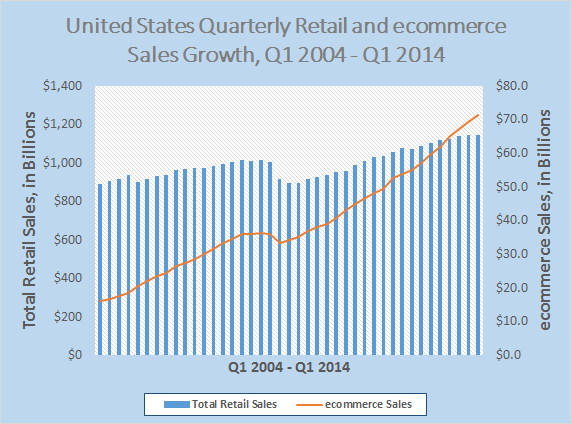
Web retailers’ skill at targeting customers and disruptive business model resulted in an estimated $71.2 billion in sales for Q1 2014, an increase of 2.4 percent over the previous year. Some argue that since traditional retail still makes up the lion’s share of total U.S. retail sales — ecommerce only made up 6.2 percent of the $1.14 trillion total U.S. retail sales in Q1 2014 —  traditional retailers have nothing to worry about. However, if we look back just a decade, we see that in Q1 2004, ecommerce sales were only at $16 billion — less than 2 percent of U.S. retail sales. Since that time, total ecommerce sales have shown steady, year-over-year growth; even after a hiccup in 2008, ecommerce sales have increased by over 300 percent in the last decade. Traditional retailers would be foolish to not make the move into ecommerce and become multi-channel retailers.

More Read

Silicon Valley: From Electronic Warfare to Big Data
Marketing Isn’t Dead – It’s Everywhere
Style your R charts like the Economist, Tableau … or XKCD
Optimizing Cost with DevOps on the Cloud
Virtual Softwares :Telecommuting 2

Chart Data from Census.gov

Multi-channel retailing traditionally resembled Sears, J.C. Penney, and other retail operations that utilized catalog-driven mail order and phone sales alongside traditional bricks-and-mortar stores. While the catalog and mail-order businesses aren’t dead, ecommerce and bricks-and-mortar retail are the new multi-channel retail model. Some savvy retailers have already begun to move heavily into ecommerce, as backed by numbers from the Wall Street Journal. Staples until just recently was the second largest U.S. online retailer, being knocked to #3 by Apple in Q1 2014. Walmart invested nearly $2.5 billion in capital expenditures for ecommerce in 2014 alone. In the Walmart 2014 Annual Report, currently available on Walmart.com, CFO Charles Holley said “we expect Global eCommerce gross merchandise value, which includes digital sales of Walmart goods and third-party sales through our sites, to exceed $13 billion.” That number could potentially knock Staples out of its third place spot on the list of online retailers with the largest sales; according to the Wall Street Journal, Staples ecommerce operations generated $10.4 billion in revenue in 2013. That same WSJ report has Walmart listed at $10 billion in ecommerce sales for the same period.  

Walmart has several strategies to grow their ecommerce operation. Their distribution system is already the model upon which others are built — including Amazon’s. They have already been leveraging their supply chain management system, built on collaborative, vendor-managed inventory, to secure their place as the largest retailer in the world. Sure, the “low, low prices” that Walmart advertises are partially because of foreign production facilities churning out low-cost product, but Walmart’s real genius was its network of distribution. Walmart operates 158 distribution hubs, which send and receive shipments carried by 6,500 Walmart trucks driven by over 7,000 people pulling 55,000 Walmart trailers. No Walmart store in the United States is more than 124 miles, one-way, from a Walmart distribution center. By employing a unified enterprise resource planning system, Walmart can give data on sales directly to manufacturers, who can plan their production accordingly, maximizing efficiency. Walmart is already making moves that leverage this infrastructure for the growth of its multi-channel retailing efforts. Other retailers, while they might not have Walmart’s size or distribution network, can take advantage of these disruptive business technologies to carve out their own multi-channel and ecommerce niche.

This article is part one of a two part series. Please check back next week for part two.

Photo Credit: benleto via Compfight cc

Share This Article
Facebook Pinterest LinkedIn
Share

Follow us on Facebook

Latest News

Flat editorial illustration: The article connects downstream report failures, data-quality gaps, and conflicting metric definitio
Signs Your Data Architecture Needs an Outside Review
Big Data Exclusive
Data-Driven Pultrusion: Best GFRP Rebar Machines & ROI
Big Data Exclusive
Flat editorial illustration: The article contrasts tools for gathering fresh interviews with tools for analyzing existing qualita
10 AI Market Research Tools That Turn Qualitative Data into Insights
Artificial Intelligence Big Data Exclusive
Flat editorial illustration: The article compares proxy MCP servers by what an AI agent can do through them: manage proxy account
Proxy MCP Servers: 7 Options and What Each Lets an AI Agent Do
Artificial Intelligence Big Data Data Collection

Stay Connected

1.2KFollowersLike
33.7KFollowersFollow
222FollowersPin

You Might also Like

How Comcast Xfinity Turns Big Data into Smart Data
Big Data

How Comcast Xfinity Turns Big Data into Smart Data

7 Min Read
Increased Demands for BI within Healthcare IT
Business IntelligenceData MiningData WarehousingPolicy and Governance

Increased Demands for BI within Healthcare IT

4 Min Read
Gartner's 2009Q1 Magic Quadrant for BI Platforms
Business IntelligenceData Warehousing

Gartner’s 2009Q1 Magic Quadrant for BI Platforms

5 Min Read
dreamstime l 199272931
Artificial IntelligenceExclusiveNews

Why the Best Accident Lawyers Are Using AI

12 Min Read

SmartData Collective is one of the largest & trusted community covering technical content about Big Data, BI, Cloud, Analytics, Artificial Intelligence, IoT & more.

ai chatbot
How AI Website Chatbots Improve Customer Support and Lead Generation
Chatbots Exclusive
5 Great Tips for Using Data Analytics for Website UX
Big Data

Quick Link

  • About
  • Contact
  • Privacy
Follow US
© 2008-26 SmartData Collective. All Rights Reserved.
Welcome Back!

Sign in to your account

Username or Email Address
Password

Lost your password?