 These days there are a variety of uses for big data solutions. Advertising companies use it to understand and target customers. Elite sports teams analyze player performance. In the financial world, traders analyze it to make money.
These days there are a variety of uses for big data solutions. Advertising companies use it to understand and target customers. Elite sports teams analyze player performance. In the financial world, traders analyze it to make money. While that’s all well and good, there are other ways big data is used that are, arguably, more important. Government agencies like the National Security Agency rely on analytics to stop terrorist plots before they happen. Scientific research centers like the CERN lab in Switzerland (home of the Large Hadron Collider) rely on it for experiments that help us understand how the universe works. And, perhaps most important of all, big data is now a tool for humanitarian aid and crisis response. Here are three ways that national organizations, regional institutions, and maybe even your local fire department are using big data.
1. Analyzing Surveillance Information
Although privacy is a significant consideration, it’s an issue that gets put on the back burner in crisis management when lives are at stake. Men and women who have to make the big decisions about when and where to send help need to know as much information as possible to make the best possible call. Inaccurate or limited information hampers crisis management. Thanks to modern technology they can instantly acquire and analyze information from satellites, sensors on aircrafts, social media, internet forum posts, UAVs, mobile phones, chats, GPS systems, images, and videos.
2. Mapping
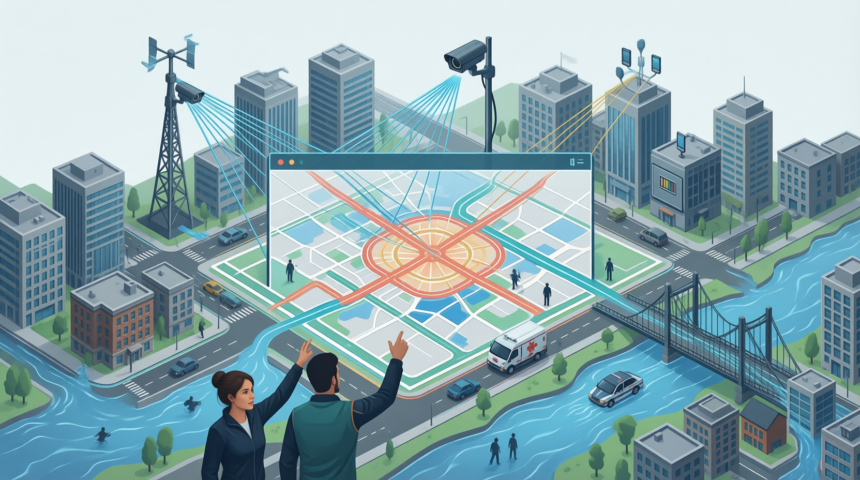
When Hurricane Sandy hit the coasts of New York and New Jersey, a grassroots coalition of high school students came together to create an online map showing people where gasoline was available. This is a simple example of a crisis map. Surveillance analysis leads rescue workers to the scene, crisis maps lead survivors to relief organizations and vice versa. When the 2010 earthquake in Haiti killed 100,000 people, the United States Marine Corps relied on a crowd-sourced map of the area to lead them to survivors and survivors to them. Firefighters who battle wildfires rely on big data to predict how a forest fire will behave. When they’re on the front lines and unable to see much more than smoke, being able to look at a real-time map can be the difference between life and death.
3. Reuniting Loved Ones
When there is a crisis, whether it’s a manmade one or Mother Nature, families and friends can get separated. During the aftermath of the earthquake in Nepal in April 2015, charities and disaster relief agencies used big data analysis to connect not just services but people. Internet icons such as Google and Facebook created their own systems, Google People Finder and Facebook’s Safety Check. People Finder gives live updates on the conditions and whereabouts of people. Safety check automatically sends messages to people who have reported their whereabouts to be in disaster zones. By extracting data from both computer and living sources, friends and family can be reunited or at least updated about each other’s condition.
The pursuit of using big data in crisis response is an international priority. In 2014 the United States National Science Foundation teamed up with the Japanese Science and Technology Agency to offer $2.0 million in funding to groups working on the problem. “We love to predict things — and we aren’t very good at it,” said statistician Nate Silver. We’re not psychic, and we’re not able to do thousands of calculations a second, which is why we rely on algorithms to extrapolate data for us. Using big data along with hyper converged infrastructure enables emergency workers and volunteers to know where, when, and how to react to save lives.