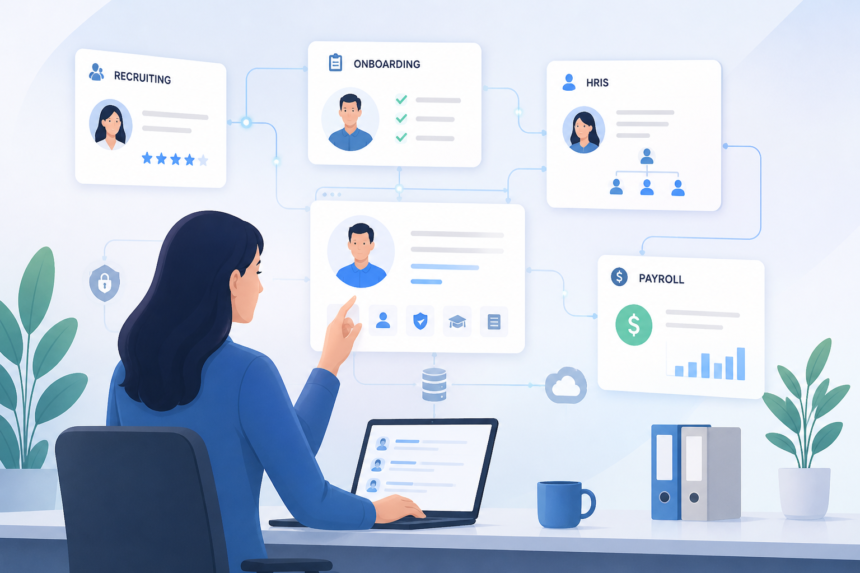
Employee data moves through several business systems before a new hire receives their first paycheck. Recruitment platforms and human resources information systems (HRIS) handle the initial intake. Timekeeping applications and payroll software then manage the actual compensation. When these systems operate independently, inconsistent records and manual data entry create expensive payroll errors. Fixing a single payroll error costs U.S. organizations an average of $339 in 2026, according to an Ernst & Young (EY) analysis commissioned by Paycom, and mistakes occur in roughly one out of every five payroll runs. Effective data management and thorough data analysis help your organization maintain accurate records, cut administrative rework, and give department heads reliable numbers.
Recruitment: Establishing Accurate Employee Records
The data management process begins when a candidate accepts a job offer. HR teams must verify legal names, Fair Labor Standards Act (FLSA) exempt or non-exempt classifications, and base pay rates. They also record specific tax work locations and start dates before the first day on the job.
Don’t enter these details separately into multiple applications. Instead, your team can establish a single central employee record within a unified HRIS such as Workday or BambooHR, using data-driven recruiting records to populate the initial profile automatically. Standardized data fields and validation rules prevent duplicate records and stop formatting mismatches—like a state tax code failing to sync because an applicant typed a full state name into a two-letter field.
Onboarding: Connecting HR and Payroll Systems
During onboarding, employees provide tax withholding forms, direct deposit routing numbers, and benefit elections required for HR processes and payroll processing. Secure application programming interface (API) integrations allow approved information to move between HR and payroll platforms without repeated manual entry. That matters immediately: the 2026 EY study found that failing to enter a new hire into payroll on time costs an employer $739 per employee, while an incorrect Form W-4 setup costs $628 to resolve.
More Read
Automation still requires clear data governance policies. Your organization must define which system is the authoritative source of truth for each field and restrict access to sensitive banking or tax files.
Businesses using technology consulting services or specialized data analytics consulting often audit their existing integrations to spot disconnected applications. These reviews catch unnecessary CSV file exports and API security gaps before an audit fails.
Timekeeping: Maintaining Reliable Data Transfers
Payroll accuracy depends on more than static employee profiles. Hourly wages and overtime multipliers must be captured accurately alongside paid leave balances and mid-week shift swaps.
Integrated timekeeping systems such as UKG or ADP Workforce Now transfer approved hours directly into payroll applications. Validation rules should flag missing clock-out punches, unapproved double-time entries, and mismatches between recorded shift differentials and an employee’s job code. Managers must review these exceptions before the payroll lock deadline rather than trusting automated batch transfers blindly.
Reporting: Turning Payroll Data Into Business Intelligence
Connected HR and payroll systems give executives the clean numbers required for workforce data analysis and financial planning. Business intelligence dashboards pull headcount and total labor costs straight from payroll runs. They also track overtime spend and voluntary turnover rates in one view. Yet according to HR.com’s State of People Analytics 2025-26 report, only 42% of HR professionals say their HR systems are well integrated for data analytics, and just 26% regularly combine HR records with non-HR finance data.
Executives often ask for predictive retention models before fixing their basic payroll feeds, yet you cannot trust workforce forecasts when your HRIS and timekeeping systems still disagree on active headcount.
Kayla Matthews, Tech-Influencer & Contributor at SmartData CollectiveWith clean data, your analysts can compare overtime spending across warehouse shifts or clinical units to spot chronic understaffing before burnout spikes. Historical payroll records also feed labor cost forecasting and annual zero-based budgeting. Getting that level of reporting takes standardized job definitions, reliable webhooks, and scheduled data quality checks.
Maintaining Data Quality Over Time
Employee records rarely sit still. Mid-cycle promotions and department transfers change pay rates, while retroactive compensation adjustments and sudden terminations can easily desynchronize separate databases if an update fails mid-sync. Each change must reach your general ledger and benefits carrier without creating conflicting records.
Organizations should maintain immutable audit trails, enforce multi-step approval workflows, and reconcile payroll registers against bank payout files every pay period. Partnering with experienced data strategy companies or setting up automated webhook monitoring can alert your IT team to a broken sync days before payday. Instead of waiting for an underpaid employee to complain on Friday morning, your team should audit the integration logs between your HRIS and payroll engine before the next pay cycle closes. Check out the infographic below for more information.