Hiring a dedicated development team is closer to building a long-term partnership than buying a service. The team you choose will shape your product, your codebase, and your delivery speed for a year or more, making stack fit and delivery-process fit the two core criteria this evaluation process is built to test. Switching partners midstream is possible, but expensive and disruptive.
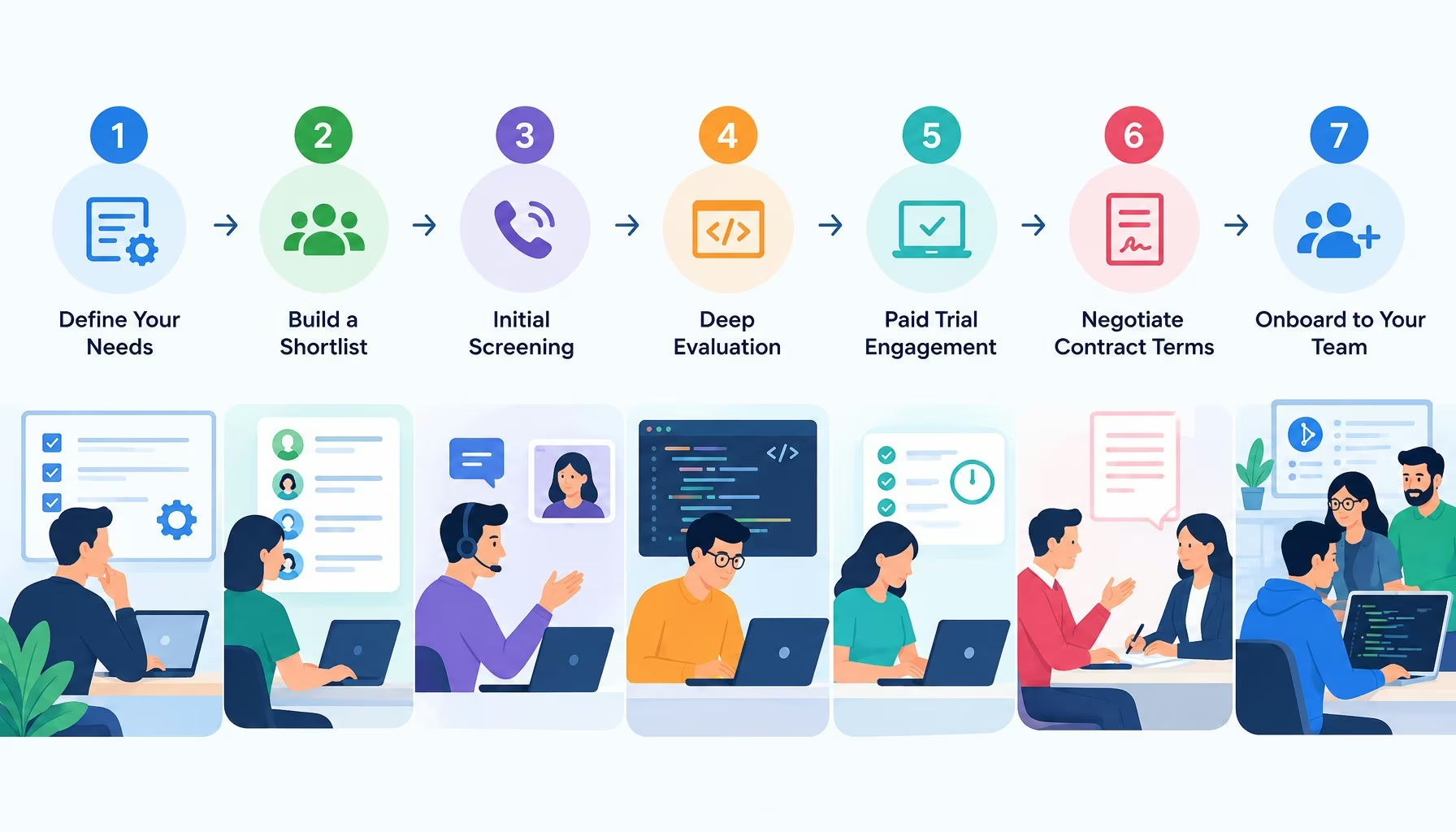
To hire a dedicated development team, follow seven sequential steps: define your technical needs, build a vendor shortlist, run initial screening calls, conduct a deep technical evaluation, execute a paid trial engagement, negotiate contract terms, and onboard engineers directly into your existing technology stack and delivery process.
Yet many companies approach the decision informally: a few calls, a couple of proposals, a gut feeling, and a contract. The result is often a mismatch that takes months to surface.
A structured process reduces that risk. Here’s a step-by-step approach to hire a dedicated development team that fits your product, your organization, and your goals.
The Process at a Glance
Across these seven stages, documenting your technical context in Step 1 sets the baseline for reviewing a candidate’s sprint planning, testing, and deployment process in Step 4, while structured seven-step hiring blueprints and dedicated team vetting guides emphasize testing real work before signing long-term commitments.
| Step | Goal | Typical Time (Illustrative Assumption) |
|---|---|---|
| 1. Define needs | Clarify what you’re building and what the team must cover | 1-2 weeks (illustrative) |
| 2. Build a shortlist | Identify vendors with relevant experience | 1-2 weeks (illustrative) |
| 3. Initial screening | Narrow to three or four serious candidates | 1-2 weeks (illustrative) |
| 4. Deep evaluation | Assess people, process, and technical quality | 2-3 weeks (illustrative) |
| 5. Trial engagement | Test the working relationship in practice | 2-6 weeks (illustrative) |
| 6. Contract | Lock in terms that protect both sides | 1-2 weeks (illustrative) |
| 7. Onboarding | Integrate the team and set up for success | 2-4 weeks (illustrative) |
Step 1: Define Your Needs
Before talking to vendors, document:
What you’re building. Product description, current state (new build or existing product), key users, and business goals.
Technical context. Existing technology stack, infrastructure, integrations, and any constraints.
Team requirements. Roles you need (backend, frontend, mobile, QA, DevOps, design, product management), seniority levels, and expected team size, including specialized dedicated developers for AI projects when your roadmap requires machine learning capabilities.
More Read

What you’ll provide. Will you supply product ownership and technical leadership, or do you need the vendor to provide them?
Working arrangements. Time zone overlap, language, communication tools, and meeting cadence.
Budget range. A realistic monthly budget helps vendors propose appropriate team compositions.
Clarity here makes every subsequent step faster and more accurate.
Step 2: Build a Shortlist
From a practitioner perspective, sources for candidates include referrals from peers, review platforms, industry communities, and vendors with relevant case studies. Look for:
- Experience with similar products or industries.
- Expertise in your technology stack.
- Experience with dedicated team engagements specifically, not just projects.
- Company size appropriate to your needs – large enough to staff and support the team, small enough that you matter to them.
As an illustrative working target, aim for eight to ten candidates at this stage.
Step 3: Initial Screening
Share a short brief and hold introductory calls. Evaluate:
- Quality of questions. Do they ask about your users, goals, and constraints, or jump straight to rates?
- Relevant experience. Can they describe similar engagements in specific terms?
- Communication. Are they clear, responsive, and easy to work with?
- Cultural fit. Do their working style and values align with yours?
As a practical assumption, narrow the list to three or four candidates.
Step 4: Deep Evaluation
This is where most of the real assessment happens, starting with direct questions about your technology stack, sprint workflow, and deployment practices.
Meet the proposed team. Interview the actual tech lead and key engineers, not just sales staff. Ask about past projects, technical decisions, and how they handle challenges.
Assess technical quality. Request code samples, architecture documentation, or a technical task. If you lack in-house expertise, involve an independent technical advisor.
Review delivery process. How do they plan sprints, estimate work, test, deploy, and report progress? Ask them to walk through a real engagement.
Check references. Speak with current and former clients of dedicated team engagements. Ask about team stability, communication, quality, and how problems were handled.
Understand team stability. Ask about employee retention, how replacements are handled, and how knowledge is preserved when someone leaves.
Step 5: Run a Trial Engagement
A short paid trial – a discovery phase or a small, well-defined piece of work, as outlined in Acqurio Tech’s step-by-step developer hiring guide and structured trial evaluation frameworks – is a practical way to reduce hiring risk. Over an illustrative period of a few weeks, you see:
- How the team communicates day to day.
- How they handle ambiguity and ask questions.
- The quality of their code and documentation.
- Whether estimates match reality.
If the trial goes well, you start the full engagement with confidence and context. If not, you’ve typically learned at limited cost.
To test brownfield delivery safely, scope the trial around a bounded change inside a non-production environment of your existing repository. Ask the candidate engineers to trace and explain the affected upstream and downstream dependencies before they write code. Require them to implement automated unit and integration tests, submit a reviewable pull request against your team’s branching standards, pass all existing continuous integration checks, and demonstrate deployment and rollback readiness. Clear acceptance criteria should verify whether the team respects your linter rules, test coverage thresholds, and peer-review feedback. Treat shortcuts such as bypassing failing test suites, committing unreviewed configuration changes, or proposing an unnecessary full-system rewrite instead of working within your current architecture as disqualifying signals.
Step 6: Negotiate the Contract
Key elements to address:
- Team composition: Roles, seniority, and named key members where possible.
- Replacement terms: How quickly departing members are replaced, and who covers ramp-up time.
- Intellectual property: Full ownership of code and work products by you.
- Scaling terms: How the team can be expanded or reduced, and with what notice.
- Performance expectations: Agreed metrics and review cadence.
- Knowledge management: Documentation standards throughout the engagement.
- Termination and transition: Notice periods and handover obligations.
- Security and confidentiality: Data handling, access controls, and compliance.
Step 7: Onboard the Team
A strong start pays off for the entire engagement:
- Give access to systems, tools, and documentation on day one.
- Introduce the team to key stakeholders and explain business context.
- Assign a product owner with the time and authority to make decisions.
- Start with well-defined work so the team can build momentum.
- Set up regular rituals: planning, standups, demos, retrospectives.
- Review progress and working relationships formally at an illustrative 30-day checkpoint, as highlighted in Upsilon’s founder guide to the first 30 days, and continue reviews at 90 days.
Common Mistakes
Choosing on rate alone. In practice, lower rates often point to less experience or higher turnover – two risks that can cost more over time.
Not meeting the actual team. The sales team won’t write your code.
Skipping the trial. Committing to a year based on presentations is a big leap.
Under-investing in onboarding. Teams without context make slow progress and wrong assumptions.
Treating the team as outsiders. Teams excluded from product discussions deliver less value.
Building a Long-Term Development Partnership
Hiring a dedicated development team well takes more effort than a quick vendor selection, and that upfront diligence pays back across the entire engagement. Define your technical needs clearly, evaluate people and delivery process instead of sales presentations, test the working relationship with a paid trial, protect your organization in the contract, and invest early in structured onboarding. Following these steps helps you establish a stable, capable dedicated team that aligns with your engineering standards and feels like an extension of your own organization.
Frequently Asked Questions
What are the main steps to hire a dedicated development team?
The main steps to hire a dedicated development team are seven sequential stages: define your technical needs, build a vendor shortlist, run initial screening calls, conduct a deep technical evaluation, execute a paid trial engagement, negotiate contract terms, and onboard engineers directly into your technology stack and delivery process. Following this structured process reduces hiring risk and helps evaluate candidates on technical and delivery fit.
Why should you run a paid trial before signing a long-term contract?
You should run a paid trial before signing a long-term contract because it is a practical way to reduce hiring risk by testing the working relationship in practice. The trial reveals day-to-day communication, how engineers handle ambiguity, code and documentation quality, and estimation accuracy. If the trial succeeds, you gain confidence and context, whereas a failed trial reveals mismatches at limited cost.
What key terms should be included in a dedicated team contract?
Key terms that should be included in a dedicated team contract cover team composition, replacement terms for departing members, full intellectual property ownership, scaling terms, agreed performance expectations, and knowledge management standards. The contract must also define termination and transition requirements, along with security and confidentiality provisions governing data handling, access controls, and compliance to protect both sides throughout the engagement.
What are the most common mistakes when hiring a dedicated development team?
The most common mistakes when hiring a dedicated development team are choosing on rate alone, not meeting the actual team, skipping the trial, under-investing in onboarding, and treating the team as outsiders. Lower rates often signal less experience or higher turnover. Furthermore, teams without proper onboarding context make slow progress, and engineers excluded from product discussions deliver less value.