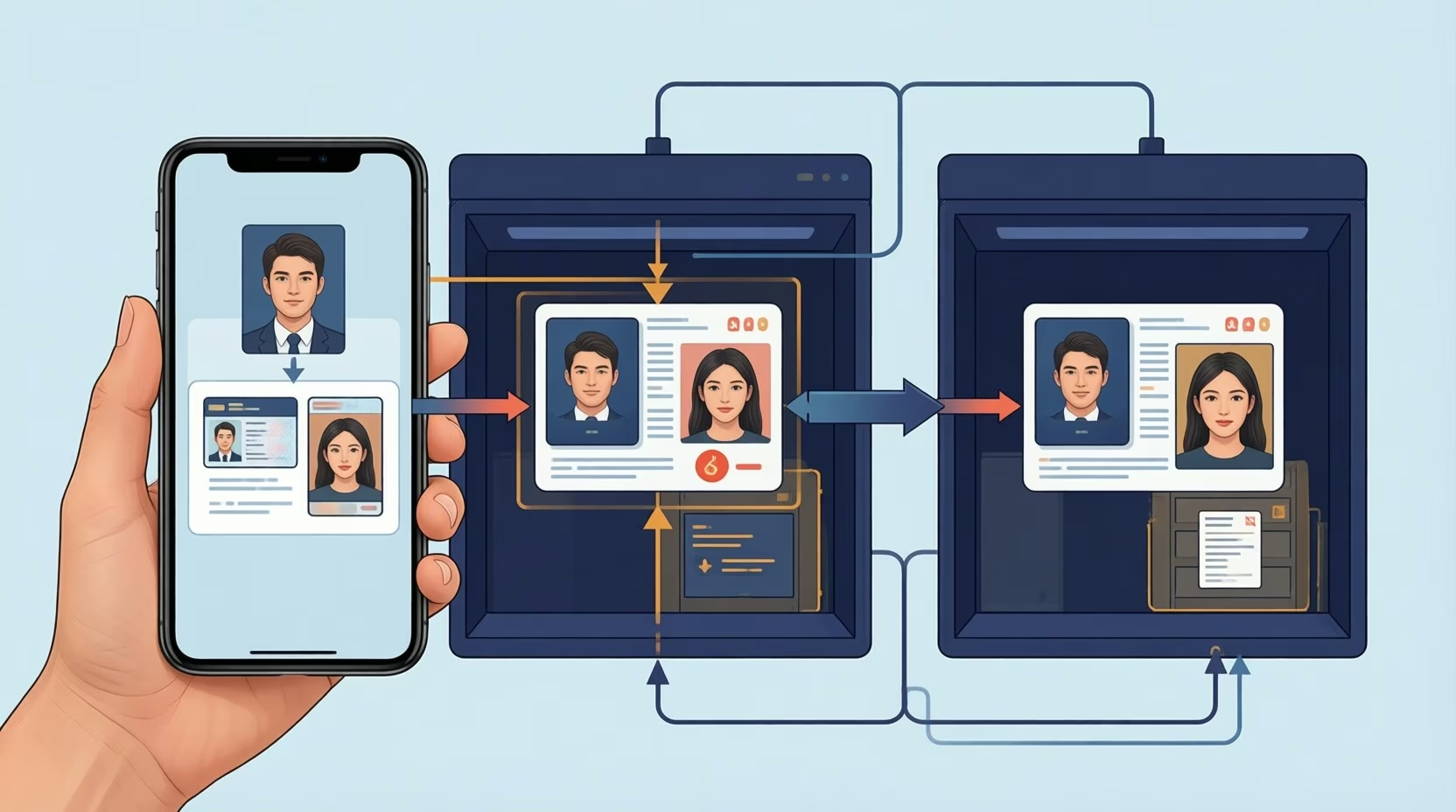
You take a picture of your passport. Then a quick selfie. You upload both, watch the little loading wheel spin for a second, and boom – your account gets approved. If you are a new customer in Indonesia, you probably figure identity checks are wrapped up right then and there. They aren’t. Behind your screen, those uploaded files split up almost immediately, heading off on very different paths.
- KYC verification in simple terms: one upload, several outputs
- Fintech identity verification: the selfie has a separate job
- When automation sends a file to a person during onboarding
- Who sees the file after the KYC process?
- KYC, storage, and access are separate concerns
- Why closing an account does not erase its history
- KYC verification: fintech teams perform beyond onboarding
- A worked example: tracing a hypothetical deletion request
- What a useful privacy response contains
- FAQ
- What is KYC all about?
- What happens if KYC is not done in bank?
- Where can I see my KYC details?
- What are the KYC requirements for a bank?
- Auditing Your KYC Data Custody and Retention Trails
After you upload an ID and selfie, your KYC data splits into separate records across multiple systems. Third-party verification vendors often store original document photos and biometric templates, while the financial institution receives extracted text, pass/fail scores, and background risk signals that remain governed by separate retention and deletion rules.
Key Takeaways
- KYC uploads can create separate copies across the financial firm, verification vendor, and support systems.
- Ask which legal entity controls each record, which vendors receive it, and where it is stored or accessed.
- Retention and transfers follow applicable legal triggers and separate cross-border safeguards for Indonesia.
So what happens to your KYC data after you upload an ID?
- Those original ID photos? Verification providers might hang onto them in their own remote databases.
- Extracted bio info and pass/fail risk scores usually get handed straight over to the financial company.
- Internal reviewer notes and system access logs can stay sitting around long after onboarding wraps up.
If you are asking “what happens to my KYC data?”, those separated files are where your answer lives. Who controls each copy turns out to matter just as much as who asked you to upload the documents in the first place.
You will see this exact setup across payment apps, online banking, and broker platforms like Versus Trade. What is written below outlines normal industry habits, not a secret diagram of how one specific company builds its servers.
KYC verification in simple terms: one upload, several outputs
Standard Know Your Customer rules exist so a financial institution can confirm who you are and check the risks of opening your account. Moving to digital onboarding pushes that whole check onto a phone screen. But the core need for solid proof? That never goes away.
Right as onboarding kicks off, software pulls key info – names, birth dates, document numbers – straight off the ID you uploaded. After that, automated document verification scans physical security markers to spot tampering, while database queries match your details against official registries. Take Indonesia’s national ID card, the e-KTP. It uses a unique NIK number. Checking that number against government files takes explicit legal authorization, so apps can’t just run wild searching public databases.
Different identity verification solutions deliver completely different payloads. Some vendors hand over raw photo files, extracted text, and raw risk signals. Others just send back a simple yes-or-no answer through an API. That green checkmark on your app screen barely tells you anything about what the receiving business keeps.
Fintech identity verification: the selfie has a separate job
Face matching runs your selfie right against the photo printed on your ID. Right alongside that, liveness detection makes sure there’s an actual, living person standing in front of the lens. Even so, passing those quick visual checks doesn’t mean your future account actions are automatically legit.
More Read

The broader biometric verification process usually creates sensitive biometric data, such as facial geometry metrics or digital templates. But generating those backend files doesn’t force a system to purge your original picture upload right away.
Relying on biometric checks won’t render a system immune to deepfakes either. Official NIST digital identity standards carefully separate basic physical presentation attacks from technical injection attacks (where someone feeds fake video directly into the stream). That is why effective KYC relies on layering multiple verification methods with broader fraud controls, because using liveness alone simply cannot stop every attack vector out there.
This operational distinction matters the second a user jumps from registration over to trading tools. Downloading a trading platform on your desktop only handles local chart access. The broker’s account-opening workflow operates entirely separately, deciding how your identity files get sent over. A software installation screen will never tell you where the broker stores your files.
When automation sends a file to a person during onboarding
A slightly blurry camera shot or an unexpected birth date can quickly pause what would have been a faster onboarding run. Modern verification platforms rely on automated document checks to grade uploads in real time. But when an outcome stays uncertain, the system routes the file straight into manual verification. When that happens, an authorized human reviewer opens up the photo, reads the extracted text, and checks why the system flagged it.
Getting flagged for human review doesn’t mean the team suspects actual identity fraud. Glare from camera flashes, typos, or unrecognized ID templates trigger manual reviews constantly. It helps to draw a clear line between an inconclusive automated check and real evidence of fraud.
- First, automated checks process the upload and output a result along with background indicators.
- Next, a human reviewer steps in to sort out exceptions within their specific permissions.
- Finally, the financial company decides to accept, reject, or request clearer photos based on their internal rules.
Who sees the file after the KYC process?
The brand name on your mobile app and the actual vendor inspecting your passport are often completely separate entities. A third-party KYC provider frequently handles technical checks on behalf of a financial company. The main financial business determines the purpose of processing, acting as the controller, while its contractor handles assigned checks as a processor.
That said, some software vendors explicitly claim separate rights as controllers for specific internal tasks, separating client-requested checks from internal system upgrades and fraud prevention work. Which policy applies, and what legal basis exists, changes what the vendor can actually do with your records. Outsourcing identity checks doesn’t instantly grant a vendor free rein to reuse your files.
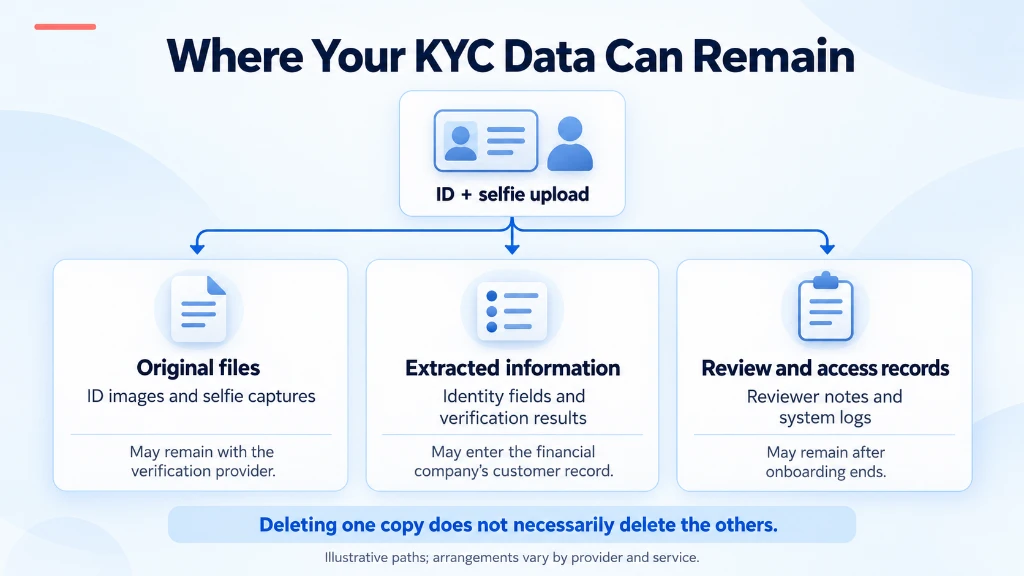
These operational setups show potential access pathways, but they don’t grant permission for unrestricted data sharing. Keeping tight KYC data privacy requires clear processing goals, strict permission boundaries, and enforced duties.
When a financial firm and its verification vendor manage records in separate databases, custody gaps appear quickly. A broker or payment app might purge a temporary image after thirty days while the third-party processor keeps its own copy under a different retention schedule. Duplicate records also build up when extracted text, manual reviewer notes, and webhook logs get copied into internal support queues without a synchronized audit trail. If the vendor processes uploads on servers overseas or routes manual reviews to analysts in another jurisdiction, cross-border transfer risks arise even if the primary financial account sits locally.
For users who are just learning trading basics, a broker app might be their very first financial product. Regardless, the official privacy notice still has to state the exact corporate entity handling their data.
KYC, storage, and access are separate concerns
A business might store your records on servers in one country while support agents or sub-processors view those files from across the globe. Data residency explains where physical hard drives sit, but it doesn’t give you a complete picture of international data transfers.
A traditional bank and a trendy new fintech app might hire the exact same vendor to verify identities. Yet, matching onboarding screens don’t imply identical KYC requirements and due diligence or equal rights to reuse your information. Digital KYC just describes how the process is delivered. The underlying verification process depends heavily on the service itself, statutory duties, and specific account configurations.
Background compliance checks also generate data you never typed into a web form. Technical device signatures or synthetic identity risk patterns often join your file during assessment. These generated metrics can shape future compliance reviews. Any privacy policy that only addresses your passport photo leaves those hidden risk files completely unexplained, even after the vendor deletes the original photo capture.
Indonesia’s Law No. 27 of 2022 on Personal Data Protection classifies biometric data as specific personal data. Article 56 sets a sequence for transfers outside Indonesia: the destination country must provide protection equivalent to or higher than Indonesia’s; if it does not, the controller must ensure adequate and binding protection; if neither condition is met, the transfer requires the data subject’s consent. This is not blanket permission to transfer biometric data, and other legal duties and financial-sector rules may also apply.
Technical security measures need to be just as specific:
- Encryption in transit locks down data while it flies back and forth across networks.
- Encryption at rest secures stored files on physical drives (assuming key security stays intact).
- Role-based access rules restrict who can open files, while audit logs track every single view.
Even top-tier encryption falls apart if someone steals an admin log-in that holds decryption rights. Plus, leaks don’t just happen in core databases. Think of exported CSV sheets or support tickets. These are sitting in external customer service software. That exact privacy dilemma is what SmartDataCollective coverage of privacy controls for outsourced customer service highlights: external helpdesk teams should only ever see info essential to their specific task, keeping sensitive user details hidden whenever full visibility isn’t mandatory.
Why closing an account does not erase its history
For financial services providers within the scope of Indonesia’s POJK No. 8/2023, Article 63 requires specified customer-identification and transaction records to be kept for at least five years from the end of the business relationship or completion of the transaction, as applicable. That is not a blanket five-year retention period for every copy of every selfie, biometric template, or vendor file.
The applicable starting point depends on the record and the rule: ending a business relationship and completing a transaction are distinct triggers. A suspicious-activity review may create separate recordkeeping duties, but it does not make every KYC copy subject to one identical retention clock.
Keep in mind that retention timing ties directly to those specific triggers. It definitely doesn’t mean a company wipes your record on a fixed schedule measured from your initial upload date. Also, just running a downloadable app doesn’t automatically place every firm under the exact same financial regulator. The contracting business, the actual service, and local regulators control what rules apply.
KYC verification: fintech teams perform beyond onboarding
Confirming a name during sign-up is only a tiny slice of Customer Due Diligence (CDD). As long as your account stays open, solid AML compliance requires non-stop efforts to catch money laundering – demanding ongoing risk monitoring, updated files, and investigating odd transaction patterns. Whenever high-risk profiles show up, compliance teams roll out enhanced due diligence (EDD) checks, demanding extra paperwork like tax forms or bank statements. Low-risk status might mean fewer checkups, but it never lets anyone skip baseline KYC obligations.
New activity creates new evidence
Automated sanctions screening catches potential name overlaps all the time, leaving compliance teams to sort them out manually. Still, during sanctions screening, sharing a name with someone on a watchlist doesn’t automatically make you a sanctioned individual. Because system lifecycle monitoring runs continuously in the background, new compliance notes can pop up months or years after your initial ID verification got approved.
A worked example: tracing a hypothetical deletion request
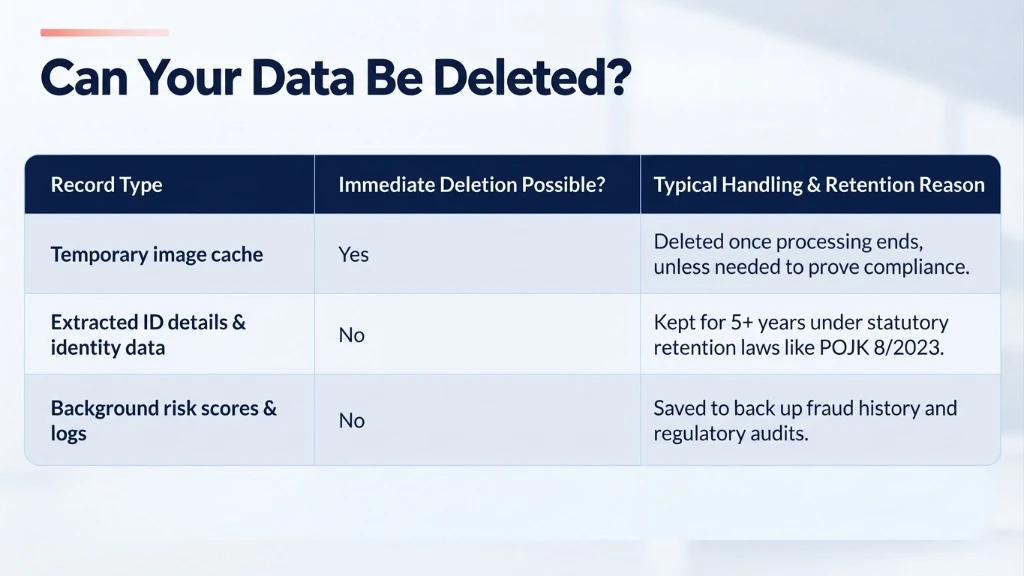
Imagine closing your account today and asking the business to delete every scrap of your data. The table below outlines how compliance teams handle different files in real life:
| KYC File Type | Typical Custodian | What Happens on a Deletion Request |
|---|---|---|
| Original ID photos and raw selfie uploads | Third-party KYC vendor or financial firm storage | Eligible for deletion once verification and quality audits finish, unless held under a specific compliance rule. |
| Extracted bio info (name, birth date, ID number) | Financial institution core database | Retained until statutory post-closure or post-transaction retention triggers expire. |
| Biometric templates and facial geometry metrics | Verification processor database | Treated as sensitive personal data; typically purged or isolated once liveness and face matching complete, depending on vendor controller claims. |
| Risk scores, device signals, and sanctions screening logs | Financial institution compliance and AML logs | Kept as audit evidence to demonstrate regulatory screening and ongoing due diligence history. |
Deleting a temporary photo snapshot is a completely different story from wiping a user’s entire identity data file. A vendor’s quick completion message won’t tell you if copies were already exported into secondary logs or internal tools. That said, mandatory legal compliance doesn’t give a business a free pass to hoard unrelated marketing files forever.
Reducing sensitive data exposure starts with knowing exactly how info flows through internal tools. Applying data minimization to identity checks means auditing every copy and keeping only what legal duties mandate.
What a useful privacy response contains
Fintech companies can easily explain their data handling without giving away secret fraud detection tools. A truly transparent privacy reply should outline:
- Which legal entity controls your data, plus direct privacy team contact info.
- Third-party vendors receiving files, processing reasons, and exact server countries.
- Active retention windows, legal justifications, and the specific event starting the clock.
- How to correct wrong entries or ask for file deletion when legally allowed.
Privacy laws often offer people the right to request deletion, but statutory record-keeping rules take precedence over general erasure requests. Dropping a deletion request won’t wipe mandatory compliance archives, so a clear privacy policy explicitly draws the line between evidence required by law and temporary files eligible for erasure.
Scammers actively exploit this exact confusion in targeted KYC scams, blasting out fake upload links under the guise of urgent account checks. Opening a firm’s official app directly or typing their domain into your browser address bar is infinitely safer than tapping an unverified link asking for your passport photo.
That approval badge on your screen only marks one past moment. The real test comes down the road: can the firm actually explain where your files ended up and why any left-over copy is still sitting in their database?
FAQ
What is KYC all about?
Know Your Customer (KYC) is the verification process where a financial institution confirms your identity and checks the risk of opening and maintaining your account. It covers initial document verification, biometric face and liveness checks, and ongoing monitoring for unusual transactions or watchlist matches.
What happens if KYC is not done in bank?
When KYC is incomplete or an uploaded image fails automated grading, onboarding pauses before account approval. The system routes uncertain files to an authorized human reviewer or asks you to submit clearer documents before granting account access.
Where can I see my KYC details?
You can request your stored KYC records directly from the financial company’s privacy team using the contact details in its privacy notice. A complete response identifies the controlling legal entity, third-party verification vendors, processing purposes, server locations, and active retention windows.
What are the KYC requirements for a bank?
Banks and fintech platforms typically require an official government ID document and a real-time selfie. Software extracts your name, birth date, and document number, checks security markers for tampering, matches your face to the ID photo, and screens your details against registries and watchlists.
Auditing Your KYC Data Custody and Retention Trails
Data governance breaks down when onboarding teams treat an API approval webhook as the end of the identity lifecycle. If your vendor stores raw passport captures on overseas servers while your internal database logs extracted text and support CSV exports, a user deletion request will leave orphaned copies behind. Map every table and third-party bucket that touches onboarding uploads, restrict helpdesk views with role-based permissions, and tie automated purge jobs directly to account closure and compliance retention triggers.