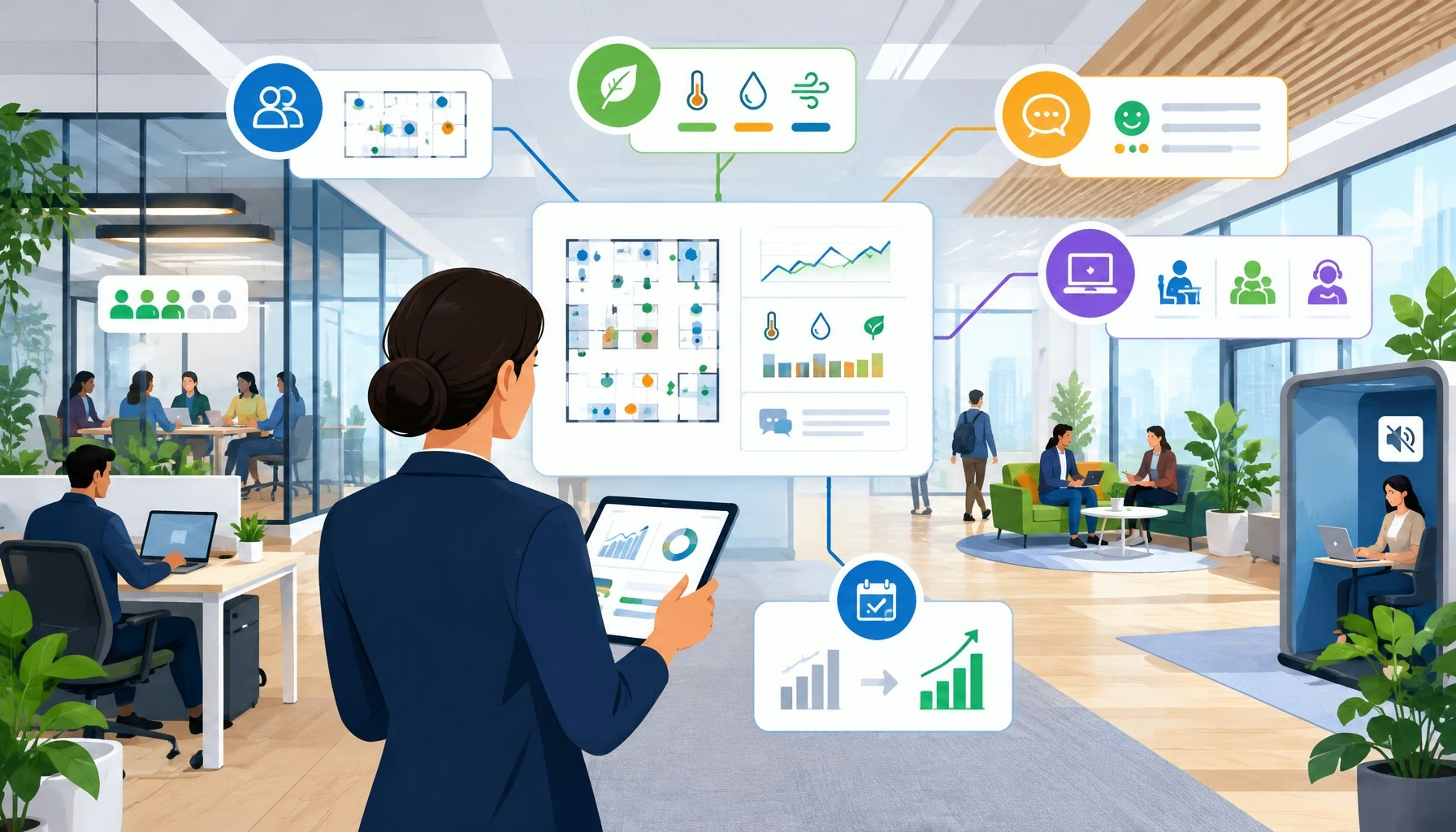
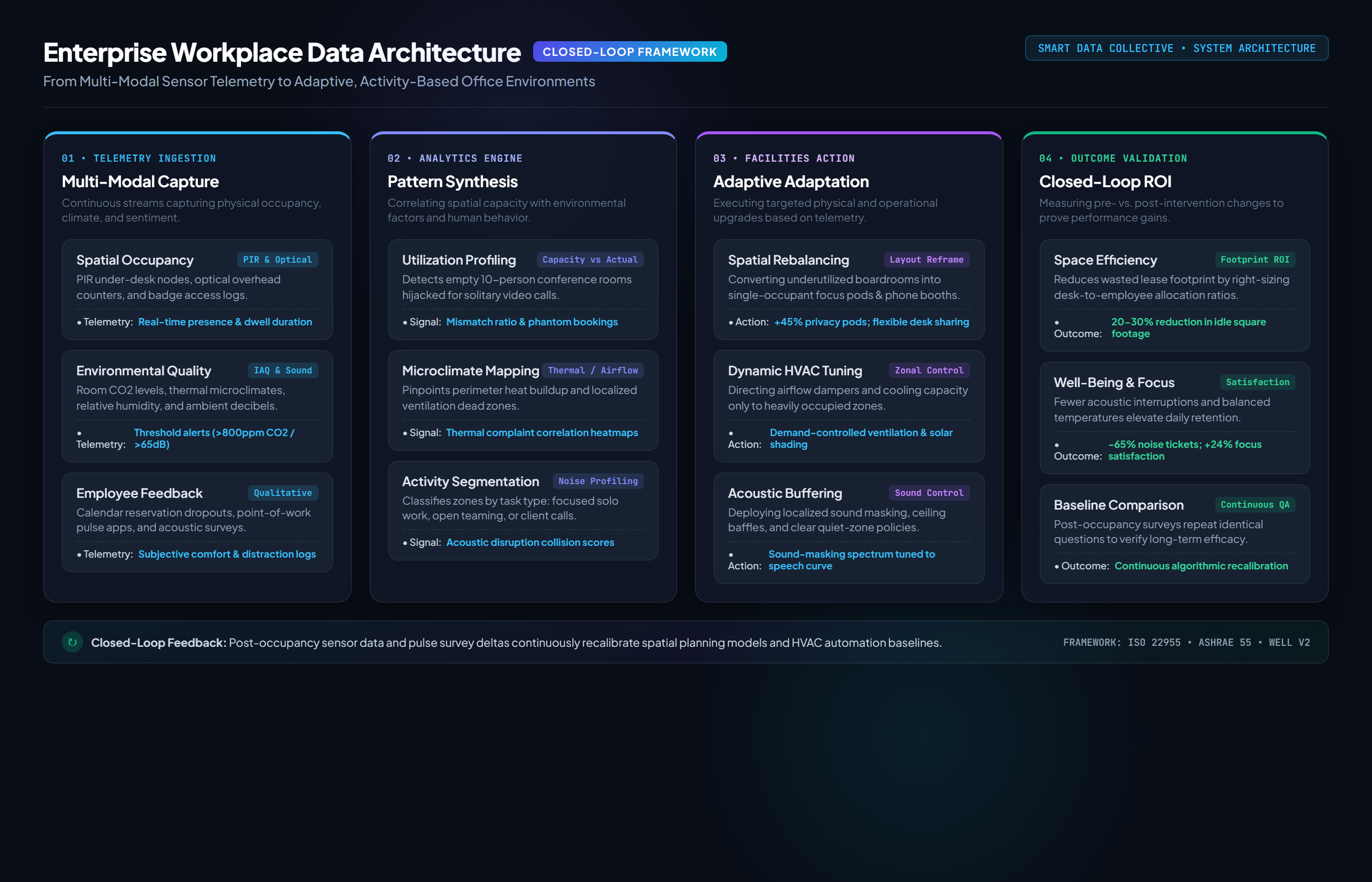
Businesses can use workplace data to identify crowded rooms, unused spaces, uncomfortable conditions, and noise problems. Combine occupancy information with environmental measurements and employee feedback to decide which changes address actual needs. Establish a baseline before changing the office, then repeat the measurements to see whether employees experience an improvement.
- Occupancy data reveals which spaces are underused and which face heavy demand.
- Environmental measurements help pinpoint temperature, lighting, and air-quality concerns.
- Employee feedback identifies problems with noise and the atmosphere in shared spaces.
- Booking patterns and surveys help match room types to employees’ activities.
- Baseline measurements and repeat assessments help establish whether changes work.
1. Understand How Employees Actually Use Office Space
Compare actual room use with reservations over the same working hours. Calculate room utilization as occupied room-hours divided by available room-hours. Record bookings separately: a full calendar can include reservations nobody used. Keep the room list and observation hours consistent when comparing results.
- 1. Understand How Employees Actually Use Office Space
- 2. Use Environmental Data to Improve Workplace Comfort
- 3. Use Employee Feedback to Improve Office Acoustics and Atmosphere
- 4. Use Workplace Analytics to Support Different Working Activities
- 5. Measure Whether Workplace Changes Are Making a Difference
- Turning Workplace Insights Into Better Employee Experiences
- FAQ
Occupancy sensors, desk booking systems, and meeting room reservations can reveal which areas are frequently used and which remain underutilized.
For example, a company might discover that its small meeting rooms are consistently booked throughout the week, while larger conference rooms sit empty for extended periods.
That pattern could suggest an opportunity to reconsider how meeting spaces are allocated, or whether larger rooms could be adapted to accommodate smaller groups.
Similarly, occupancy patterns might reveal that certain areas of an open-plan office see considerably more activity than others.
Businesses can use these insights to improve seating arrangements, create additional collaborative spaces, or introduce quieter areas for individual work.
Choose the least detailed data that answers the facilities question. Explain to employees what will be collected, who can access it and when it will be deleted. Group results by space where possible, restrict access to identifiable records, and avoid reporting small groups that could reveal individual behavior. Aggregation alone does not guarantee anonymity.
The objective should be to understand how physical spaces function as a whole, not to track individual employees at their desks. Clear communication also supports data-driven decision-making in the workplace.
More Read

2. Use Environmental Data to Improve Workplace Comfort
Temperature, lighting, ventilation, and air quality all contribute to how comfortable an office feels throughout the working day.
Connected building systems and environmental sensors can help businesses monitor these conditions and identify patterns that might otherwise go unnoticed.
Consider an office where employees regularly complain that certain meeting rooms become uncomfortable during afternoon meetings.
Temperature readings might reveal that rooms facing the afternoon sun experience significant heat buildup, while other parts of the building remain relatively cool.
Instead of adjusting the temperature across the entire office, facilities managers could investigate more targeted improvements, such as window shading, ventilation adjustments, or changes to heating and cooling schedules.
Lighting can be evaluated in a similar way. Measurements may reveal areas with insufficient illumination or excessive glare that interfere with screen-based work.
Environmental data becomes particularly valuable when combined with employee feedback.
A room might technically remain within acceptable temperature ranges, for example, while occupants consistently report discomfort. Reviewing both sources of information helps businesses understand problems that numerical measurements alone may not fully explain.
3. Use Employee Feedback to Improve Office Acoustics and Atmosphere
Noise is another important aspect of the office environment, although its impact can vary considerably depending on the work being performed.
An open-plan office may provide opportunities for informal conversations and collaboration, but the same environment can become distracting for employees carrying out tasks that require sustained concentration.
Ask employees the same questions about distraction before and after a change. Record which room, activity and time each sound measurement represents. A reading taken in an empty office cannot explain complaints during a busy meeting period.
Gensler’s 2026 Global Workplace Survey involved 16,459 full-time office workers across 16 countries. Approximately two-thirds reported adapting their workspaces to compensate for performance gaps. The survey was conducted between July and September 2025 among workers at organizations with at least 100 employees, so it is not a survey of small businesses specifically.
The research identified noise and meeting space availability among the workplace challenges employees continued to experience.
If employees regularly report difficulty concentrating because of nearby conversations, possible improvements might include acoustic panels, designated quiet areas, or greater separation between collaborative and individual workspaces.
Background music also deserves consideration, although it won’t be appropriate everywhere.
Reception areas, staff lounges, and informal communal spaces may benefit from a carefully selected soundtrack that creates a welcoming atmosphere. In contrast, spaces intended for concentrated work may be better suited to silence or minimal background noise.
Businesses introducing background music for offices can use scheduled music programming to maintain a consistent atmosphere in suitable areas throughout the working day.
Specialist providers such as SoundMachine offer commercially licensed music and scheduling capabilities that help organizations manage these environments without requiring employees to select music manually.
4. Use Workplace Analytics to Support Different Working Activities
Let the experiments proliferate, and let the people who are working in the spaces feel ownership over them
Ethan Bernstein, speaking to Harvard Gazette about his research with Ben Waber in Harvard Business Review.Modern offices are expected to accommodate a variety of activities, from individual concentration and virtual meetings to collaborative projects and informal conversations.
These activities don’t always require the same physical environment, though.
A documented example comes from Harvard’s account of GlaxoSmithKline’s office pilot. The company rotated teams through a pilot space and used measurements to refine its design. This illustrates a way to test configurations; the account does not establish that every business would obtain the same outcome.
For example, booking data may show that employees frequently reserve meeting rooms for individual video calls because there are insufficient quiet spaces elsewhere.
Check why people use meeting rooms for individual calls before buying more furniture. A shortage of quiet alternatives is one possibility; poor acoustics or unreliable equipment elsewhere may also need investigation.
Similarly, employee surveys might reveal that teams struggle to find suitable spaces for collaborative discussions, even when overall office occupancy is relatively low.
By comparing these findings with occupancy patterns, businesses can make more informed decisions about furniture arrangements, room configurations, and the allocation of shared spaces.
The analysis should also account for differences between departments and working schedules.
Employees whose roles involve frequent collaboration may have different requirements from those spending long periods on detailed individual tasks.
Businesses can use workplace data to provide a range of environments that employees can choose from according to their needs, without trying to make every part of an office suitable for every activity.
Comparing Workplace Data Collection Approaches
A busy booking calendar and an uncomfortable room describe different problems. Sensors, reservation records, and surveys give your team different evidence about the same office. YAROOMS’ workplace analytics overview identifies space utilization, office attendance, and employee satisfaction as relevant metrics. The comparison below separates the data each approach supplies from the deployment and privacy questions that depend on your implementation.
| Approach | Data type collected | Measure to record | Privacy sensitivity to assess | Best use case | Check before acting |
|---|---|---|---|---|---|
| Sensor-based | Occupancy and environmental readings | Occupied room-hours / available room-hours; room conditions during use | Are readings aggregated by space or linked to individuals? | Locating underused areas and uncomfortable room conditions | Check sensor coverage, timestamps and missing readings |
| Booking/software-based | Desk bookings and meeting room reservations | Booked room-hours / available room-hours; reservations with no check-in | Does the analysis require named reservation records? | Identifying demand for room types and shared spaces | A booking is not evidence that the room was occupied |
| Survey-based | Reported comfort, distractions, and space needs | Responses to the same comfort and distraction questions before and after | Are responses identifiable, and how will results be grouped? | Understanding discomfort and activity mismatches that readings do not explain | Compare response rates and attendance before interpreting a change |
The software category also extends beyond room reservations. Microsoft’s Workplace Analytics service description focuses on communication and collaboration trends. Microsoft Viva’s workplace analytics and employee feedback offering addresses employee sentiment and behavioral data. Those descriptions concern how people work and what they report; the room-temperature question still calls for environmental measurements.
5. Measure Whether Workplace Changes Are Making a Difference
For each trial, keep a short decision record: the problem, the baseline measure and observation period, the proposed change, the person responsible, and the date and method of follow-up. Choose the success measure before changing the space so that the result can be judged against the original objective.
For example, a company planning to improve office acoustics might begin by surveying employees about noise-related distractions, measuring sound levels in relevant areas, and recording how frequently quiet rooms are used.
After introducing acoustic panels or creating additional focus areas, the business could repeat those measurements and review whether employees report an improvement.
This approach can also be applied to lighting, temperature, room availability, and other environmental conditions.
Interpreting results requires care, however.
A reduction in noise complaints following an office redesign might reflect the improvements, but it could also be influenced by lower occupancy, changes to working arrangements, or quieter business periods.
Where practical, businesses can introduce changes in a limited number of areas before implementing them across an entire workplace.
Comparing similar spaces over the same period can provide a clearer indication of whether an adjustment is delivering the intended benefits.
It is also important to select measurements that reflect the purpose of the change. If the objective is to improve comfort, employee feedback may provide more meaningful information than attempting to measure changes in output or productivity.
Workplace improvements should therefore be treated as an ongoing process of collecting information, making adjustments, and reviewing results.
Turning Workplace Insights Into Better Employee Experiences
Workplace analytics can provide businesses with valuable information about how their offices function, but collecting data alone doesn’t create a better working environment.
The real benefit comes from understanding what that information reveals about employee needs and using it to make practical improvements.
Occupancy patterns can guide decisions about office layouts, environmental measurements can help identify uncomfortable conditions, and employee feedback can highlight issues that might otherwise remain overlooked.
Check that booking records, sensor readings and surveys refer to the same spaces and observation periods. Disconnected workplace systems can make those comparisons difficult.
An effective office doesn’t necessarily need the latest technology or the most elaborate design features. It needs to support the activities employees carry out while providing a comfortable and functional environment.
By regularly reviewing workplace conditions and involving staff in the review process, businesses can create physical workplaces that actively respond to how teams actually work instead of unverified architectural assumptions.
FAQ
How can businesses use workplace data to create better office environments?
Combine occupancy information, environmental measurements, and employee feedback to identify underused spaces, comfort problems, and mismatches between rooms and activities. Record conditions before making changes, then repeat the measurements afterward. Account for differences in attendance and working arrangements when interpreting the results.
What is workplace analytics and how does it improve office design?
In office design, the practice involves collecting and interpreting occupancy information, environmental readings, and employee feedback. These sources help businesses decide how to allocate rooms, adjust layouts, improve comfort, and provide spaces for different activities. For example, meeting rooms frequently booked for individual calls may indicate a shortage of enclosed focus areas.