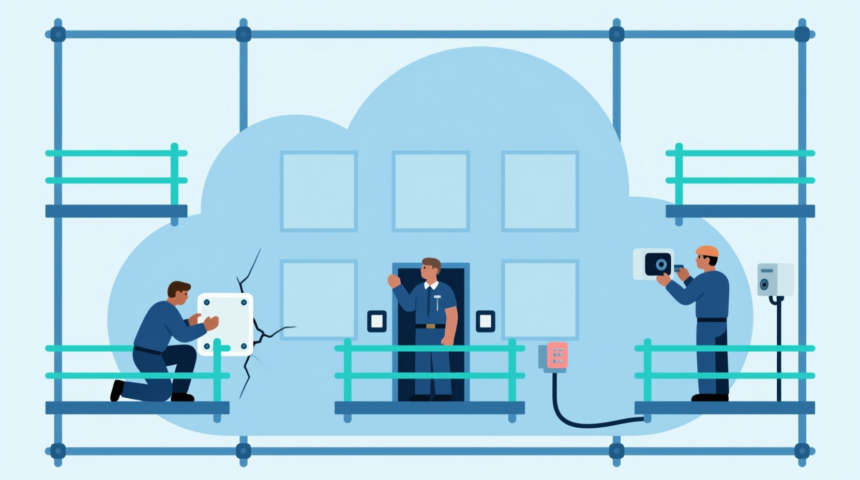
In recent years, cloud computing has gained increasing popularity and proved its effectiveness. There is no doubt that cloud services are changing the business environment. Small companies value the ability to store documents in the cloud and conveniently manage them. Large business players appreciate the opportunity to save money on the acquisition and maintenance of their own data storage infrastructure. The movement towards cloud technologies is perceived as an undoubtedly positive trend that facilitates all aspects of human interaction with information systems.
Despite the obvious benefits of cloud technologies, there is a set of problematic issues that pose a significant threat to cloud users, such as:
- The degree of trust to the cloud service provider;
- Ensuring confidentiality, integrity, relevance, and incontrovertibility of information at all levels;
- Loss of data control and data leaks;
- Protection against unauthorized access;
- Malicious insiders;
- Saving personal data of users transmitted and processed in the cloud.
Although cloud computing today is no longer a new technology, issues of ensuring data security represents a relevant point for users worldwide. Security concerns remain to be the main obstacle to the widespread adoption of cloud technologies. What are the main threats to cloud security today? How will they affect the industry? What measures are essential to keep your sensitive data confidential? Read on to figure it out!
Risks Associated with Cloud Computing
As you can guess, cloud computing servers have become a very attractive target for hackers. A virtual threat is associated with the possibility of remote penetration due to the vulnerable infrastructure. Cybercriminal groups often steal users’ data for the purposes of blackmailing and committing various frauds. As a rule, cybercriminals focus on small business networks because they are easier to breach. At the same time, the cases of data leakages among large corporation still take place. Fraudsters often go after larger companies because of the allure of larger payouts.
More Read

In November 2018, Marriott International announced that cyber thieves stole data on 500 million customers. The attackers’ targets were contact info, passport number, Starwood Preferred Guest numbers, travel information, credit card numbers and expiration dates of more than 100 million customers. Moreover, police officials have noted that the “human factor” was directly related to the problem. Employees did not follow all security rules, which made the system vulnerable to hacker attacks.
Security Threats
When a cloud service vendor supplies your business and stores your corporate data, you place your business in the partner’s hands. According to Risk Based Security research published in the 2019 MidYear QuickView Data Breach Report, during the first six months of 2019, there were more than 3,800 publicly disclosed breaches exposing 4.1 billion compromised records.
In case you entrust your data to the cloud provider, you should be confident about the reliability of the cloud server. Thus, it is essential to be aware of the existing risk to prevent disclosure of your sensitive information.
The cloud computing system can be exposed to several types of security threats, which can be divided into the following groups:
- Threats to the integrity;
- Threats to confidentiality;
- Accessibility risks;
- Authorization risks;
- Browser vulnerabilities.
Data Security
Nobody wants their personal information to be disclosed to the broad audience. However, according to Forbes research, unsecured Facebook databases leakages affected more than 419 million users.The principles of virtual technology pose potential threats to the information security of cloud computing associated with the use of shared data warehouses. When the data is transmitted from one VM to another, there is a risk of disclosure from a third party.
Threats Related to the Functioning of Virtual Machines
Virtual machines are dynamic. They are cloned and can move between physical servers. This variability affects the development of the integrity of the security system. However, vulnerabilities of the OS or applications in a virtual environment spread unchecked and often manifest after an arbitrary period of time (for example, when restoring from a backup). In a cloud computing environment, it is important to securely record the security status of the system, regardless of its location.
Vulnerability of Virtual Environment
Another major risk you may face is vulnerability within the virtual environment. Cloud computing servers and on-premises servers use the same OS and applications. For cloud systems, the risk of remote hacking or malware infection is high. An intrusion detection and prevention systems are installed to detect malicious activity at the virtual machine level, regardless of their location in the cloud.
Blurring of Network Perimeter
When you sign in your cloud, the network perimeter is blurred or disappears. This leads to the fact that the protection of the less secure part of the network determines the overall level of security. To distinguish between segments with different levels of trust in the cloud, virtual machines must be provided with protection by moving the network perimeter to the virtual machine itself. A corporate firewall is the main component for implementing IT security policies and delimiting network segments that will protect your business from undesired disclosure.
Attacks on Hypervisor
The hypervisor is one of the key elements of a virtual system. Its main function lies in the sharing of resources across virtual machines. An attack on a hypervisor can help one virtual machine (usually installed on the fraudsters’ side) to gain access to the memory and resources of another. To secure your data, it is recommended to use specialized products for virtual environments, integrate host servers with the Active Directory service, use high password complexity and expiration policies, standardize procedures for accessing host server management tools, and use the built-in virtualization host firewall. It is also possible to disable frequently unused services such as web access to the virtualization server.
Solutions to Decrease Cloud Computing Risks
Encryption
As you already know, most of the problems related to cloud technologies can be solved with the help of cryptographic information protection. Encryption is one of the most effective ways to protect data. The provider must encrypt the client’s information stored in the data center and also permanently delete it after it is removed from the server. Encryption makes users’ data useless for any person who does not have the keys to decrypt it. The owner of the encryption keys maintains data security and decides to whom, and to what degree their access should be provided.
Encrypted data is available after authentication only. This data cannot be read or changed, even in cases of access through untrusted nodes. Such technologies are well known, and algorithms and reliable protocols AES, TLS, IPsec have long been used by providers.
Authentication
Authentication is an approach to ensure data security. In simple terms, it can be defined as a reliable password protection method. Certification and tokens can also be used to gain a higher level of reliability. For instance, such protocols as LDAP (Lightweight Directory Access Protocol) and SAML (Security Assertion Markup Language) can ensure your sensitive data is stored securely on the cloud server.
Conclusion
In these times, data security is more important than ever. Be sure to enact key cloud security measures as we head into 2020.