Cookies help us display personalized product recommendations and ensure you have great shopping experience.

By using this site, you agree to the Privacy Policy and Terms of Use.
Accept
SmartData CollectiveSmartData Collective
  • Analytics
    AnalyticsShow More
    predictive analytics risk management
    How Predictive Analytics Is Redefining Risk Management Across Industries
    7 Min Read
    data analytics and gold trading
    Data Analytics and the New Era of Gold Trading
    9 Min Read
    composable analytics
    How Composable Analytics Unlocks Modular Agility for Data Teams
    9 Min Read
    data mining to find the right poly bag makers
    Using Data Analytics to Choose the Best Poly Mailer Bags
    12 Min Read
    data analytics for pharmacy trends
    How Data Analytics Is Tracking Trends in the Pharmacy Industry
    5 Min Read
  • Big Data
  • BI
  • Exclusive
  • IT
  • Marketing
  • Software
Search
© 2008-25 SmartData Collective. All Rights Reserved.
Reading: Is Hyper Converged Infrastructure Right For Your Organization
Share
Notification
Font ResizerAa
SmartData CollectiveSmartData Collective
Font ResizerAa
Search
  • About
  • Help
  • Privacy
Follow US
© 2008-23 SmartData Collective. All Rights Reserved.
SmartData Collective > IT > Is Hyper Converged Infrastructure Right For Your Organization
IT

Is Hyper Converged Infrastructure Right For Your Organization

Anand
Anand
5 Min Read
SHARE

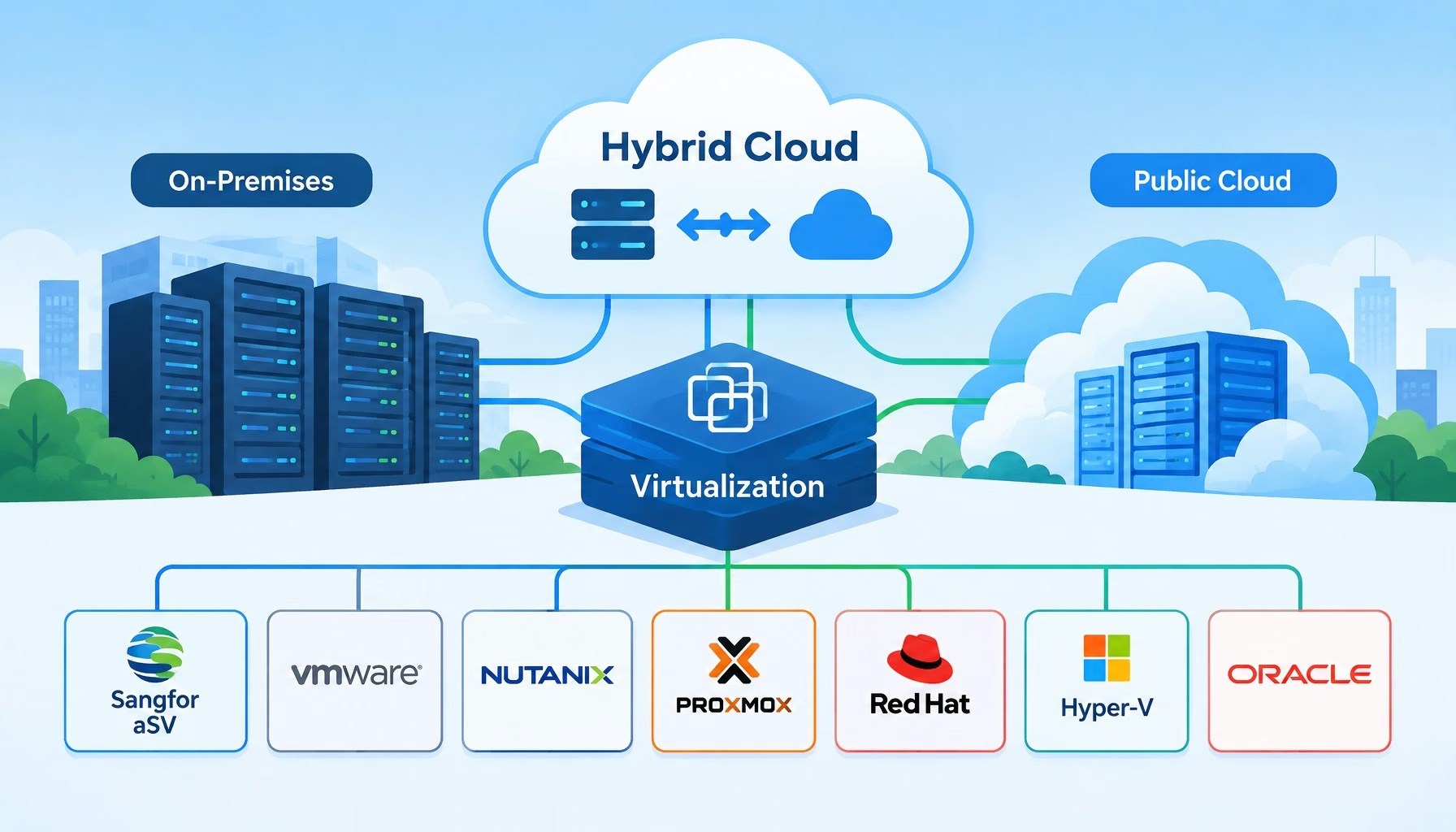
Back in the day, organizations built their IT infrastructure in distinct silos. This included separate entities for networking, storage, systems administration and software. Much of this has changed in the past few years thanks to virtualization. With tools like EMC’s VMWare, most of these silos don’t exist physically anymore but are instead virtual components that can be managed entirely through software applications.

Back in the day, organizations built their IT infrastructure in distinct silos. This included separate entities for networking, storage, systems administration and software. Much of this has changed in the past few years thanks to virtualization. With tools like EMC’s VMWare, most of these silos don’t exist physically anymore but are instead virtual components that can be managed entirely through software applications.

This has given to what has come to be known as converged infrastructure. Unlike the traditional systems that work in silos, converged infrastructure systems tend to centralize the resources into a single package that services networking, storage, servers, and software through shared resources. The objective is to reduce capital expenses incurred on cabling, cooling, power and floor space and instead increase utilization rate and thereby optimize the use of resources.

More Read

webinar marketing with cloud technology
Cloud Hosting Creates Better Sales Opportunities through Improved Webinar Platforms
The 4 Biggest Problems with Big Data
Absolutely Essential Cloud Security Practices For 2020
Yesterday’s Security vs Today’s Threats
Key Points from Microsoft Dynamics 365 Tech Conference

While converged infrastructure systems tend to pool in resources for better utilization, they are essentially hardware-driven. What this means is that converged systems are still independent components that are simply engineered to work well together. Users can still add or remove pieces of the components from a converged infrastructure and use them elsewhere, and this is where converged infrastructure differ from hyper-converged alternatives.

Hyper-converged infrastructure systems take the pooling of resources one level higher and work as modules with each module containing components to handle storage, networking and computing resources. The advantage of this design is to make it easy to scale up or down your requirements by adding or removing these modules. The biggest advantage over converged infrastructure is not resource optimization but a reduction in administrative costs and a smaller data footprint overall.

So what does this mean to an organization looking at deploying fresh storage or server platforms? Is a hyper-converged infrastructure system right for your organization or not? To answer these questions, it is first important to understand what your end objectives with the fresh deployment are. If you are looking for a system that is relatively cheap, quicker to deploy and is highly reliable, then the module-based hyper-converged systems are quite ideal for your requirements.

The issue arises with performance. The relatively high reliability of hyper-converged systems come from the massive series of tests that are conducted on these modules to ensure interoperation and integration. This approach tends to also increase the latency in operations which essentially brings down the performance. If you are seeking a platform to carry out your big data operations, the relatively high latency on hyper-converged systems can result in performance issues and may not be an ideal setup for your needs.

Hyper-converged systems, however, come with their own set of benefits and are much sought after today. One of the biggest reasons is that it does not require businesses to replace their existing infrastructure. The hyper-converged modules can easily sit beside existing systems and can work seamlessly with the active environment. It is hence very useful when you want to make a smooth, non-disruptive transformation to a modern infrastructure setup. Not just that, hyper-converged systems are extremely beneficial for organizations looking to deploy Virtual Desktop Infrastructure (VDI) systems or for managing their sites remotely through a unified management system. But most importantly, hyper-converged systems help remove the complexities around setting new environments and are best suited for enterprises looking to quickly build test environments for development or want to manage backup and recovery with minimal resources.

Share This Article
Facebook Pinterest LinkedIn
Share
ByAnand
Follow:
Anand Srinivasan is the founder of Hubbion, a suite of business apps. The Hubbion Project Management app was ranked among the top 20 in its category for 2017 by Capterra.

Follow us on Facebook

Latest News

street address database
Why Data-Driven Companies Rely on Accurate Street Address Databases
Big Data Exclusive
predictive analytics risk management
How Predictive Analytics Is Redefining Risk Management Across Industries
Analytics Exclusive Predictive Analytics
data analytics and gold trading
Data Analytics and the New Era of Gold Trading
Analytics Big Data Exclusive
student learning AI
Advanced Degrees Still Matter in an AI-Driven Job Market
Artificial Intelligence Exclusive

Stay Connected

1.2kFollowersLike
33.7kFollowersFollow
222FollowersPin

You Might also Like

Nine Components of a HIPAA Risk Analysis

5 Min Read
AnalyticsCloud ComputingKnowledge ManagementWorkforce Analytics

What Led to the Recent Huge Buzz Around Analytics?

4 Min Read
cybersecurity with AI and big data
Artificial IntelligenceBig DataInternet of ThingsSecurity

Tapping AI to Counter Rising Ransomware Threat in Big Data Era

9 Min Read
Image
AnalyticsBig DataBusiness IntelligenceData MiningDecision ManagementITMarketingPredictive AnalyticsSocial DataUnstructured DataWorkforce Data

Big Data Is Nothing Without Its Little Brother

4 Min Read

SmartData Collective is one of the largest & trusted community covering technical content about Big Data, BI, Cloud, Analytics, Artificial Intelligence, IoT & more.

data-driven web design
5 Great Tips for Using Data Analytics for Website UX
Big Data
giveaway chatbots
How To Get An Award Winning Giveaway Bot
Big Data Chatbots Exclusive

Quick Link

  • About
  • Contact
  • Privacy
Follow US
© 2008-25 SmartData Collective. All Rights Reserved.
Go to mobile version
Welcome Back!

Sign in to your account

Username or Email Address
Password

Lost your password?