We use cookies, including third-party cookies from Google to serve personalized ads through AdSense, to operate this site and understand how it is used. By continuing to browse, you accept this use. See our Privacy Policy and Terms of Use for details, including how to opt out of personalized advertising.
Accept
SmartData CollectiveSmartData Collective
  • Analytics
    AnalyticsShow More
    chatgpt image jul 21, 2026, 04 34 30 pm
    4 Core Benefits of Predictive Maintenance after Vibration Analysis
    10 Min Read
    How Does Data Mining Boost Customer Satisfaction in Logistics? Harnessing Analytics for Results -- AI-generated illustration
    How Does Data Mining Boost Customer Satisfaction in Logistics? Harnessing Analytics for Results
    11 Min Read
    chatgpt image jul 13, 2026, 04 23 45 pm
    How Data Analytics Helps Companies Improve User Engagement
    19 Min Read
    chatgpt image jul 13, 2026, 03 59 46 pm
    How Data Analytics Improves Multi-Location Search Strategies
    10 Min Read
    cybersecurity efforts
    How Behavioral Analytics and AI Are Redefining Cybersecurity for Boca Raton Businesses
    14 Min Read
  • Big Data
  • BI
  • Exclusive
  • IT
  • Marketing
  • Software
Search
© 2008-25 SmartData Collective. All Rights Reserved.
Reading: Rules-based innovation
Share
Notification
Font ResizerAa
SmartData CollectiveSmartData Collective
Font ResizerAa
Search
  • About
  • Help
  • Privacy
Follow US
© 2008-23 SmartData Collective. All Rights Reserved.
SmartData Collective > Uncategorized > Rules-based innovation
Uncategorized

Rules-based innovation

JamesTaylor
JamesTaylor
6 Min Read
Rules-based innovation
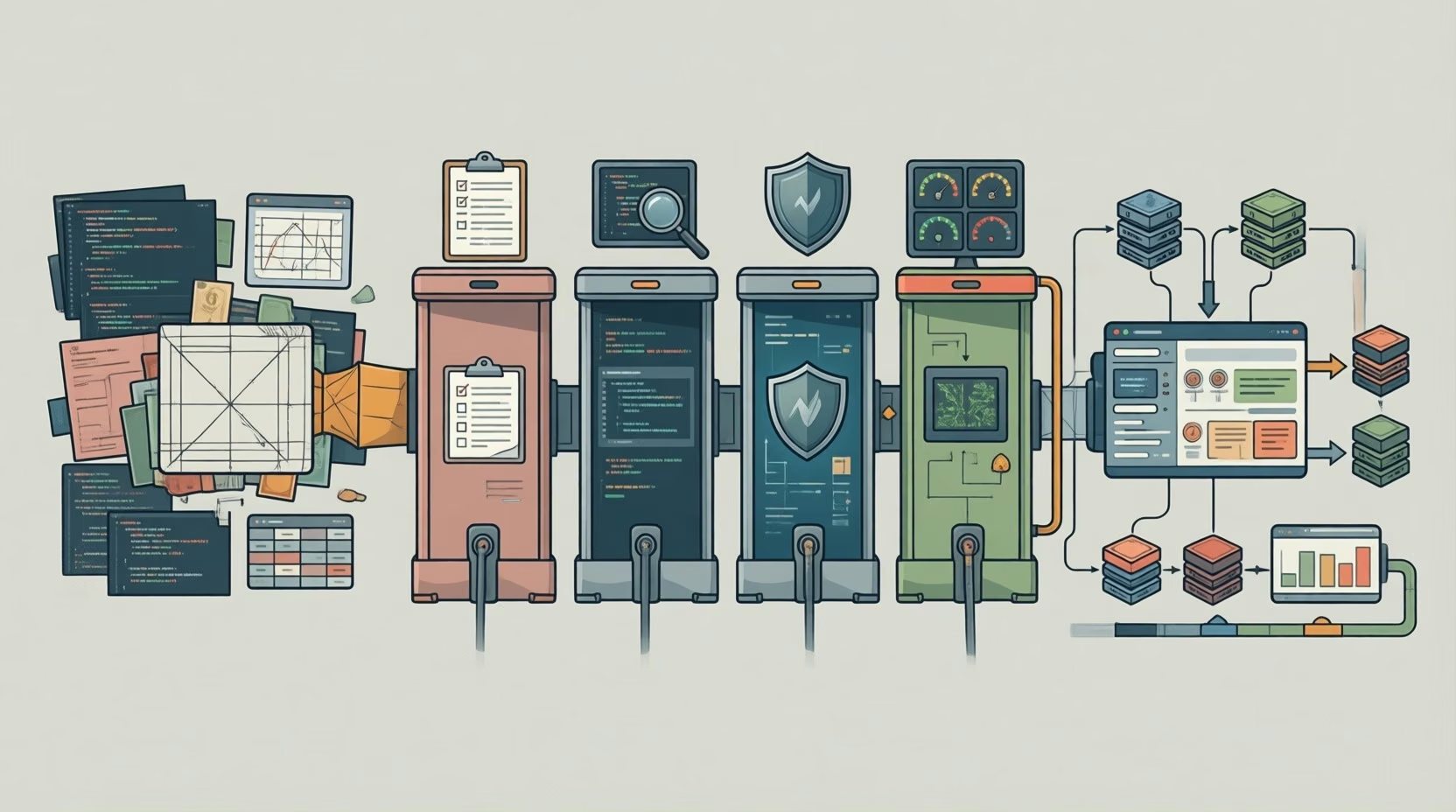
Illustration generated with FLUX.2 [klein 4B] via Cloudflare Workers AI.
SHARE

Copyright © 2009 James Taylor. Visit the original article at Rules-based innovation.

An old friend of mine, Anders Björlin, has just won a 2009 Humanitarian Impact award from The Itanium Solutions Alliance. The press release says:

Judges selected Kiwok of Sweden for its BodyKom(TM) Series remote ECG monitor. Deployed in conjunction with caregivers and health systems, BodyKom allows heart patients to live independently while their heart is monitored through a reliable wireless network powered by Itanium-based hardware. The Kiwok system provides automatic, real-time notifications as well as furnishing long-term data for diagnosis and treatment. Utilizing a Itanium-based server to ensure the heart monitoring information is reliable, secure and highly available at all times, Kiwok’s technology saves significant resources by freeing up hospital beds and providing immediate feedback on the effects of ongoing treatments.

Besides being Itanium-based, Kiwok’s system uses a business rules management system to make constant operational decisions – does the data coming from this heart monitor justify some kind of intervention. The rules are based on medical know-how as well as the specific understanding that a doctor has for his or her patient. Personalized, real-time decisions.

Previously, when a patient had heart problems, hospitals hooked up a device to a patient and took recordings for 24-48 hours. Then a doctor analyzed the recording. Unless the problem showed up during the recording you got no useful data. Anders, one of the founders, had a heart problem and went through this process 4 times before the doctor saw the problem. He could not understand why it was not possible to monitor someone constantly. As a result Kiwok built a solution for constant monitoring device and used rules to “watch” the information flow.

More Read

Connecting the Cyber-Threat Dots Through Big Data
Predictive Analytics Interview Series: Jack Levis of UPS
In Return for your Email ID
Corporate Restructuring is Hard – Transparency and Authenticity are Required
Quantum Encryption: Some economic and national security implications

The system uses standard hardware for monitoring heart activity, connects it using mobile phone technology to transmit the data to servers. This allows real time monitoring of the heart and uses GPS/GSM network to locate the person. However, each patient generates 25-28Mb of data a day and clearly it is no use having a doctor just watch a bunch of screens as they cannot effectively watch very many. To manage this they run rules created by the doctor and patient together – each case is unique and so needs their own rules. Doctors can set up alerts and new monitoring rules and patients can identify relatives and others to get alerts too. Personal information is not transmitted but managed within the hospital systems and combined with the heart information when it arrives.

They defined 21 standard templates for various kinds of rules like pulse limits in certain time windows or certain patterns of heart activity. This allows doctors to create rules easily for each patient (templates being one of the secrets of business user rule maintenance). The doctors can also define how much data they want to see when there is a incident and how they want to be notified etc. The system does not necessarily transmit data all the time – it might be triggered by particular activity or by a fall. Patients like the peace of mind of continuous monitoring, doctors like the custom monitoring and the healthcare system saves money. Personally I think this kind of intelligently monitored remote medical device is going to play a huge role in the future.

Congratulations to Anders and his team.
Share This Article
Facebook Pinterest LinkedIn
Share

Follow us on Facebook

Latest News

How Search Engine Indexing Lags Behind Large-Scale Website Domain Migrations -- AI-generated illustration
How Search Engine Indexing Lags Behind Large-Scale Website Domain Migrations
News
How Great Content Moves Through A Marketing Ecosystem -- AI-generated illustration
How Great Content Moves Through A Marketing Ecosystem
Exclusive Infographic Marketing
What Your Brand Misses That Data Reveals -- AI-generated illustration
What Your Brand Misses That Data Reveals
Big Data Exclusive Infographic
5 Common Mistakes Businesses Make During the Risk Assessment Process -- AI-generated illustration
5 Common Mistakes Businesses Make During the Risk Assessment Process
Business Intelligence Exclusive Risk Management

Stay Connected

1.2KFollowersLike
33.7KFollowersFollow
222FollowersPin

You Might also Like

Mobile Technology in Data Centers: After the Cloud, What Next?
Uncategorized

Mobile Technology in Data Centers: After the Cloud, What Next?

4 Min Read
Technical Debt and the Cost/Benefit of Knowledge Retention
Uncategorized

Technical Debt and the Cost/Benefit of Knowledge Retention

8 Min Read
New Momentum and the “Mafia of the Future”
Uncategorized

New Momentum and the “Mafia of the Future”

5 Min Read
A Recap of the 2009 DoDIIS Worldwide Conference
Uncategorized

A Recap of the 2009 DoDIIS Worldwide Conference

9 Min Read

SmartData Collective is one of the largest & trusted community covering technical content about Big Data, BI, Cloud, Analytics, Artificial Intelligence, IoT & more.

ai chatbot
How AI Website Chatbots Improve Customer Support and Lead Generation
Chatbots Exclusive
From Bolts to Bots: How AI Is Fortifying the Automotive Industry
Artificial Intelligence

Quick Link

  • About
  • Contact
  • Privacy
Follow US
© 2008-26 SmartData Collective. All Rights Reserved.
Welcome Back!

Sign in to your account

Username or Email Address
Password

Lost your password?