We use cookies, including third-party cookies from Google to serve personalized ads through AdSense, to operate this site and understand how it is used. By continuing to browse, you accept this use. See our Privacy Policy and Terms of Use for details, including how to opt out of personalized advertising.
Accept
SmartData CollectiveSmartData Collective
  • Analytics
    AnalyticsShow More
    chatgpt image jul 21, 2026, 04 34 30 pm
    4 Core Benefits of Predictive Maintenance after Vibration Analysis
    10 Min Read
    How Does Data Mining Boost Customer Satisfaction in Logistics? Harnessing Analytics for Results -- AI-generated illustration
    How Does Data Mining Boost Customer Satisfaction in Logistics? Harnessing Analytics for Results
    11 Min Read
    chatgpt image jul 13, 2026, 04 23 45 pm
    How Data Analytics Helps Companies Improve User Engagement
    19 Min Read
    chatgpt image jul 13, 2026, 03 59 46 pm
    How Data Analytics Improves Multi-Location Search Strategies
    10 Min Read
    cybersecurity efforts
    How Behavioral Analytics and AI Are Redefining Cybersecurity for Boca Raton Businesses
    14 Min Read
  • Big Data
  • BI
  • Exclusive
  • IT
  • Marketing
  • Software
Search
© 2008-25 SmartData Collective. All Rights Reserved.
Reading: 5 ways to reduce cost with predictive analytics
Share
Notification
Font ResizerAa
SmartData CollectiveSmartData Collective
Font ResizerAa
Search
  • About
  • Help
  • Privacy
Follow US
© 2008-23 SmartData Collective. All Rights Reserved.
SmartData Collective > Business Intelligence > CRM > 5 ways to reduce cost with predictive analytics
Business IntelligenceCRMData MiningPredictive Analytics

5 ways to reduce cost with predictive analytics

JamesTaylor
JamesTaylor
6 Min Read
5 ways to reduce cost with predictive analytics
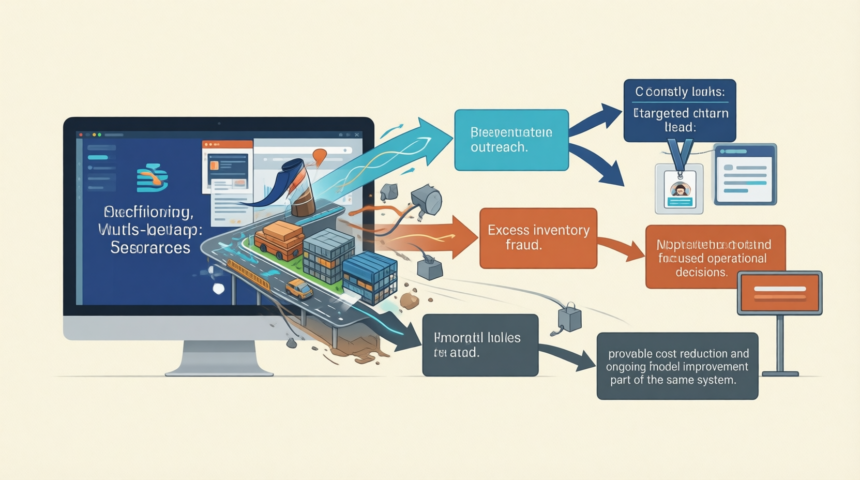
Illustration generated with Qwen Image.
SHARE

Copyright © 2009 James Taylor. Visit the original article at 5 ways to reduce cost with predictive analytics.

Syndicated from Smart Data Collective

I am blogging live from Predictive Analytics World on behalf of SmartData Collective. Hopefully there will also be some podcasts. First up is Eric Siegel, program chair and President of Prediction Impact for the event.

Eric defines predictive analytics as “business intelligence” technology that produces a predictive score for each customer or prospect. A predictive model uses the data you have to create a prediction – you learn from the collective experience your organization has. You can do this in strategic decisions, tactical decisions or in low individual impact but high volume operational decisions (as Neil and I discussed in Smart (Enough) Systems). Predictive analytics can help with response modeling, customer retention, recommendations, credit scoring, ad quality and more. And these solutions can be found in industries from banking to healthcare, consumer services to insurance and retail. The core predictive analytic techniques work consistently across these industries, making it possible to use what one industry learns in another.

More Read

IBM Brings Business Analytics to Apple iPad
Designed to be used
Self-Service Business Intelligence is Catching On — And Paying Off
Four Trends in Business Intelligence and Data Analytics
INSA Report: Cloud Computing: Risks, Benefits, and Mission Enhancement for the Intelligence Community

Everyone is focused on cutting costs without decreasing business. Eric identified 5 ways to do this along with associated cost cutting bullets:

  1. Response modeling
    Focusing on targeting or marketing to those likely to respond creates “lift” or better results by eliminating the cost of sending direct mail or calling those who are not likely to respond. You can target fewer customers and still get the same response.
    Don’t target those who won’t respond
    .
  2. Response uplift modeling
    But what about the people who responded but who would have responded anyway, even if you had not contacted them. This means having two prediction goals and is sometimes called net lift modeling or incremental modeling. The analytical method is to model on the residual. You model 4 conceptual segments – those who will respond whether you contact them or not, those who will buy if they get an offer, those who won’t buy anyway and those who will buy unless you contact them.
    Don’t contact those who would respond anyway.
  3. Churn modeling
    A customer saved is a customer earned. Much less expensive to keep or reactivate a customer than to find a new one. So find out who is likely to stay a customer and don’t spend money on them.
    Don’t waste expensive retention offers on those who will stay anyway
    .
  4. Churn uplift modeling
    Just like #2, uplift modeling can be used to improve churn modeling. In particular, there are people who will stay UNLESS they hear from you – making a retention offer will trigger them to think about their contract.
    Don’t trigger those who would otherwise stay
    .
  5. Risk modeling
    Don’t charge too little for high-risk applicants or give credit to someone likely to default. Personally I like the old saying “there’s no such thing as a bad risk, only a bad price”.
    Don’t acquire “loss customers

In fact Eric had more that 5 examples and went on to talk about scoring leads to focus sales resources, detecting fraud and preventing theft, avoiding hiring those who won’t stay and more. He also made the point that while all of these are ways to reduce costs, you can and should also focus predictive analytics on boosting revenue. And once you have deployed predictive analytics, any improvement in your model can make a further difference. For instance, creating an ensemble model using multiple techniques can boost results over a single technique.

Eric made a side point that keeping a control set is critical – keep treating some customers the old way. This helps prove the value you get from the model, helps you monitor the value over time and let’s you perform uplift modeling to improve results. Of these it is particularly important to prove the value, a sentiment with which I could not agree more. Experience is that unless you can prove the value of an analytic deployment it won’t, in the end, matter.


Next
Share This Article
Facebook Pinterest LinkedIn
Share

Follow us on Facebook

Latest News

Synthetic Data vs Real Web Data: Comparison, Limitations, and Collection Methods  -- AI-generated illustration
Synthetic Data vs Real Web Data: Comparison, Limitations, and Collection Methods 
Big Data Exclusive
Illustration of mobile analytics dashboards with ad performance charts connected to backend databases
11 Best Sisense Alternatives for Embedded Analytics
Business Intelligence Exclusive
Analyst points at colorful circular data dashboard on screen - information technology business metrics
How Fragmented Workplace Tech Undermines Reliable Business Metrics and Reporting
Cloud Computing Exclusive Infographic IT
Using Multi-Source Data and Analytics to Detect Operational Drift Across Franchise Networks -- AI-generated illustration
Using Multi-Source Data and Analytics to Detect Operational Drift Across Franchise Networks
Exclusive Infographic

Stay Connected

1.2KFollowersLike
33.7KFollowersFollow
222FollowersPin

You Might also Like

Fraud Prediction - Decision Trees & Support Vector Machines
CRMData MiningPredictive Analytics

Fraud Prediction – Decision Trees & Support Vector Machines

5 Min Read
Drowning in Data: New Research Reveals that Sales Reps are Struggling to Keep Up
Big DataCRM

Drowning in Data: New Research Reveals that Sales Reps are Struggling to Keep Up

0 Min Read
Zen and Mao
Business IntelligenceData QualityData Warehousing

Zen and Mao

4 Min Read
AI chatbots
Artificial IntelligenceExclusive

How AI Chatbots Are Revolutionizing IT Operations and Customer Service

6 Min Read

SmartData Collective is one of the largest & trusted community covering technical content about Big Data, BI, Cloud, Analytics, Artificial Intelligence, IoT & more.

ai chatbot
How AI Website Chatbots Improve Customer Support and Lead Generation
Chatbots Exclusive
From Bolts to Bots: How AI Is Fortifying the Automotive Industry
Artificial Intelligence

Quick Link

  • About
  • Contact
  • Privacy
Follow US
© 2008-26 SmartData Collective. All Rights Reserved.
Welcome Back!

Sign in to your account

Username or Email Address
Password

Lost your password?