Cookies help us display personalized product recommendations and ensure you have great shopping experience.

By using this site, you agree to the Privacy Policy and Terms of Use.
Accept
SmartData CollectiveSmartData Collective
  • Analytics
    AnalyticsShow More
    How Does Data Mining Boost Customer Satisfaction in Logistics? Harnessing Analytics for Results -- AI-generated illustration
    How Does Data Mining Boost Customer Satisfaction in Logistics? Harnessing Analytics for Results
    11 Min Read
    chatgpt image jul 13, 2026, 04 23 45 pm
    How Data Analytics Helps Companies Improve User Engagement
    19 Min Read
    chatgpt image jul 13, 2026, 03 59 46 pm
    How Data Analytics Improves Multi-Location Search Strategies
    10 Min Read
    cybersecurity efforts
    How Behavioral Analytics and AI Are Redefining Cybersecurity for Boca Raton Businesses
    14 Min Read
    data driven risk management in heatlhcare
    How Data Analytics Is Changing Healthcare Risk Management
    17 Min Read
  • Big Data
  • BI
  • Exclusive
  • IT
  • Marketing
  • Software
Search
© 2008-25 SmartData Collective. All Rights Reserved.
Reading: Is Your POS Plugged To The Cloud?
Share
Notification
Font ResizerAa
SmartData CollectiveSmartData Collective
Font ResizerAa
Search
  • About
  • Help
  • Privacy
Follow US
© 2008-23 SmartData Collective. All Rights Reserved.
SmartData Collective > IT > Cloud Computing > Is Your POS Plugged To The Cloud?
Cloud Computing

Is Your POS Plugged To The Cloud?

Anand
Anand
5 Min Read
SHARE

Point of saleIn my previous article, I talked about the need for retail point of sale systems to be integrated with big data solutions. As I explained in the article, such integrations help retailers understand customer movements, shopping behavior better and this can in turn help them optimize store layout as well as personalize the shopping experience for each of their customers.

Point of saleIn my previous article, I talked about the need for retail point of sale systems to be integrated with big data solutions. As I explained in the article, such integrations help retailers understand customer movements, shopping behavior better and this can in turn help them optimize store layout as well as personalize the shopping experience for each of their customers.

But before you can even get there, there is one challenge at hand for small retailers – scaling their business up sufficiently enough for big data to make sense. Big data is all about connecting millions or billions of data points to decipher patterns of user behavior. While big retailers with annual turnover in the billions stand to gain from this technology, the need of the hour for small retailers is to adopt technological tools that will help them scale. There are two ways of doing this.

More Read

5 Signs SOA Has Morphed Into Cloud
Has ‘cloud computing’ become a redundant phrase?
Cloud Technology Changes Role of Soft Skills in Nursing
Where the Fog Meets the Edge
A Mouse With His Head In The Clouds – Can Cloud Computing Help the Studios Help Themselves

Multi-Channel Approach: A lot of brick and mortar retail businesses are now partnering with online platforms like Amazon or Groupon to find a larger market for their products. In a lot of ways, this is a double-edged sword – retailers definitely get access to a larger market for their products. But these marketing channels come with their own set of challenges. Pricing in an online medium is much more cut-throat than what it is in a brick and mortar store. Consequently, the margins are much lower. This puts a strain on your relationship with a loyal offline customer who realize that they are getting a raw-deal. Lowering the price on your brick and mortar store is not really an option considering the real-estate and stock-holding costs that come associated with it.

Expanding Footprint: This is done by opening more retail stores to cater to neighborhoods you did not serve before. The challenges here are the exorbitant capital costs required to set up each of your new store.

In some cases, retailers that launched online have started opening brick and mortar stores to serve specific neighborhoods. In all these cases, there is one pertinent challenge – how does a retail owner scale up from handling transactions and supply chain for one retail location to serving multiple channels and handling the supply chain for each of these channels.

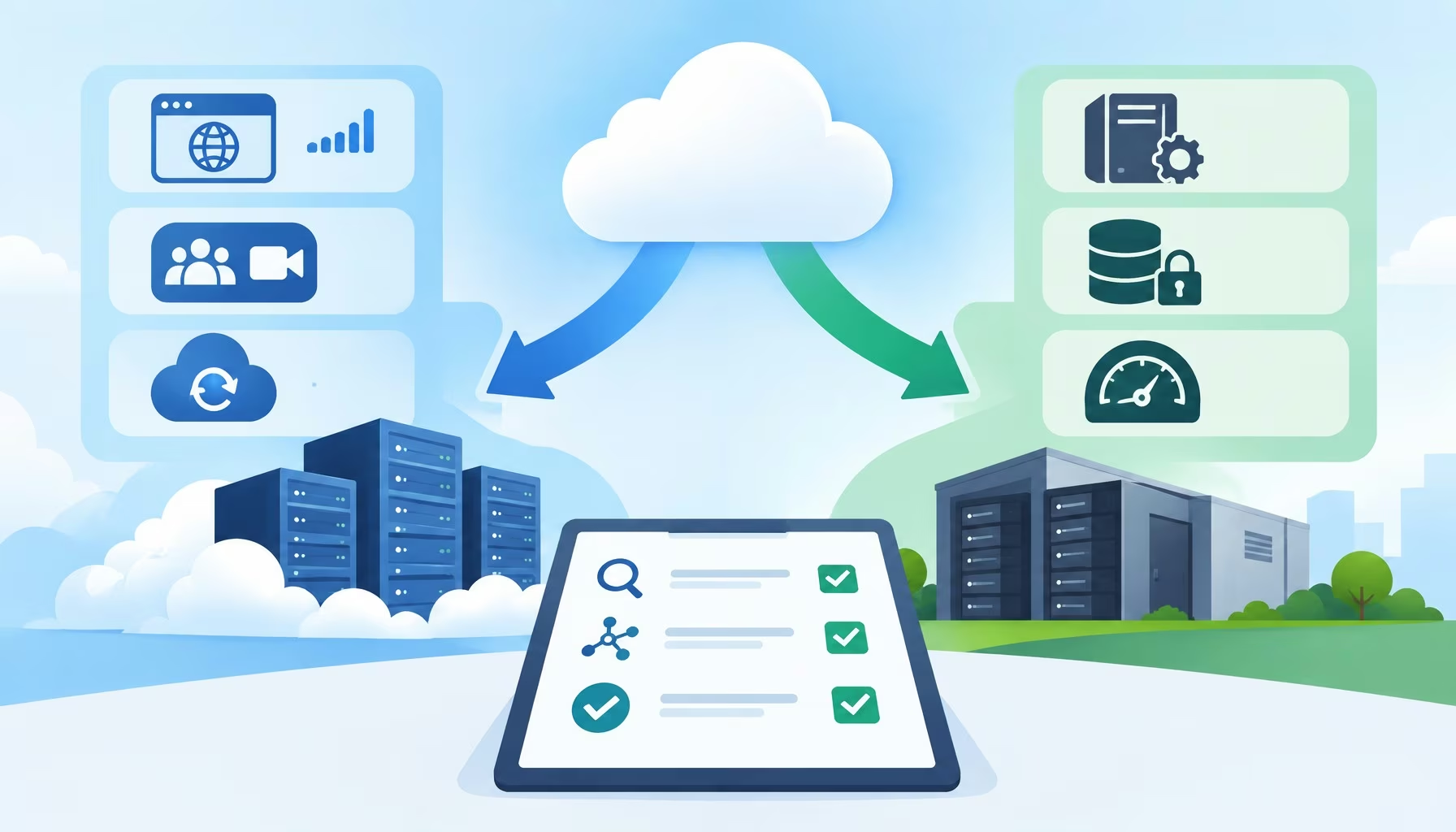
The answer to this is integrating the point-of-sale systems for each of these different channels to create a consolidated database that brings together the transaction details from all these different channels into one dashboard. Such a cloud-integrated POS system provides you with a host of valuable information like – customers who buy from you over more than one channel or store, what products are popular over various channels and the inventory demand across these various outlets. This helps you in devising a strategy that ensures your loyal customers across channels are incentivize to continue transacting with you irrespective of the channel, and in demand planning.

This is not the only benefit of integrating your multiple POS systems through a cloud. Such systems also make it possible for a retailer to accept payments more seamlessly. Cloud based tools work over any platform that is connected to the internet. This means you could as easily accept payments over your iPhone as you could from your POS hardware. For small businesses, this is less capital intensive and is hence a better strategy to scale up.

Big data is surely the future of retail POS. But cloud integration is the present. As a retail business owner, it is high time to plug your point of sale to the cloud in order to reap the rewards that such an integration would bring. What are your thoughts?

TAGGED:cloud computing
Share This Article
Facebook Pinterest LinkedIn
Share
ByAnand
Follow:
Anand Srinivasan is the founder of Hubbion, a suite of business apps. The Hubbion Project Management app was ranked among the top 20 in its category for 2017 by Capterra.

Follow us on Facebook

Latest News

What Is Fine Tuning AI Models And When Should You Actually Do It? -- AI-generated illustration
What Is Fine Tuning AI Models And When Should You Actually Do It?
Artificial Intelligence Exclusive
Industrial IoT (IIoT) Implementation: A Step-by-Step Guide for Manufacturers -- AI-generated illustration
Industrial IoT (IIoT) Implementation: A Step-by-Step Guide for Manufacturers
Exclusive
How Does Data Mining Boost Customer Satisfaction in Logistics? Harnessing Analytics for Results -- AI-generated illustration
How Does Data Mining Boost Customer Satisfaction in Logistics? Harnessing Analytics for Results
Analytics Big Data Exclusive Predictive Analytics
Top 20 Git Commands for Modern Development -- AI-generated illustration
Top 20 Git Commands for Modern Development
Exclusive

Stay Connected

1.2KFollowersLike
33.7KFollowersFollow
222FollowersPin

You Might also Like

Don’t SaaS me?

3 Min Read
cloud-based communication
Cloud Computing

Cloud Technology Can Reduce Employee Turnover by Improving Communication

9 Min Read
cloud computing
Cloud Computing

7 Common Challenges Companies Face While Migrating to the Cloud

5 Min Read

The 4 Advantages of Choosing a Cloud BI Provider

6 Min Read

SmartData Collective is one of the largest & trusted community covering technical content about Big Data, BI, Cloud, Analytics, Artificial Intelligence, IoT & more.

AI and chatbots
Chatbots and SEO: How Can Chatbots Improve Your SEO Ranking?
Artificial Intelligence Chatbots Exclusive
data-driven web design
5 Great Tips for Using Data Analytics for Website UX
Big Data

Quick Link

  • About
  • Contact
  • Privacy
Follow US
© 2008-26 SmartData Collective. All Rights Reserved.
Welcome Back!

Sign in to your account

Username or Email Address
Password

Lost your password?