
Bring privacy counsel in before any personal data hits an AI tool, and check back in whenever your use case shifts. Wait until a workflow turns routine, and you’ll end up untangling data deals and permissions you should’ve sorted out from day one.
- Before Personal Data Enters an AI Tool
- What to bring to your first privacy review
- During Vendor Selection
- When Existing Data Gets a New Purpose
- If AI Outputs Begin Shaping Decisions About People
- Ahead of Moving From a Trial to Routine Use
- After Material Changes or Suspected Data Exposure
- AI privacy review triggers at a glance
- Keep privacy reviews close to AI decisions
- Frequently asked questions
- What should a data team bring to its first AI privacy review?
- Does having a staff member review each AI score avoid automated-decision privacy rules?
- When does an AI project require a Data Protection Impact Assessment (DPIA)?
- If legal already approved an AI vendor, do we need another review for a new use case?
Show counsel what data you plan to use before you sign vendor terms or test with personal records. Return to legal before you reuse stored records for a new job, let AI outputs shape decisions about people, or move a pilot into routine operations. Changed vendor terms need a fresh look, and suspected data exposure needs an immediate call.
- Clear the data flow with legal before any test touches customer emails, employee records, or meeting transcripts.
- Audit AI vendor terms before signing, covering model training rights, retention windows, cross-border transfers, and subprocessors.
- Re-check legal approval before reusing old records for a new task, since vendor sign-off covers only the reviewed workflow.
- Involve counsel before AI outputs rank, score, or filter people, because UK and EU automated-decision rules require real human override authority.
- Test live access controls, prompt-history isolation, and DPIA thresholds before opening a small pilot to wider staff.
Teams use AI across daily work, scanning customer records, summarizing documents, or backing up staff calls. Knowing the right moment to loop in legal saves real headaches later.
Before Personal Data Enters an AI Tool
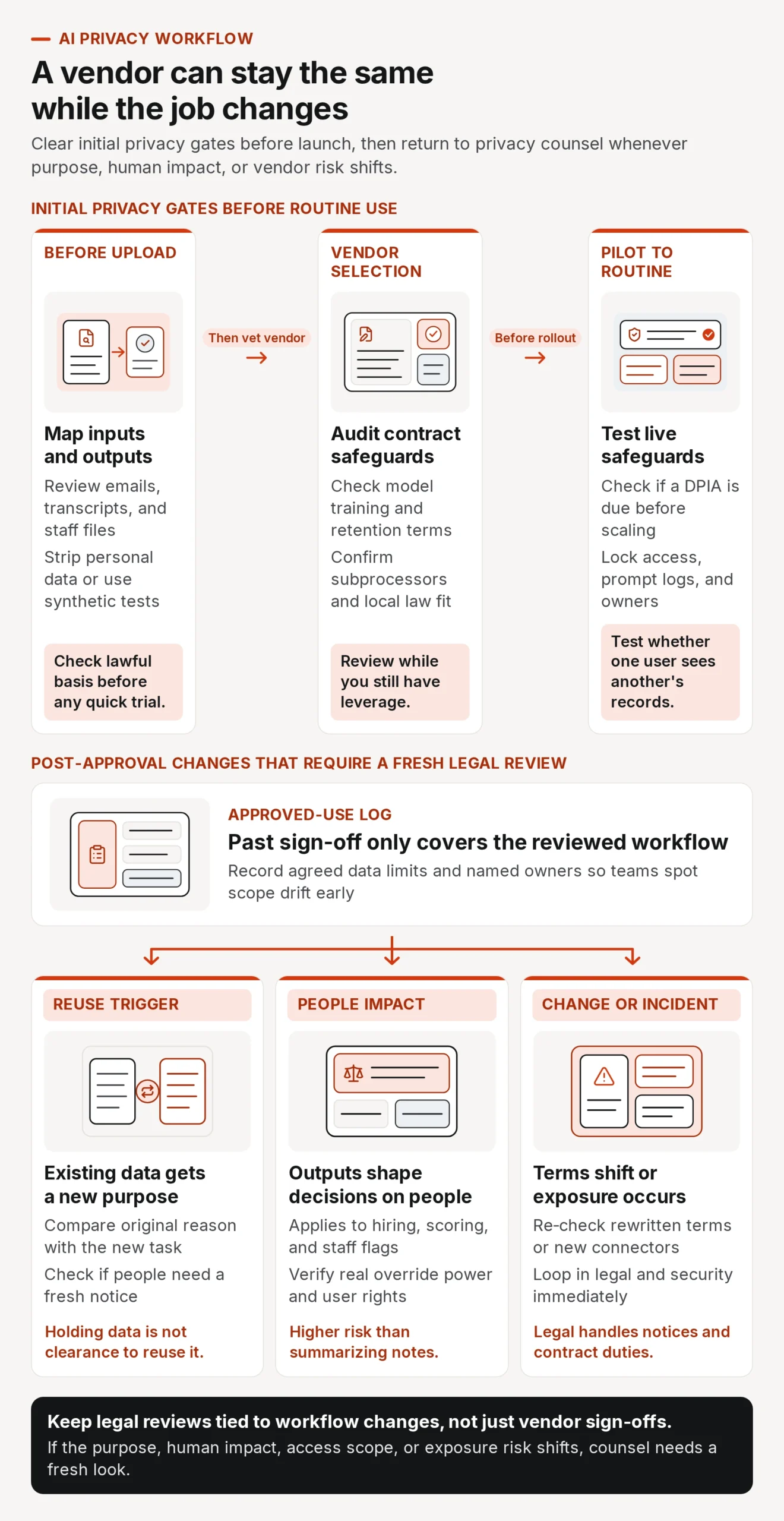
Loop in legal the moment your team maps out the information an AI workflow needs. Customer emails, staff records, and meeting transcripts all need a look before anyone uploads them, even for a quick test.
Counsel checks the lawful basis, purpose, and transparency rules for what you’re planning to run. From there, your team can strip out personal details, shrink the dataset, or swap in synthetic examples.
Skip the jargon and give counsel a plain breakdown of the job. Spell out what data goes in, what output you want, and who’ll see the results.
What to bring to your first privacy review
Privacy reviews slow down when legal has to guess how the system works. Before booking time with counsel, put five concrete facts on one page.
Start with the exact input fields and record sources, noting whether customer emails, staff details, or special category attributes such as health or financial data are included. Describe the output the model produces and list who will read or act on it. State whether data goes to an internal model or a third-party API, and flag whether the vendor retains prompts or trains on inputs. Finally, note how the team can locate, correct, or erase a person’s record if they submit a rights request.
That one-page summary lets counsel tell you in a single meeting whether you can proceed with stripped or synthetic data, whether you need a formal Data Protection Impact Assessment (DPIA) under GDPR Article 35 or UK GDPR, or whether vendor terms must change first.

During Vendor Selection
Have privacy counsel look over any AI vendor before your company signs its terms or runs a trial with personal data. Your vendor pick sets where data travels and what safeguards you can actually enforce.
Local rules carry weight when your work touches country-specific operations or covers people living in a specific place.
Instead of taking broad compliance claims at face value, a local legal expert checks regional rules directly against the vendor’s processing terms.
A UK-facing business, for instance, can bring in a London-based data privacy lawyer to vet data protection agreements, third-party privacy agreements, impact assessments, privacy notices, and more.
Get clear answers on a few core points: does the vendor train on your inputs, how long does it keep data, and which subprocessors get a copy? Sort those out while you’ve still got room to push back or walk away.
When Existing Data Gets a New Purpose
Check back with counsel before pointing old records at a new task. Data you gathered to close support tickets might look handy for AI-assisted customer profiling down the road.
Already holding the data doesn’t mean you’re clear to reuse it. Counsel can weigh whether the new task fits the original purpose, verify the lawful basis, and tell you if people need fresh notice about how their data’s being processed.
Keep that review tightly scoped to the change itself. Putting the original reason for collection side by side with the new use flags gaps a blanket tool sign-off will miss.
Write down the agreed limits. That stops another team from treating sign-off on one workflow as a blank check for everything else.
European regulators have also tightened rules on how personal data carries across model training and downstream deployment. In Opinion 28/2024, the European Data Protection Board clarified that AI models trained on personal data are not anonymous by default, and that unlawful processing during development can create legal risk when a model is later deployed.
If AI Outputs Begin Shaping Decisions About People
Bring counsel in the second AI stops organizing notes and starts shaping how people get treated. Ranking job applicants, flagging staff behavior, or scoring customer eligibility carries far more risk than summarizing a general business report.
Walk counsel through how staff act on the output and whether they can genuinely push back on it. Legal can spot automated-decision rules and guide you on transparency, human oversight, and individual rights.
Transparency and building individual rights straight into generative AI have been a clear focus for the Information Commissioner’s Office. For data teams, that means figuring out how to track down relevant records and handle user requests before the workflow locks into place.
In the UK, Section 80 of the Data (Use and Access) Act 2025 replaced UK GDPR Article 22 with Articles 22A to 22D from February 5, 2026. UK law allows solely automated significant decisions under wider lawful bases when mandatory safeguards are in place. Organisations must inform people when an automated decision happens, give them a way to challenge the outcome, and provide human review, with stricter limits whenever special category data is involved. Labeling a scoring tool as decision support does not clear that bar if human reviewers simply rubber-stamp the model output.
Ahead of Moving From a Trial to Routine Use
A small pilot runs under very different conditions than an everyday business process. Loop counsel back in before you open access to more staff or swap synthetic test data for real personal records.
Treat this check-in as a test of whether your safeguards actually hold up. Counsel can tell you if a data protection impact assessment is due and flag lingering risks you should fix before a wider rollout.
Privacy practitioners have run data protection impact assessments across enough organizations to see the same pattern: the ideal state looks great, but the inputs arrive so slowly that the assessment goes stale before it’s finished.
Michael Moore in From shadow IT to demonstrable DPIAs: Building visibility for modern privacy programsRun hands-on checks too, like testing whether one user can pull up someone else’s records or sensitive prompt histories.
Lock down access controls, retention rules, and who handles user requests. Everyday operations need named owners, just as organizations must verify the human behind an AI agent when automated workflows act at scale. Don’t assume somebody else will catch a problem.
After Material Changes or Suspected Data Exposure
Go back for a fresh legal look whenever a vendor rewrites key terms, a new integration pulls in data, or another team pitches a different use case. Past sign-off only covers what counsel actually reviewed.
Set clear review triggers so teams can tell small tweaks apart from shifts that need legal eyes. A short log of approved uses and guardrails makes those calls quick.
If you suspect data exposure, bring counsel in right away alongside security and incident-response teams. While technical colleagues trace what happened, legal can sort out notification duties, contract obligations, and communications.
AI privacy review triggers at a glance
| Project milestone or change | Legal check counsel runs | What the data team brings | Review gate |
|---|---|---|---|
| Before personal data enters a tool | Lawful basis, purpose fit, data minimization, and transparency notices | Input fields, sample schema, intended output, and audience list | Pause before upload, even for trials |
| Vendor selection and contract review | DPA terms, training opt-outs, data retention, subprocessors, and local rules | Vendor security docs, DPA draft, data residency needs, and API flow | Pause before signing or testing |
| New purpose for existing records | Purpose-limitation check (GDPR Art. 5(1)(b)), lawful basis, and fresh notices | Original collection notice side by side with the proposed new task | Scoped re-review before build |
| Outputs shaping decisions about people | Automated-decision safeguards (UK GDPR Arts. 22A to 22D; GDPR Art. 22) and user rights | Scoring workflow, human override rules, and appeal or request path | Mandatory pre-deployment sign-off |
| Pilot moving to routine use | DPIA requirement (GDPR or UK GDPR Art. 35), residual risks, and ownership | Pilot access-test results, prompt-history controls, retention settings, and owner names | Go-live gate before widening access |
| Vendor term change or suspected exposure | Contract gap check or breach notification duties, regulatory deadlines, and notices | Diff of updated terms, new integration map, or incident timeline from security | Immediate escalation |
Keep privacy reviews close to AI decisions
Say your team has approval to summarize support tickets, and a later proposal uses those same tickets in the same tool to score customers for eligibility. Pull up the approved-use log and show counsel where the score will go and what staff will do with it. Even if the vendor terms haven’t changed, the reason for using those records has, so agree on the limits of that use before staff start acting on the scores.
Privacy counsel does the most good when you’ve still got real choices over data, vendors, and daily workflows. Plan to check back in whenever your purpose, impact on people, access scope, or exposure risk shifts. At your next planning meeting, pin down the next call that needs legal input and name who’s setting up the review.
Frequently asked questions
What should a data team bring to its first AI privacy review?
Bring a plain one-page summary of the workflow before personal data enters the tool. List the exact input fields, where those records come from, what output the model will generate, who will see it, and whether a third-party vendor retains prompts or trains on inputs. That gives counsel enough detail to check lawful basis, purpose fit, and which personal fields can be stripped or replaced with synthetic examples during testing.
Does having a staff member review each AI score avoid automated-decision privacy rules?
No. Counsel still needs to check whether human review is genuine or a rubber stamp. Walk legal through whether the reviewer has the authority, context, and time to overturn the AI output, and show how an affected customer or applicant can contest the result or submit a data rights request.
When does an AI project require a Data Protection Impact Assessment (DPIA)?
Under GDPR and UK GDPR Article 35, a DPIA is required before processing that is likely to create high risk for individuals. In AI projects, that commonly applies when a team introduces new technology at scale, profiles customers or employees, processes special category data such as health or biometric records, or moves a pilot from synthetic test data to live personal records.
If legal already approved an AI vendor, do we need another review for a new use case?
Yes. Vendor approval covers the contract and the specific workflow counsel reviewed, not every future task. If your team has sign-off to summarize support tickets and later wants to feed those same tickets into the same tool to score customer eligibility, the purpose and risk to individuals have changed and require a fresh scoped review.