We use cookies, including third-party cookies from Google to serve personalized ads through AdSense, to operate this site and understand how it is used. By continuing to browse, you accept this use. See our Privacy Policy and Terms of Use for details, including how to opt out of personalized advertising.
Accept
SmartData CollectiveSmartData Collective
  • Analytics
    AnalyticsShow More
    chatgpt image jul 21, 2026, 04 34 30 pm
    4 Core Benefits of Predictive Maintenance after Vibration Analysis
    10 Min Read
    How Does Data Mining Boost Customer Satisfaction in Logistics? Harnessing Analytics for Results -- AI-generated illustration
    How Does Data Mining Boost Customer Satisfaction in Logistics? Harnessing Analytics for Results
    11 Min Read
    chatgpt image jul 13, 2026, 04 23 45 pm
    How Data Analytics Helps Companies Improve User Engagement
    19 Min Read
    chatgpt image jul 13, 2026, 03 59 46 pm
    How Data Analytics Improves Multi-Location Search Strategies
    10 Min Read
    cybersecurity efforts
    How Behavioral Analytics and AI Are Redefining Cybersecurity for Boca Raton Businesses
    14 Min Read
  • Big Data
  • BI
  • Exclusive
  • IT
  • Marketing
  • Software
Search
© 2008-25 SmartData Collective. All Rights Reserved.
Reading: Universal Decision Engine – How so?
Share
Notification
Font ResizerAa
SmartData CollectiveSmartData Collective
Font ResizerAa
Search
  • About
  • Help
  • Privacy
Follow US
© 2008-23 SmartData Collective. All Rights Reserved.
SmartData Collective > Business Intelligence > Decision Management > Universal Decision Engine – How so?
Business IntelligenceDecision Management

Universal Decision Engine – How so?

CMatignon
CMatignon
4 Min Read
Universal Decision Engine - How so?
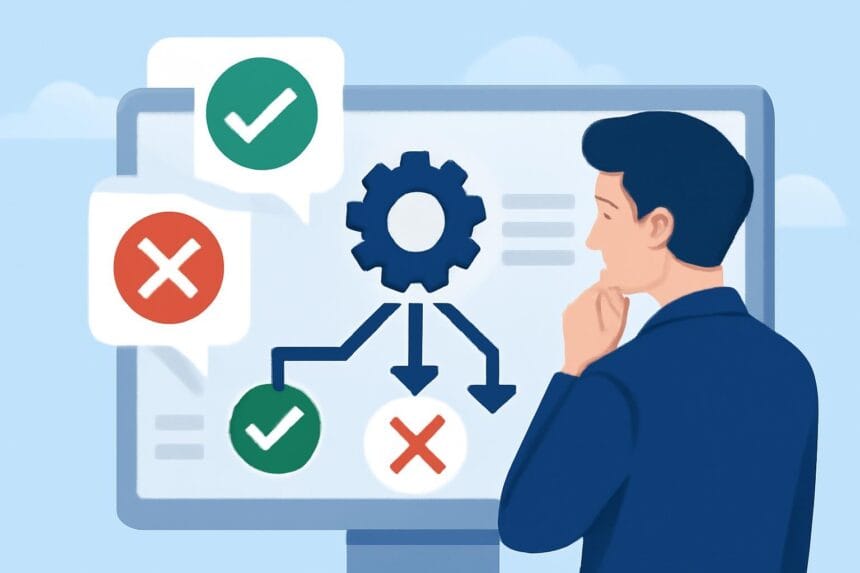
Illustrative image generated with OpenAI gpt-image-1.
SHARE

What a fabulous idea: having a centralized decision service!  For any checkpoint in the enterprise, you could hit a written-once decision service.  Beyond the maintenance savings, consistency is a Holy Grail that appeals to business owners.

What a fabulous idea: having a centralized decision service!  For any checkpoint in the enterprise, you could hit a written-once decision service.  Beyond the maintenance savings, consistency is a Holy Grail that appeals to business owners.

What is a centralized decision service?

As an oversimplification, we draw a box in the architecture blueprint: “decision service” or “decision engine”.  Et voila!

Architecture is rarely that simple though…  There are at least two components to consider and what is “universal” is not necessarily ‘universally understood’.

Centralized Management

This is clearly the main objective.

If Joe is codifying the new batch of regulations for 2013 in the order entry system, and Susan is repeating the same logic in the fulfillment process, and Tom is doing the same thing in the billing system, we end up with a lot of waste of time on one end, and higher odds of errors / inconsistencies.  Regardless of the systems that will consume the capture decision logic, the biggest savings are in the maintenance of this logic.  If we write it only once then we can free up Susan and Tom’s time, and remove any chances of inconsistency.  Or they might team up and do the work in a third of the time!

Decision management technologies are used to isolate the capture of the logic from the code that will execute in the end, allowing the business rules to be stored and managed in a centralized repository.  The team might be spread out all around the world, collaborating on the crafting of the decision logic, writing business rules and testing that the decision outcome matches expectations.

Centralized Deployment

This is a little more subtle.

We want the decision logic to execute in all those disparate systems: order entry, fulfillment process and billing system in our previous example.  And I saw many blueprints that drew a link from each one of those systems to an actual deployed decision service.  The links could have been loose bindings, but, more often than none, they were API calls in the J2EE fabric or .NET infrastructure.  Each system could get the same decisions made consistently by running the exact same piece of code for all of them.
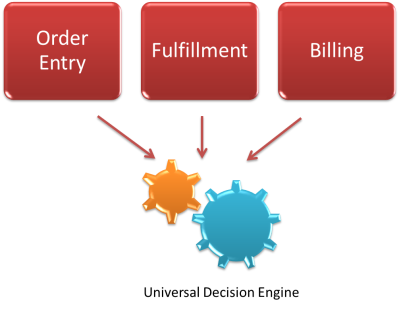
Universal Decision Engine

In reality though, it is rare that businesses can afford to re-engineer all of your systems to fit in the same architecture.  Beautiful greenfield project…  But rare.

So how do businesses take advantage of centralized decisions?  They simply deploy the rules in the mode that is the most appropriate for the consuming applications.  It might mean that the same rules end up in different execution components.  Maybe your order entry is J2EE-based but your billing system is .NET.  Getting your inter-compatibility right may be more headache than you have appetite for.  The main driver is often performance: in order for your systems to run efficiently, you might need to balance the execution in local modules.  They may be part of the fabric, and load-balanced by your infrastructure, or not.
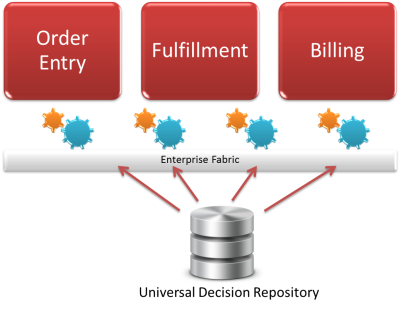
Universal Decision Repository

A little irony

This is where it gets odd.  In our terminology, we think and we speak of a centralized decision service, which is technically a deployment thing…  but we really mean a management thing…

 
Share This Article
Facebook Pinterest LinkedIn
Share

Follow us on Facebook

Latest News

How Local Service Businesses Can Map Which Neighborhoods Generate the Most Revenue -- AI-generated illustration
How Local Service Businesses Can Map Which Neighborhoods Generate the Most Revenue
Business Intelligence
Best VMware Alternatives in Thailand for Private Cloud and HCI Deployments -- AI-generated illustration
Best VMware Alternatives in Thailand for Private Cloud and HCI Deployments
Cloud Computing Exclusive IT
Using Safety Metrics and Incident Data to Reduce Construction Risk and Insurance Costs -- AI-generated illustration
Using Safety Metrics and Incident Data to Reduce Construction Risk and Insurance Costs
Big Data Exclusive
How Business Intelligence Can Help Small Businesses Build Better Decision Rules -- AI-generated illustration
How Business Intelligence Can Help Small Businesses Build Better Decision Rules
Business Intelligence Business Rules Exclusive

Stay Connected

1.2KFollowersLike
33.7KFollowersFollow
222FollowersPin

You Might also Like

3 Big Data Use Cases to Kickstart Your Data-Driven Initiatives
Big DataBusiness IntelligenceData Management

3 Big Data Use Cases to Kickstart Your Data-Driven Initiatives

8 Min Read
Not dead...
CRM

Not dead…

2 Min Read
Is AI Improving Fairness in the Lending Industry?
Artificial IntelligenceExclusiveFintech

Is AI Improving Fairness in the Lending Industry?

5 Min Read
Big Data Helps Gaming Industry Implement Cross-Regional CS Strategies
AnalyticsArtificial IntelligenceBig DataExclusive

Big Data Helps Gaming Industry Implement Cross-Regional CS Strategies

5 Min Read

SmartData Collective is one of the largest & trusted community covering technical content about Big Data, BI, Cloud, Analytics, Artificial Intelligence, IoT & more.

The Art of Conversation: Enhancing Chatbots with Advanced AI Prompts
Chatbots
AI chatbots
AI Chatbots Can Help Retailers Convert Live Broadcast Viewers into Sales!
Chatbots

Quick Link

  • About
  • Contact
  • Privacy
Follow US
© 2008-26 SmartData Collective. All Rights Reserved.
Welcome Back!

Sign in to your account

Username or Email Address
Password

Lost your password?