
Qlik was an early pioneer in developing a substantial market for a visual discovery tool that enables end users to easily access and manipulate analytics and data. Its QlikView application uses an associative experience that takes an in-memory, correlation-based approach to present a simpler design and user experience for analytics than previous tools. Driven by sales of QlikView, the company’s revenue has grown to more than $.5 billion, and originating in Sweden it has a global presence.
At its annual analyst event in New York the business intelligence and analytics vendor discussed recent product developments, in particular the release of Qlik Sense. It is a drag-and-drop visual analytics tool targeted at business users but scalable enough for enterprise use. Its aim is to give business users a simplified visual analytic experience that takes advantage of modern cloud technologies. Such a user experience is important; our benchmark research into next-generation business intelligence shows that usability is an important buying criterion for nearly two out of three (63%) companies. A couple of months ago, Qlik introduced Qlik Sense for desktop systems, and at the analyst event it announced general availability of the cloud and server editions.
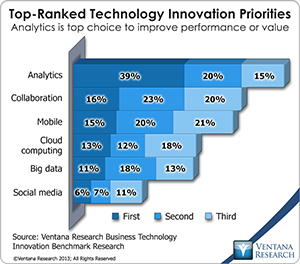 According to our research into business technology innovation, analytics is the top initiative for new technology: 39 percent of organizations ranked it their number-one priority. Analytics includes exploratory and confirmatory approaches to analysis. Ventana Research refers to exploratory analytics as analytic discovery and segments it into four categories that my colleague Mark Smith has articulated. Qlik’s products belong in the analytic discovery category. Users can use the tool to investigate data sets in an intuitive and visual manner, often conducting root cause analysis and decision support functions. This software market is relatively young, and competing companies are evolving and redesigning their products to suit changing tastes. Tableau, one of Qlik’s primary competitors, which I wrote about recently, is adapting its current platform to developments in hardware and in-memory processing, focusing on usability and opening up its APIs. Others have recently made their first moves into the market for visual discovery applications, including Information Builders and MicroStrategy. Companies such as Actuate, IBM, SAP, SAS and Tibco are focused on incorporating more advanced analytics in their discovery tools. For buyers, this competitive and fragmented market creates a challenge when comparing offers in the analytic discovery market.
A key differentiator is Qlik Sense’s new modern architecture, which is designed for cloud-based deployment and embedding in other applications for specialized use. Its analytic engine plugs into a range of Web services. For instance, the Qlik Sense API enables the analytic engine to call to a data set on the fly and allow the application to manipulate data in the context of a business process. An entire table can be delivered to node.js, which extends the JavaScript API to offer server-side features and enables the Qlik Sense engine to take on an almost unlimited number of real-time connections by not blocking input and output. Previously developers could write PHP script and pipe SQL to get the data, and the resulting application is viable but complex to build and maintain. Now all they need is JavaScript and HTML. The Qlik Sense architecture abstracts the complexity and allows JavaScript developers to make use of complex constructs without intricate knowledge of the database. The new architecture can decouple the Qlik engine from the visualizations themselves, so Web developers can define expressions and dimensions without going into the complexities of the server-side architecture. Furthermore, by decoupling the services, developers gain access to open source visualization technologies such as d3.js. Cloud-based business intelligence and extensible analytics are becoming a hot topic. I have written about this, including a glimpse of our newly announced benchmark research on the next generation of data and analytics in the cloud. From a business user perspective, these types of architectural changes may not mean much, but for developers, OEMs and UX design teams, it allows much faster time to value through a simpler component-based approach to utilizing the Qlik analytic engine and building visualizations.

 The modern architecture of Qlik Sense together with the company’s ecosystem of more than 1,000 partners and a professional services organization that has completed more than 2,700 consulting engagements, gives Qlik a competitive position. The service partner relationships, including those with major systems integrators, are key to the company’s future since analytics is as much about change management as technology. Our research in analytics consistently shows that people and processes lag technology and information in performance with analytics. Furthermore, in our benchmark research into big data analytics, the benefits most often mentioned as achieved are better communication and knowledge sharing (24%), better management and alignment of business goals (18%), and gaining competitive advantage (17%).
As tested on my desktop, Qlik Sense shows an intuitive interface with drag-and-drop capabilities for building analysis. Formulas are easy to incorporate as new measures, and the palate offers a variety of visualization options which automatically fit to the screen. The integration with QlikView is straightforward in that a data model from QlikView can be saved seamlessly and opened intact in Qlik Sense. The storyboard function allows for multiple visualizations to build into narratives and for annotations to be added including linkages with data. For instance, annotations can be added to specific inflection points in a trend line or outliers that may need explanation. Since the approach is all HTML5-based, the visualizations are ready for deployment to mobile devices and responsive to various screen sizes including newer smartphones, tablets and the new class of so-called phablets. In the evaluation of vendors in our Mobile Business Intelligence Value Index Qlik ranked fourth overall.
In the software business, of course, technology advances alone don’t guarantee success. Qlik has struggled to clarify the position its next-generation product and it is not a replacement for QlikView. QlikView users are passionate about keeping their existing tool because they have already designed dashboards and calculations using this tool. Vendors should not underestimate user loyalty and adoption. Therefore Qlik now promises to support both products for as long as the market continues to demand them. The majority of R&D investment will go into Qlik Sense as developers focus on surpassing the capabilities of QlikView. For now, the company will follow a bifurcated strategy in which the tools work together to meet needs for various organizational personas. To me, this is the right strategy. There is no issue in being a two-product company, and the revised positioning of Qlik Sense complements QlikView both on the self-service side and the developer side. Qlik Sense is not yet as mature a product as QlikView, but from a business user’s perspective it is a simple and effective analysis tool for exploring data and building different data views. It is simpler because users no do not need to script the data in order to create the specific views they deem necessary. As the product matures, I expect it to become more than an end user’s visual analysis tool since the capabilities of Qlik Sense lends itself to web scale approaches. Over time, it will be interesting to see how the company harmonizes the two products and how quickly customers will adopt Qlik Sense as a stand-alone tool.
For companies already using QlikView, Qlik Sense is an important addition to the portfolio. It will allow business users to become more engaged in exploring data and sharing ideas. Even for those not using QlikView, with its modern architecture and open approach to analytics, Qlik Sense can help future-proof an organization’s current business intelligence architecture. For those considering Qlik for the first time, the choice may be whether to bring in one or both products. Given the proven approach of QlikView, in the near term a combination approach may be a better solution in some organizations. Partners, content providers and ISVs should consider Qlik Branch, which provides resources for embedding Qlik Sense directly into applications. The site provides developer tools, community efforts such as d3.js integrations and synchronization with Github for sharing and branching of designs. For every class of user, Qlik Sense can be downloaded for free and tested directly on the desktop. Qlik has made significant strides with Qlik Sense, and it is worth a look for anybody interested in the cutting edge of analytics and business intelligence.