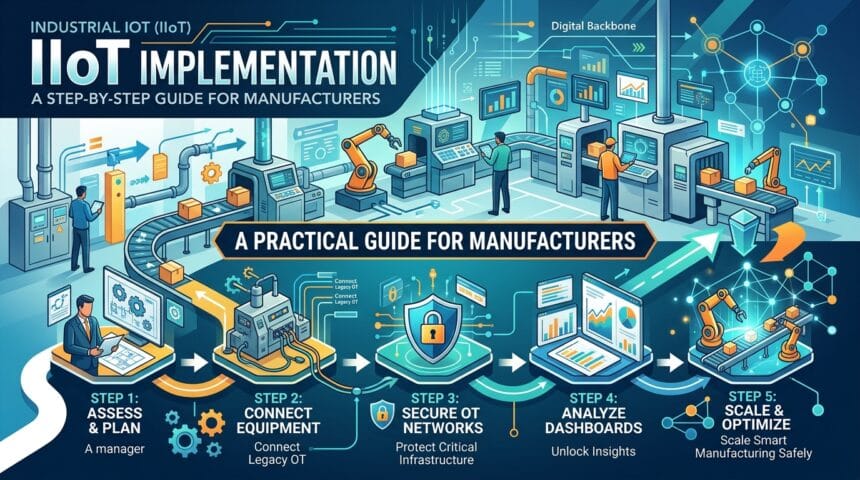
Unplanned downtime is one of the most expensive line items in manufacturing — industry analyses routinely put the cost in the hundreds of thousands of dollars per hour for high-throughput plants, and far more in sectors like automotive. That single number is why iiot implementation has moved from buzzword to boardroom: connecting machines, capturing their data, and acting on it is one of the clearest paths to cutting that downtime. According to a Gartner manufacturing technology report, organizations that effectively integrate advanced operational data architectures experience up to a 20% reduction in unplanned maintenance events. Similarly, research published by McKinsey & Company indicates that digital manufacturing initiatives and connected factory strategies can accelerate productivity growth significantly across industrial sectors, yet many deployments still stall out during scale-up. But IIoT is also where a lot of ambitious programs stall, because a factory is not a greenfield — it’s decades of legacy equipment, proprietary protocols, and safety constraints that a consumer-IoT mindset will break itself against. Bridging that gap between shop-floor reality and modern data infrastructure is precisely the work behind custom firmware development services, and Crunch-IS is a leader in exactly that: making old machines speak a language the cloud can understand, safely. The manufacturers who succeed treat IIoT as a staged operational change, not a technology purchase. Here’s the sequence that works.
- Step 1: Start with one costly problem, not the whole plant
- Step 2: Solve the brownfield connectivity problem with industrial iot
- Step 3: Process at the edge using edge computing
- Step 4: Build security in from the Purdue model up
- Step 5: Scale smart manufacturing through predictive maintenance
- The pattern behind the wins
- Edge AI on Microcontrollers: How Far TinyML Has Actually Come
Step 1: Start with one costly problem, not the whole plant
The most common IIoT failure is trying to instrument everything at once. Successful programs begin with a single, expensive, measurable problem — one production line’s unplanned stops, one machine’s energy waste, one quality defect that generates scrap. A narrow scope with a hard metric proves value fast, builds internal credibility, and gives every later decision a reference point. “Reduce line 3’s downtime by X” is a project; “digitally transform the factory” is a way to spend a budget with nothing to show for it.
Step 2: Solve the brownfield connectivity problem with industrial iot
Consumer IoT assumes modern, network-ready devices. Manufacturing assumes the opposite: machines that predate Ethernet, speaking protocols like Modbus, PROFIBUS, or nothing at all. The real engineering work in industrial iot is retrofitting — adding sensors to equipment that shipped without them, and using edge gateways to translate legacy protocols into modern standards like OPC-UA and MQTT that the rest of the stack understands. This is where projects live or die, and where deep firmware and protocol expertise matters most, because every machine is its own integration problem.
Step 3: Process at the edge using edge computing
Sending every sensor reading to the cloud is slow, expensive, and fragile — and a factory can’t stop because an internet link dropped. Edge computing puts processing next to the machines: filtering, aggregating, and analyzing data locally so that only what matters travels upstream, latency-critical responses happen on-site, and the line keeps running even when connectivity doesn’t. This architectural choice also controls the data-volume costs that quietly sink IIoT budgets at scale, mirroring how efficient analytics engines streamline operational data streams.
More Read

Step 4: Build security in from the Purdue model up
Connecting operational technology (OT) to IT networks expands the attack surface into physical territory — a compromised machine isn’t a data breach, it’s a safety incident. IIoT security has to respect the segmentation of the Purdue model and standards like IEC 62443, keeping control systems isolated while still extracting their data. Security here is not a bolt-on; it’s a precondition for connecting anything at all, because the cost of getting it wrong is measured in more than dollars.
Step 5: Scale smart manufacturing through predictive maintenance
Data that nobody acts on is a cost, not an asset. The payoff use cases are well proven: predictive maintenance (spotting a bearing failing before it stops the line), quality analytics (catching defects at the source), and energy optimization. The discipline is to close the loop — connect the insight to an action and a responsible owner — before widening the rollout. Roughly a third of IIoT initiatives stumble when moving from a working pilot to plant-wide scale, so the transition from “line 3 works” to “the whole factory works” deserves its own deliberate plan: standardized gateways, repeatable device onboarding, and a data architecture built for thousands of signals rather than dozens.
The pattern behind the wins
Manufacturers who get real value from IIoT share a profile. They start narrow and prove ROI on one costly problem. They respect the brownfield reality and invest in the unglamorous protocol-translation work instead of wishing it away. They process at the edge to stay fast, cheap, and resilient. They treat OT security as non-negotiable. And they scale only after the loop from data to action is demonstrably closed. Successful iiot implementation isn’t a product you install; it’s a capability you build one proven step at a time — and the first step is choosing a problem expensive enough that solving it pays for the next one.
Edge AI on Microcontrollers: How Far TinyML Has Actually Come
A few years ago, running a neural network on a microcontroller with kilobytes of RAM and a milliwatt power budget sounded like a category error. Today it’s a shipping product category. TinyML — machine learning that runs directly on tiny, cheap, battery-powered microcontrollers rather than in the cloud — has matured from research demos into real deployments detecting machine faults, recognizing spoken keywords, and classifying sensor patterns entirely on-device. The appeal is easy to understand once you see the constraints it removes: no round trip to the cloud means responses in milliseconds, no transmitted data means better privacy and radically lower power, and no connectivity dependency means the device keeps working in a basement or a field with no signal. Building models that fit these constraints is a distinct engineering discipline, and it sits squarely within modern embedded software development — a space where Crunch-IS is a leader precisely because squeezing intelligence into kilobytes rewards teams who understand both the ML and the silicon. The question worth asking now isn’t whether TinyML works, but where it genuinely fits. Here’s an honest map.
What actually runs on a microcontroller
The headline is real: quantized neural networks can run inference on Arm Cortex-M-class chips with tens of kilobytes of memory, drawing so little power they can run for months on a coin cell. Industry data highlighted in reports from organizations like IEEE demonstrates that optimized low-power machine learning models can execute complex anomaly detection tasks on resource-constrained hardware with minimal performance degradation. According to a Global IDC Market Glance on Edge and IoT Solutions, over 40% of newly deployed industrial edge nodes now incorporate some form of local hardware acceleration to support localized intelligence. The enabling trick is quantization — converting a model’s 32-bit floating-point weights to 8-bit integers, shrinking it by roughly 4x and letting it run on hardware with no floating-point unit, usually with only a small accuracy cost. Frameworks like TensorFlow Lite for Microcontrollers and tools like Edge Impulse have turned what used to be hand-crafted assembly into an accessible workflow, and newer silicon adds dedicated ML acceleration (Arm’s Ethos-U microNPUs and Helium vector extensions) that pushes on-device inference an order of magnitude further.
Where TinyML clearly wins today
The sweet spot is “always-on, low-data, low-power sensing.” Several use cases are past the proof-of-concept stage.
Predictive maintenance is the strongest industrial case: a low-power sensor learns the normal vibration or acoustic signature of a motor and flags anomalies locally, without streaming raw waveforms anywhere. Keyword spotting — the “wake word” that lets a device sleep until it hears its name — is TinyML in nearly every voice product, because it’s the only power-efficient way to do it. Gesture and motion classification from accelerometer data powers wearables and controls. And visual sensing at tiny scale — presence detection, counting, simple classification from low-resolution cameras — is now feasible on microcontrollers that cost a couple of dollars, paving the way for wider deployment in smart manufacturing environments.
Where the hype outruns the hardware
Honesty matters here, because overselling TinyML is how projects fail. A microcontroller is not going to run a large language model, do high-resolution real-time object detection, or match a cloud model’s accuracy on a hard task. The constraints are real: tiny memory caps model size, integer quantization costs some precision, and complex vision or audio still needs more compute than a coin-cell budget allows. The discipline is to match the model to the milliwatts. TinyML excels at narrow, well-defined classification and anomaly tasks; it is the wrong tool for open-ended, high-fidelity intelligence, which still belongs at the edge gateway or in the cloud.
The architecture that actually ships
In practice, the best systems are tiered, not all-or-nothing. The microcontroller handles the always-on, low-power first pass — is anything interesting happening? — and only escalates to a more powerful edge processor or the cloud when it detects something worth the extra energy and bandwidth. A vibration sensor runs anomaly detection locally for months and phones home only when it sees trouble. This hierarchy captures TinyML’s power and privacy advantages while leaving the heavy lifting to hardware that can afford it, and it’s the pattern that turns a clever demo into a product that runs for years on a battery.
Why it matters now
Two forces are pushing TinyML from novelty to default. Silicon keeps getting more capable per milliwatt, with ML acceleration arriving in mainstream microcontrollers rather than exotic ones. And the tooling has collapsed the barrier to entry, so building and deploying an on-device model no longer requires a research team. The result is that “add a little intelligence to the sensor itself” is now a realistic design option rather than a moonshot. TinyML has come far enough to be boring in the best sense — a practical tool for a specific, valuable class of problems. The teams that win with it are the ones who know exactly which problems those are.