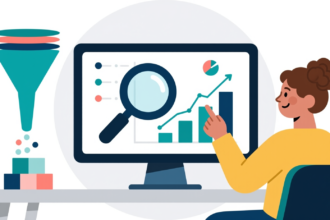
Increasingly, our world has become obsessed with data. Companies everywhere want to know who their customers are, how they behave, how they make purchasing decisions, and how they can be persuaded.
In some ways, this concept is nothing new. Entrepreneurs, innovators, and creatives have always benefited from doing research and better understanding their business environments. The difference is, today’s world is abundant with data – and there are more tools than ever before to help us gather, organize, and analyze data.
This is strictly a good thing, right?
Not necessarily. To capitalize on all the benefits of a data rich business, we need good leaders who can lean into the benefits of a data surplus while minimizing the possible downsides.

The Value of Data
There’s no question that data is valuable, but only when it’s utilized properly. With better benchmarks, KPIs, and statistics, business leaders can better understand their environments and ultimately make more objective, logical decisions.
What’s important to recognize here is that it’s not the data itself that’s valuable. Simply having a graph in front of you isn’t what enables you to make better business decisions; instead, it’s your interactions with data that really matter. And unfortunately, many of those interactions can be corrupted by inherent problems with data fixation.
The Problems With Data
Believe it or not, there are some significant problems associated with organizations having too much data, or working with more data than they can reasonably handle.
For example:
- Fixation on KPIs. Key performance indicators (KPIs) can serve as excellent measuring sticks that guide your progress and allow you to define and evaluate success. But a problem arises when you become overly fixated on KPIs. These metrics are typically narrow in scope, such that they can’t tell you everything about the progress of your campaign. As an example, you may have gained 10,000 followers on social media, but if those followers aren’t part of your target demographics, or if they don’t engage with your content, they may not be especially valuable for achieving your goals.
- Too much noise, not enough signal. The more data you have, the harder it becomes to separate the signal from the noise. In other words, it becomes hard to separate what’s truly valuable or meaningful about your data from all the meaningless fluff. Skilled analysts can usually discern this with small data sets, but when you’re working with millions of data points, this becomes an excruciating challenge.
- Misleading conclusions. If you’re obsessed with numerical data, you could easily be led to misleading conclusions. This is an especially important risk to acknowledge when presenting or interpreting data in ways that can potentially skew it. For example, data visualization has been an awesome tool for making objective data more abstract and easily interpretable – but it can also distort the meaning of data. Additionally, confirmation bias and other cognitive biases can change how you interpret data, ultimately diminishing the objective power of your conclusions.
- Ignorance of outliers. Large data sets must be aggregated to be analyzed effectively, but this large-scale aggregation comes with a massive drawback: ignoring outliers. Outliers might be statistical anomalies, but they’re still important to acknowledge and analyze to get a clear picture of what’s going on.
- Ignorance of subjective insights. Objectivity is crucial in making business decisions, but we can’t ignore the power of subjective insights. Customers might tell you that they think your business is worth 4 out of 5 stars – but what’s stopping them from giving you that final star? Every customer might have a slightly different answer.
How Good Leaders Keep Data in Perspective
So what can good leaders do to keep data in perspective?
- Quantitative and qualitative data. Quantitative and qualitative data may be similarly spelled, but they represent two totally different types of data. Quantitative data is objective and typically numerical, while qualitative data is more subjective and verbal. Both are essential for better understanding your business environment.
- Narrow, specific reports. Every report you generate should be narrow and specific. Including more data points, or showing more granular detail aren’t necessarily good things. You need to be focused on the metrics that truly matter as well as the context that allows you to interpret them correctly.
- Actionable insights. Your data strategy should be oriented toward actionable insights. In other words, you need to gather data to direct your decisions – not just to satisfy your curiosity.
- Trusted analysts. You should hire and trust seasoned data analysts to assist you in all your analytics needs. More experience and more diverse perspectives can only help you.
With these strategies, data analysts and organizational leaders can make the most of big data sets while mitigating the risks and downsides associated with them. It’s not easy to thrive in a world that’s so fixated on data, but with the right mentality and the right tools, it becomes much easier.