The market for cloud technology is booming. Companies spent over $405 billion on cloud services last year. The sudden growth is not surprising, because the benefits of the cloud are incredible.
Enterprise cloud technology applications are the future industry standard for corporations. Cloud computing has found its way into many business scenarios and is a relatively new concept for businesses.
Here’s how enterprises use cloud technologies to achieve a competitive advantage in their essential business applications.
Data streaming
Information is moving at a faster pace today than ever before. Companies must take advantage of the information about their customers to stay updated and respond in real-time for quick decision-making.
More Read

Cloud computing (https://www.striim.com/product/striim-cloud/) can be used to support real-time data streams for better business decision-making. With cloud computing, companies can use their servers and hardware as much as they want with little overhead from extra hardware and software.
Cloud technology results in lower costs, quicker service delivery, and faster network data streaming. It also allows companies to offload large amounts of data from their networks by hosting it on remote servers anywhere on the globe.
Multi-cloud computing
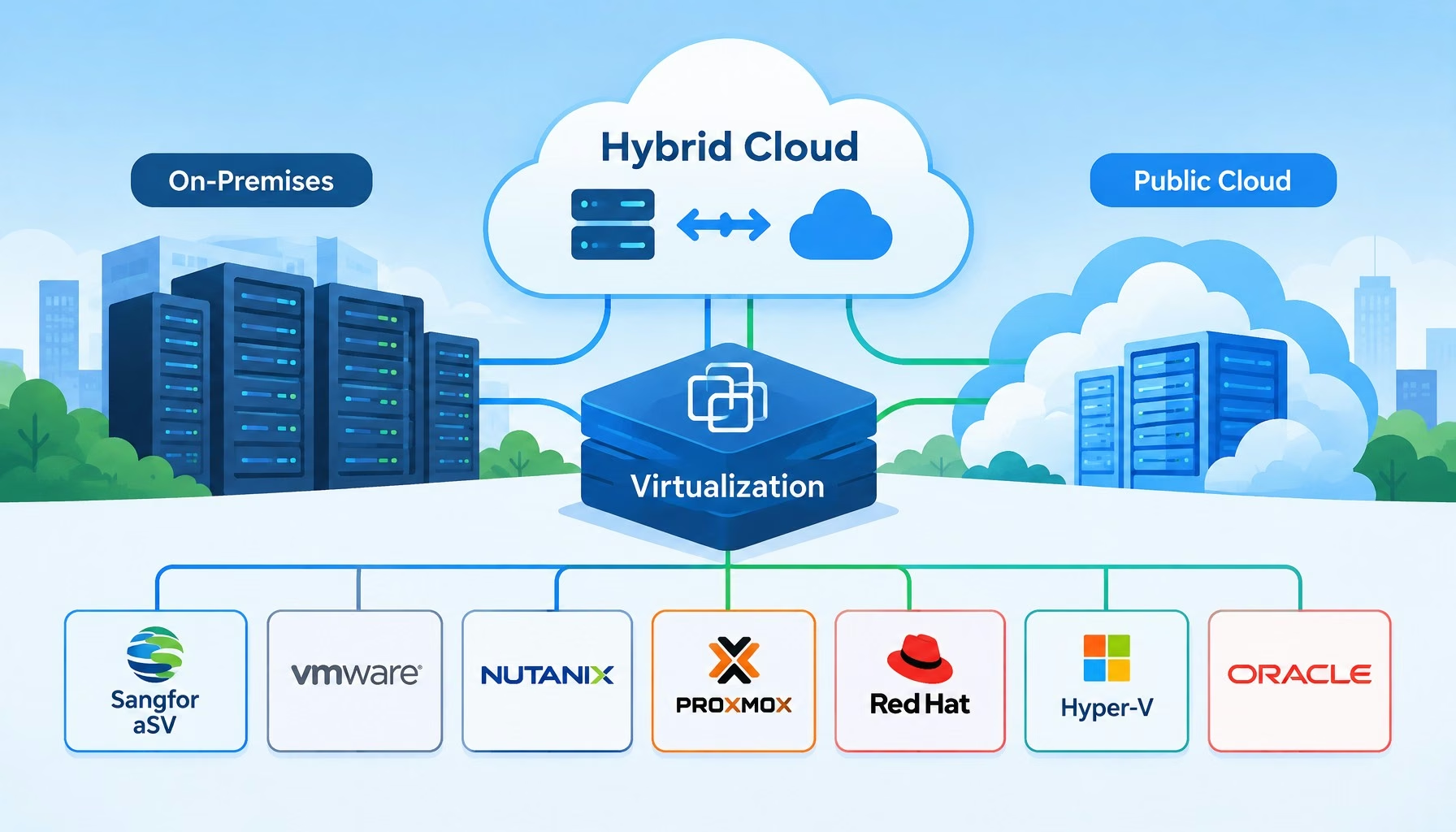
Cloud computing allows companies’ multiple servers to store and manage their data in a distributed fashion. The model enables easy transfer of cloud services between different geographic regions, either onshore or offshore.
Companies have the flexibility to choose the location where they have the best infrastructure to deploy their businesses. Cloud computing has provided additional advantages like interoperability with traditional enterprise systems via APIs.
Testing new programs
With cloud computing, companies can test new programs and software applications from the public cloud. Parameters can be changed, updated, or performance enhanced without the time-consuming installation of new hardware and software.
Cloud technology allows companies to test many programs and decide which ones to launch for consumers quickly. The testing helps reduce the overall cost, time, and risk associated with building new hardware so companies can focus more on their core business functions.
Centralized data storage
Cloud technologies provide users with centralized storage for all information. For example, e-mail messages and documents are stored in the cloud, giving users access to their data from any location.
Information is encrypted and stored on firewalls or protected by redundancy and many other security methods to ensure data safety. The data storage from one company can be accessed by another company through multiple clouds, decreasing or even eliminating the need for traditional onsite storage systems for companies.
Disaster recovery and data backup
Cloud technology helps companies recover business processes in a natural disaster. Cloud technology allows for information to be shared and stored in remote data centers, making it possible to continue operations even when premises get damaged. Companies can also implement redundant systems and virtualized equipment to ensure the continuity of services.
Data backup is one of the most important benefits of cloud computing. The data backup solution makes it possible to recover your business operations when a system fails. The system eliminates the requirement to purchase expensive backup systems and other equipment.
Big data analytics
The amount of data in today’s world is growing exponentially, and cloud computing provides excellent tools that analyze large volumes of information and carry out marketing segmentation. Using data mining and advanced analytics, companies can better analyze customer behavior patterns to predict their needs and provide more customized products and services.
An organization can process vast amounts of unstructured data from social media networks and websites by running computationally intense workflows on these applications in a distributed network environment.
Provision of infrastructure as a service (IaaS) and platform as a service (PaaS)
Cloud technologies allow companies to rent servers and storage to provide IaaS. The IaaS model works well for new startups that don’t want the capital expense of building an IT infrastructure.
Companies that handle hardware, software, and security measures in a data center provide managed cloud hosting services. Companies can share resources and pay according to their usage with automatic billing, lowering costs while still enjoying the security of scalable IT offerings.
Companies use PaaS to rent access to a development environment with applications and storage. Users can develop new software or update existing programs without installing additional software. Cloud computing enables companies to quickly deploy new applications for employees without wasting time on installation in their IT networks.
Before you go
Cloud technology has proven to be an excellent model for large companies. Cloud computing allows companies to increase productivity with reduced costs and improve their business structures by improving real-time information. Cloud technology also provides customers and employees new ways of connecting, sharing data, and creating customized services.