We use cookies, including third-party cookies from Google to serve personalized ads through AdSense, to operate this site and understand how it is used. By continuing to browse, you accept this use. See our Privacy Policy and Terms of Use for details, including how to opt out of personalized advertising.
Accept
SmartData CollectiveSmartData Collective
  • Analytics
    AnalyticsShow More
    What Kind of Problem-Solving Distinguishes Data Analysts From Software Engineers -- AI-generated illustration
    What Kind of Problem-Solving Distinguishes Data Analysts From Software Engineers
    7 Min Read
    chatgpt image jul 21, 2026, 04 34 30 pm
    4 Core Benefits of Predictive Maintenance after Vibration Analysis
    10 Min Read
    How Does Data Mining Boost Customer Satisfaction in Logistics? Harnessing Analytics for Results -- AI-generated illustration
    How Does Data Mining Boost Customer Satisfaction in Logistics? Harnessing Analytics for Results
    11 Min Read
    chatgpt image jul 13, 2026, 04 23 45 pm
    How Data Analytics Helps Companies Improve User Engagement
    19 Min Read
    chatgpt image jul 13, 2026, 03 59 46 pm
    How Data Analytics Improves Multi-Location Search Strategies
    10 Min Read
  • Big Data
  • BI
  • Exclusive
  • IT
  • Marketing
  • Software
Search
© 2008-25 SmartData Collective. All Rights Reserved.
Reading: Cloud OPEX vs. CAPEX – Which is the Better Choice?
Share
Notification
Font ResizerAa
SmartData CollectiveSmartData Collective
Font ResizerAa
Search
  • About
  • Help
  • Privacy
Follow US
© 2008-23 SmartData Collective. All Rights Reserved.
SmartData Collective > IT > Cloud Computing > Cloud OPEX vs. CAPEX – Which is the Better Choice?
AnalyticsCloud ComputingExclusive

Cloud OPEX vs. CAPEX – Which is the Better Choice?

paulbarsch
paulbarsch
5 Min Read
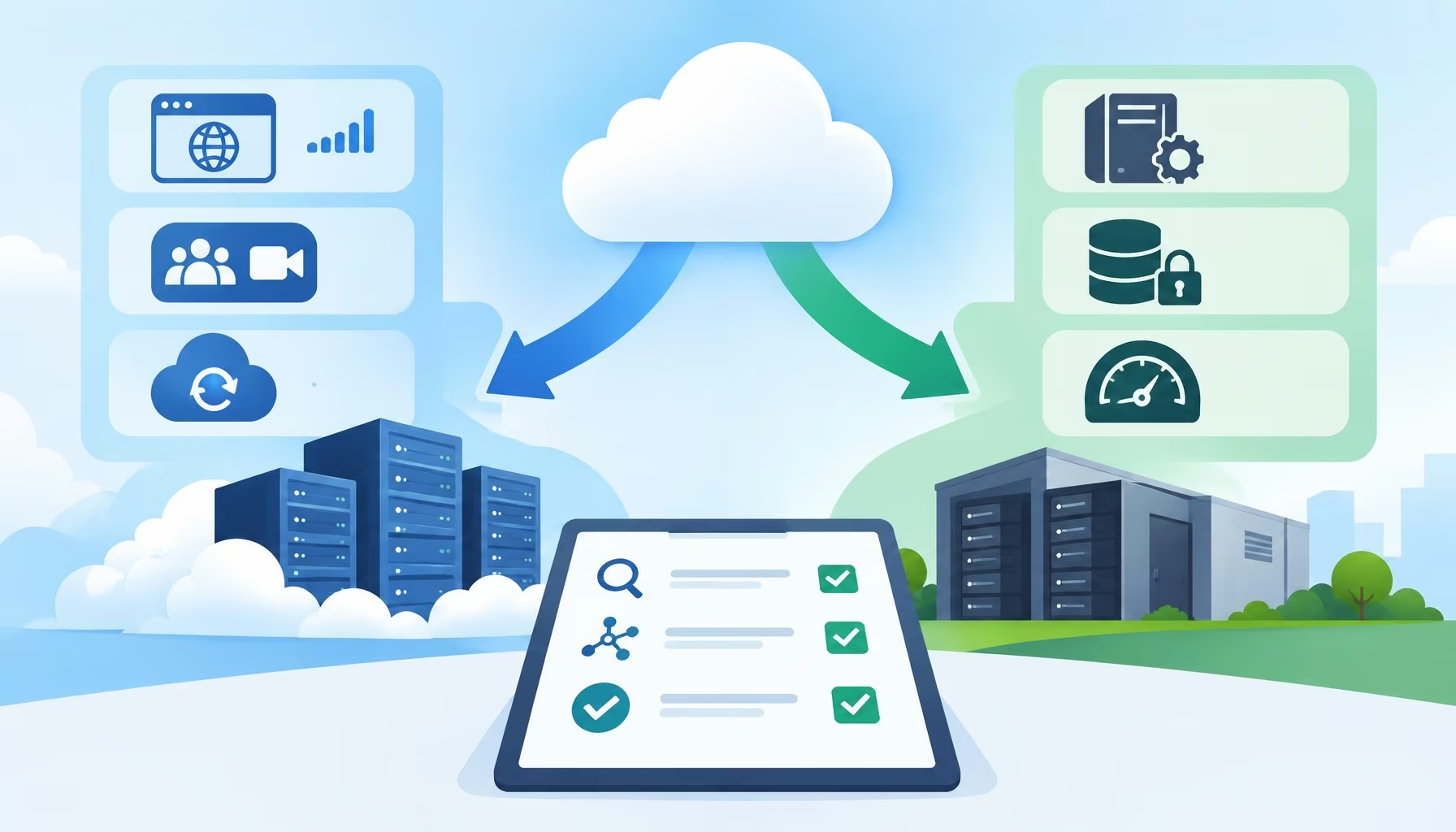
Cloud OPEX vs. CAPEX - Which is the Better Choice?
Illustration generated with Qwen Image.
SHARE

Among CIOs and CFOs debate swirls regarding how to best budget for and acquire IT resources. The key questions are; should companies own, lease or essentially “rent” IT services via cloud computing? It’s actually a tougher choice than you may think.

An Economist article explains the “Big Data” conundrum facing global enterprises. Data volumes are increasing faster than many companies have the capacity to store much less mine them for insights. In this exploding “data revolution” many companies are also finding their internal processes—much less budgets—for acquiring technology are not keeping up with business user needs.

That’s why cloud computing is so attractive.  With the public cloud model, compute, memory and storage can be acquired on a “pay per use” basis. In the public cloud there is typically no hardware/software to buy upfront, thus companies can use operating expense budgets (OPEX) to fund their needs, giving them plenty of budgeting flexibility.  The alternative is to purchase needed hardware and software outright—thus capitalizing assets (CAPEX).  

On the surface, going the OPEX route seems to be the better choice, but it’s a more complex decision than it seems.

More Read

Customer Data Quality: What Is the Value-at-Risk?
Helpful Forecasting Resources
Empowering Partners and Customers with Data Insights: A Win-Win for Everyone
Big Data Analytics Versus Your Own Lying Eyes
The True Vision of Big Data in Healthcare

One primary factor in the CAPEX vs. OPEX debate really boils down to how much of each budget a company has (as determined by the CFO). Moreover, plenty of small to medium size businesses are capital constrained. They simply don’t have tons of dollars to invest in assets.  For these companies it makes sense to discover options such as leasing or cloud that can convert a given investment into an operating expense that would flow from SG&A on the income statement.

Larger companies usually have more significant capital budgets. That said they still must balance various and competing alternatives, seeking the best return on investment. These companies have capital budgeting processes completed on an annual basis and they’re usually only capital constrained for unexpected mid-year requirements or restricted based on investor and/or industry expectations/guidelines for ratios such as current ratio or Return on Assets (ROA).

Another consideration in deciding CAPEX vs. OPEX for IT acquisitions is resource utilization per Chief Information Officer Bernard Golden. In a CIO Magazine article, Golden provides an example of the decision to buy or rent a car.  If you plan on using the car full-time, then purchasing/financing the car likely makes the most sense. However, if you plan on using the automobile only for a week a month, then perhaps renting is the better choice.

In the same way, if you plan on running IT resources at near or full resource utilization for long periods of time then it probably makes best economic sense to purchase assets (if you have the CAPEX to do so). Using IT resources for just a little while, and then shutting them down? This is probably the best use case for cloud computing according to Golden.

There are many facets to the OPEX vs. CAPEX debate in terms of cloud computing, and certainly more than can be discussed in a short article.  However more than discussions of which funding model (CAPEX vs. OPEX) for IT is best, a more realistic choice architecture is 1) which budget do you have available (i.e. some companies have little to no capital budgets)?  and 2) do you plan to fully utilize the IT asset for long periods of time (i.e. 1-3 years or more) or do you need it on a temporary basis (days, weeks, months)? 

Answers to these questions will initially help you determine which (if any) cloud computing options are the best business choice for your company.

Share This Article
Facebook Pinterest LinkedIn
Share

Follow us on Facebook

Latest News

Technical architecture diagram and decision framework for ai-powered logo generation: design.com vs looka
AI-Powered Logo Generation: Design.com vs Looka
Artificial Intelligence Exclusive
Retailers Should Stop Treating Every Stockout as Equal -- AI-generated illustration
Retailers Should Stop Treating Every Stockout as Equal
Business Intelligence Exclusive
Best Vibe Coding Cleanup Specialists in the USA: Fix or Rebuild? -- AI-generated illustration
Best Vibe Coding Cleanup Specialists in the USA: Fix or Rebuild?
Development Exclusive
Using Warehouse, Transportation and Order Data to Plan Distribution-Center Capacity -- AI-generated illustration
Using Warehouse, Transportation and Order Data to Plan Distribution-Center Capacity
Big Data Exclusive

Stay Connected

1.2KFollowersLike
33.7KFollowersFollow
222FollowersPin

You Might also Like

Lifting Up: How Big Data Can Help Eliminate Poverty
Predictive Analytics

Lifting Up: How Big Data Can Help Eliminate Poverty

6 Min Read
Going Big – Teradata to Acquire Aster Data
AnalyticsData Warehousing

Going Big – Teradata to Acquire Aster Data

9 Min Read
Top 7 Data-Driven E-Learning Trends Changing the Face Of Education
Big Data

Top 7 Data-Driven E-Learning Trends Changing the Face Of Education

9 Min Read
Understanding Data Restoration Options for Disaster Management
Best Practices

Understanding Data Restoration Options for Disaster Management

6 Min Read

SmartData Collective is one of the largest & trusted community covering technical content about Big Data, BI, Cloud, Analytics, Artificial Intelligence, IoT & more.

Chatbots and SEO: How Can Chatbots Improve Your SEO Ranking?
Artificial Intelligence Chatbots Exclusive
The Art of Conversation: Enhancing Chatbots with Advanced AI Prompts
Chatbots

Quick Link

  • About
  • Contact
  • Privacy
Follow US
© 2008-26 SmartData Collective. All Rights Reserved.
Welcome Back!

Sign in to your account

Username or Email Address
Password

Lost your password?