The healthcare sector is evolving rapidly as new technology helps healthcare providers offer better service and improve its business models. Healthcare providers spent $67 billion on big data last year. Keep reading to learn more about the benefits that it provides.
Big Data is Changing Healthcare Forever
There is denying the fact that big data is changing the world of business. A growing number of companies are using big data to improve their decision-making models.
Businesses around the world are expected to spend $348.21 billion on big data this year. This figure is going to increase every year for the foreseeable future, as the benefits of big data become more evident.
There are so many ways that companies are using big data to improve their bottom lines. These include using predictive analytics to anticipate customer buying behavior, using big data to enhance cybersecurity and taking advantage of data mining to find potential new employees.

Thanks to technology, many changes are made in different sectors, and healthcare is no exception. These changes are driven by big data and advanced analytics. Modern-day patient-centered care emphasizes providing treatments that are tailored to each individual’s specific requirements and preferences. To improve patient outcomes, service quality, and treatment delivery, healthcare providers use data to guide their decisions. This article discusses how big data and analytics are changing patient care by personalizing medicine, increasing results, and incorporating feedback.
The Role of Big Data in Healthcare
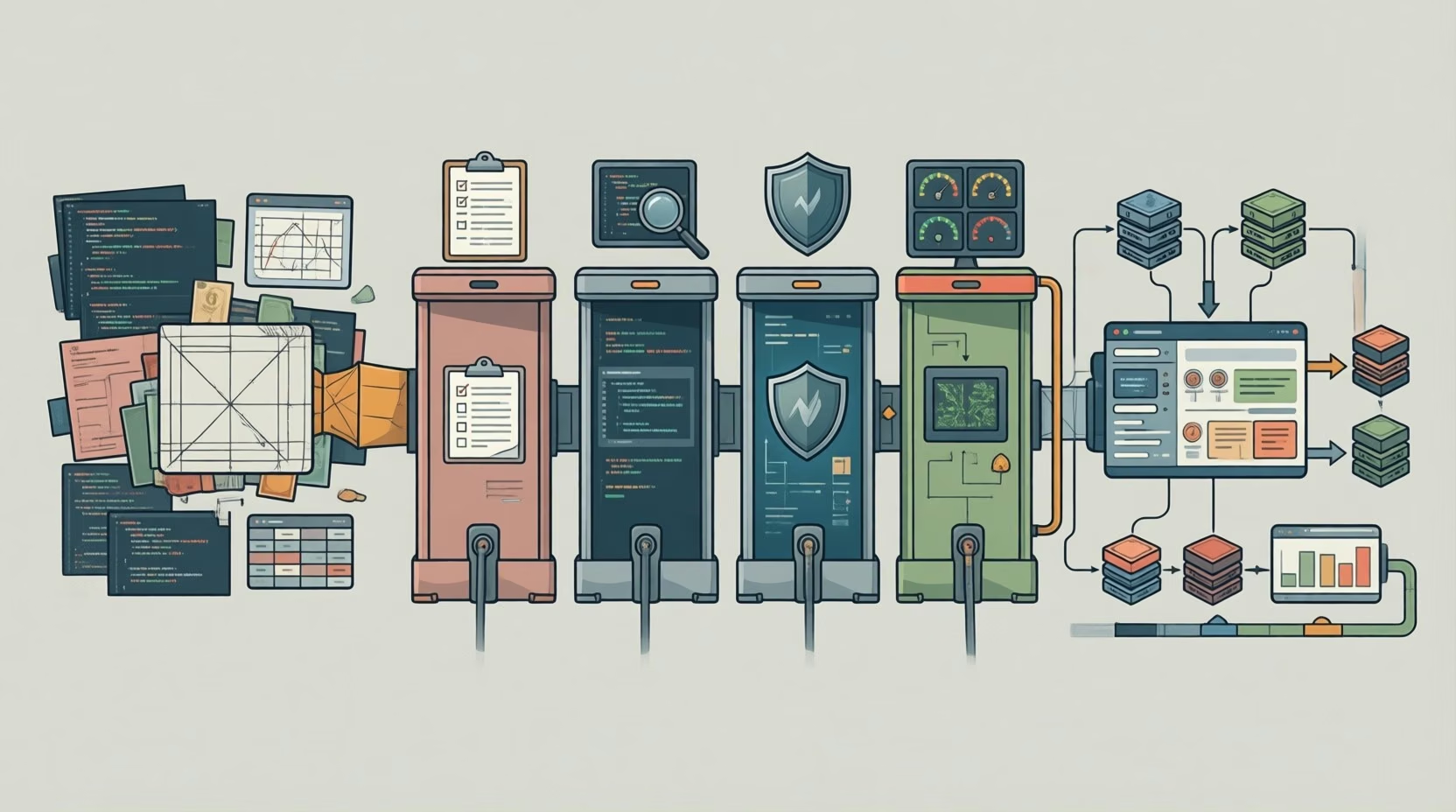
Big data refers to enormous datasets that typical methods cannot handle adequately. Huge volumes of data are gathered in the medical field. These datasets have the following characteristics: truthfulness, volume, velocity, and diversity. Advanced technologies help to process and analyze complex healthcare data more effectively. These discoveries enable healthcare organizations to make better decisions and provide better treatment.
All kinds of professionals in the healthcare sector are relying on big data. These include everyone from accountants to doctors to human resources professionals. The importance of big data will likely keep growing in the months and years to come.
For human resources professionals, understanding regulations like SCHADS award interpretation is vital when managing staff in healthcare settings. Big data can support this by providing detailed analytics, ensuring compliance, and streamlining workforce management processes.
Advanced Analytics for Better Outcomes
Advanced analytics derives deeper insights from healthcare data by combining predictive analytics and ML to anticipate patient needs. To identify high-risk patients and start early therapy, these technologies take into consideration genetics, lifestyle choices, and medical histories. Advanced analytics reduces healthcare costs by eliminating needless treatments and hospital readmissions. AI algorithms guarantee that patients receive tailored and efficient therapy, leading to improved outcomes and less problems. Ultimately, these advancements improve operations in the medical sector.
Supporting Personalized Medicine
With personalized medicine, therapies are customized to each patient’s specific genetic composition, medical conditions, and preferences. This is as opposed to using a one-size-fits-all strategy. Big data is essential to this change because it offers the knowledge needed to create individualized treatment programs.
Healthcare professionals can design treatments that are specific to the health profile of each patient. Genetic data, medical histories, and environmental variables may all be used to do this. For example, a cancer patient’s treatment strategy can be personalized to their tumor’s genetic alterations, significantly increasing their chances of recovery. This method treats patients by using customized remedies instead of depending just on standard clinical recommendations.
Integrating Patient Feedback
Crucially, patient-centered care revolves around making sure that choices about their treatment are made with their needs and desires in mind. Here is where Patient-Centered Outcomes Research (PCOR) insights come into play. Patient experiences, preferences, and results are directly gathered for this study by questioning patients about them. By combining this information into big data systems, healthcare workers can ensure that patient opinions are heard in treatment decisions.
The evaluation system ensures that healthcare is continually improved based on real-world experiences, hence enhancing efficacy and satisfaction.
Challenges and Considerations
Although there are many advantages to healthcare analytics, issues with interoperability, security, and data privacy must be resolved. To fully realize its potential, continuous investment in personnel training, infrastructure, and laws is essential.
Conclusion
The application of big data and advanced analytics is changing patient-centered care. Healthcare practitioners use data to provide proactive, efficient, and patient-centered treatment, resulting in better outcomes and experiences. They will remain useful for the healthcare system as technology advances.