
An Exchange database (EDB) can hold many mailboxes. A Personal Storage Table (PST) is a file you can open in Outlook to inspect a mailbox export. Which tools you can use depends on whether Exchange can already read the source mailbox.
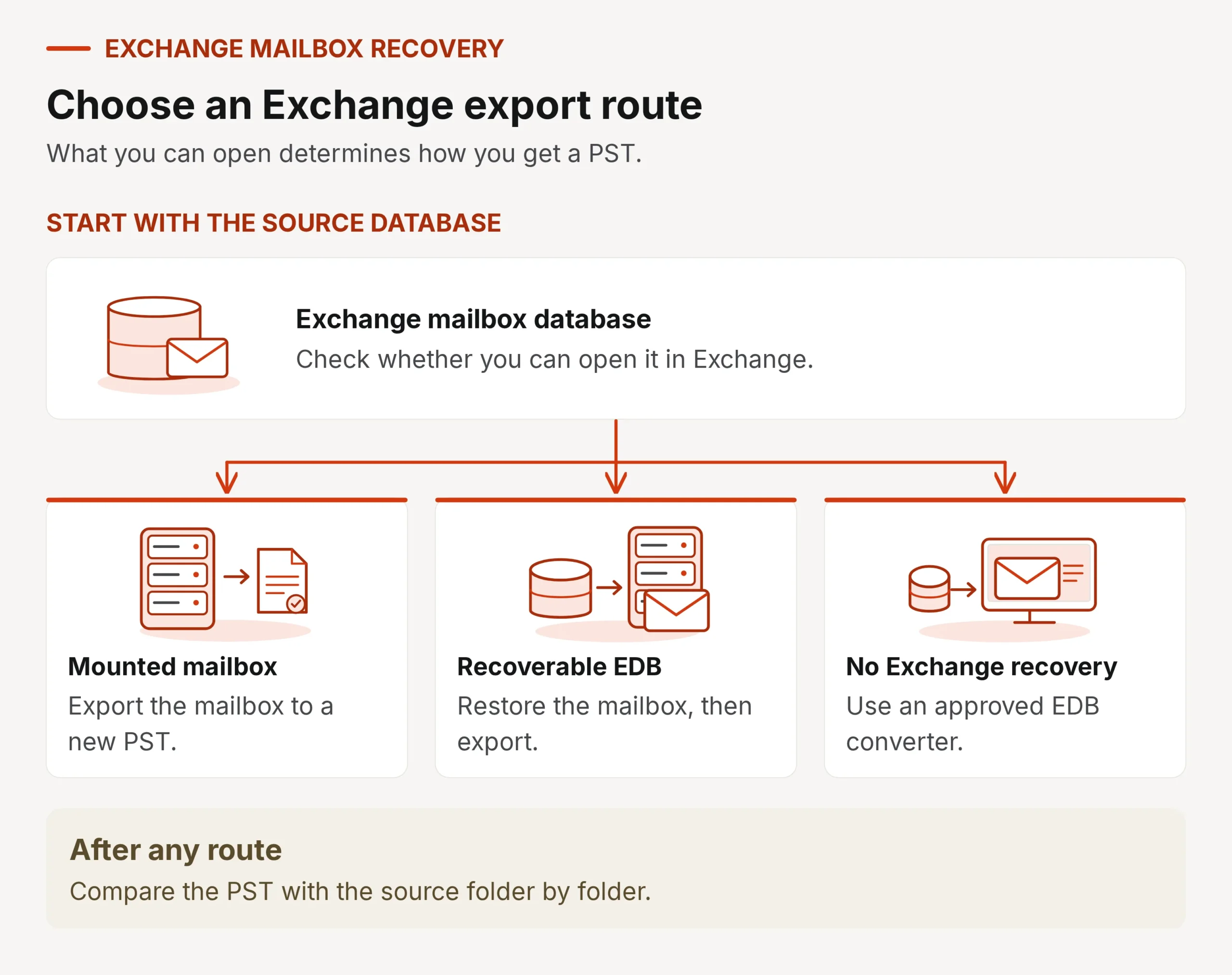
To convert EDB to PST for free, export an accessible on-premises mailbox with the Exchange Admin Center or Exchange Management Shell. If you only have an offline EDB, restore the mailbox in a compatible Exchange environment or check whether an approved converter can read the file. Compare the PST with the source folder by folder before you sign off.
- An Exchange export produces a PST for a mailbox or archive. The EDB can contain many mailboxes.
- Exchange needs a writable network share for the PST. A detached EDB needs a recovery or conversion step first.
- Save the export report and compare the PST with the source before retiring the original.
Which EDB-to-PST method fits your source?
The EDB-to-PST method that fits your source depends on whether Exchange can open the mailbox. Export a mounted mailbox directly with Exchange. If you only have a detached EDB, check whether you can restore it in Exchange before choosing a converter.
| Method | Use it when | Check first |
|---|---|---|
| Exchange Admin Center | One mailbox is accessible on-premises and you prefer a wizard. | Export role and network share permissions |
| Exchange Management Shell | The mailbox is accessible and you want request tracking or repeatable exports. | Mailbox identity, export scope and a fresh PST path |
| Exchange recovery database | The EDB is offline and you have a compatible Exchange environment and usable recovery files. | Recovery prerequisites and a target mailbox |
| Offline EDB converter | You have a detached EDB and need to extract mailboxes without mounting it in Exchange. | Version support, export limits and where data is processed |
Export a mailbox from a running Exchange server
To export a mailbox from a running Exchange server, check the Exchange role and the destination share first. Your admin account needs the Mailbox Import Export role, which Exchange does not assign by default. The Exchange Trusted Subsystem group needs read and write access to the destination network share. Choose a new PST filename so the results are easy to reconcile. Follow Microsoft’s mailbox export procedures for the supported workflow.
Use the Exchange Admin Center
Use the Exchange Admin Center wizard to export one accessible mailbox or its archive to a new PST.
- In the on-premises Exchange Admin Center, go to Recipients and select Mailboxes.
- Select the mailbox and open More options, then choose Export to a PST file.
- Pick the primary mailbox or archive, enter the full network path including the
.pstfilename, and submit the request. - Check the export request and inspect the PST in Outlook after Exchange finishes.
Use the Exchange Management Shell
Run New-MailboxExportRequest in the Exchange Management Shell. Replace the mailbox and share with your own. The two leading backslashes identify a UNC path, and the path must end with the PST filename.
New-MailboxExportRequest -Mailbox user@example.com -Name PSTExport -FilePath "\fileserverPSTExportsuser.pst"Check the status of that specific request. If you export the archive too, use the -IsArchive switch with a different request name and PST path.
Get-MailboxExportRequest -Mailbox user@example.com -Name PSTExportUse the detailed request report to investigate warnings or failures. Save it with the export record.
Get-MailboxExportRequest -Mailbox user@example.com -Name PSTExport |
    Get-MailboxExportRequestStatistics -IncludeReport |
    Format-List
Recover or convert an offline EDB
Recover an offline EDB through a compatible Exchange recovery database if you have the required files. An approved offline converter is another option when Exchange recovery is unavailable. Work from a copy and keep the original EDB and available logs intact. If you need to identify the database contents first, see our guide to viewing mailboxes in an EDB file.

Restore through an Exchange recovery database
To restore through an Exchange recovery database, use a compatible Exchange environment and follow Microsoft’s recovery database procedure. Mount the recovered copy in a recovery database and use New-MailboxRestoreRequest to restore the source mailbox contents to a designated target mailbox. Export the target mailbox once the restore has completed. If you use an existing mailbox as the target, keep the restored items in a known folder so you can reconcile what the PST should contain.
In a worked Exchange 2016 restore, Paul Cunningham describes who can open the recovery database:
Recovery databases can only be accessed by administrators performing mailbox restores, they are not accessible by end users via Outlook
Paul Cunningham, Practical 365Convert a detached EDB outside Exchange
An offline EDB converter reads a detached file. Check where processing happens and whether the tool saves full PSTs before choosing one. Stellar’s online EDB to PST converter takes an uploaded EDB, previews the mailboxes it can read and packages the selected PST files in a ZIP. Stellar lists one EDB of up to 500 MB per free session, with a 24-hour download window. Its paid online plan lists up to 5 GB and 10 mailboxes per request. Check the limits before starting and use the browser service only if your organization permits uploading the mailbox data to that provider.
For an offline EDB that exceeds the online limits or must stay on infrastructure you control, assess a local tool such as Stellar Converter for EDB. Check support for your Exchange version and confirm what the license lets you save. Preview a representative mailbox and check its folder tree and attachments before committing a large export to any tool.
Check the PST for missing data
Check the PST for missing data by matching its folders and items to the export scope you recorded before the job. Save the request report and review exceptions before you retire the original. If mail continues to arrive, use the same cutoff for the source comparison and the PST.
- Record the scope. Note the mailbox, primary or archive, any filters, and the folders and date range you expect. For a live mailbox,
Get-MailboxFolderStatisticscan help establish folder counts. Compare equivalent folders and account for hidden items and changes after the baseline. - Read the export report. Investigate skipped or damaged items and compare them with the agreed scope.
- Open the PST as a separate data file. In classic Outlook, choose File → Open & Export → Open Outlook Data File. Microsoft’s Outlook instructions also cover the requirements for new Outlook.
- Reconcile the folders and test individual items. Compare folder names and counts where available. Open messages near the start and end of your intended date range, test attachments, and check calendar entries and contacts when they are in scope.
- Keep the source until discrepancies are resolved. If you have only a converter preview as a baseline, record that limitation. A preview and a PST can agree even if the tool failed to read items from the EDB.
For example, suppose your export covers a single 2024 project folder. If the source has 420 items for the agreed date range and Outlook shows 417, check the filters and the export report before signing off. If the three items are still unexplained, retain the source and record the discrepancy alongside the PST.
What to do when Exchange reports bad items
If Exchange reports bad items, check which items the request could not copy. Microsoft’s BadItemLimit reference lists a default of zero. At that setting the request fails if Exchange detects a bad item.
A higher limit allows Exchange to finish with some items left behind. Check the source and the detailed report first. If a retry is needed, use a fresh PST path and compare the new file with the same baseline.
Frequently asked questions
Does New-MailboxExportRequest work in Exchange Online?
No. New-MailboxExportRequest runs on on-premises Exchange Server. For an authorized Microsoft 365 mailbox search, Microsoft Purview eDiscovery can export Exchange results to PST. The export covers the search results, so review the data sources and filters before relying on it.
Can you recover an EDB without its transaction logs?
Recovery without the EDB’s transaction logs depends on whether Exchange needs them to bring the database into a clean shutdown state. If Exchange needs logs that are missing, look for a backup that includes them. Keep the original EDB untouched and record any limits of a converter that can only read part of the file.
Why is my PST smaller than the original EDB?
A PST can be smaller than the original EDB because an EDB can hold multiple mailboxes and the PST holds the mailbox, archive, or folders selected for export. Check folder counts, date ranges and attachments against your agreed scope to find out whether anything you need is missing.