Social service agencies help people who need housing, mental health support, employment, family services, and financial aid. The information that makes those services possible rarely lives in one place. It sits in separate databases, Excel sheets, paper files, and email threads. When a client’s record is scattered across systems, social workers can’t see the full picture – even when several teams are working toward the same goal.
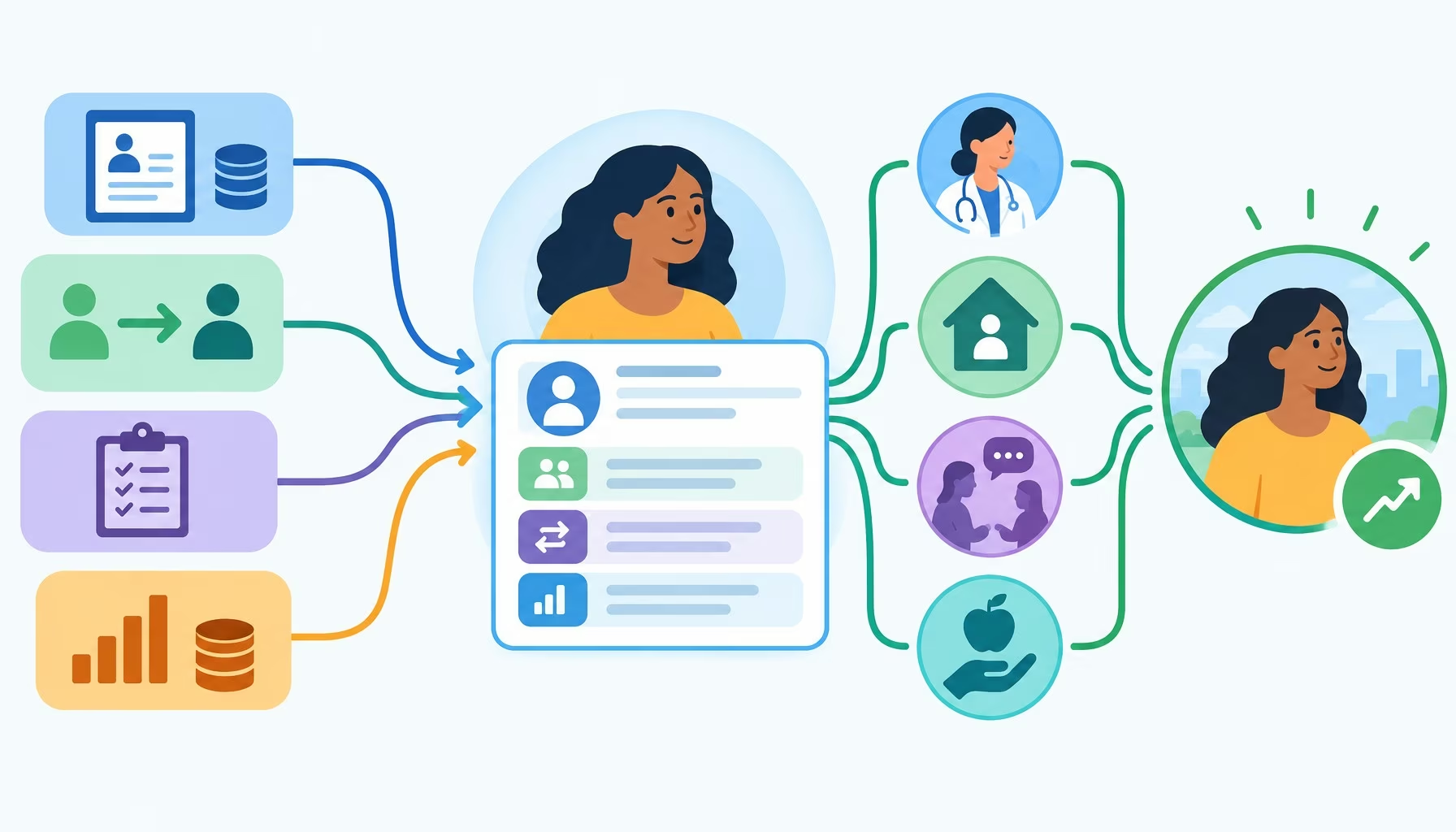
Social service data integration connects program records, referral workflows, and outcome measures so agencies can act on one accurate client picture. Agreeing on shared service pathways, standardizing core data fields, and enforcing role-based privacy controls cuts duplicate intake, prevents missed referrals, and speeds up coordinated care.
The result is inefficiency that compounds: duplicated effort, missed referrals, and changes in a client’s condition that nobody records. More data alone won’t fix this. Agencies need real methods for integrating information and distributing responsibility across the people who touch it.
Core priorities for connecting agency records include four operational practices:
- Eliminate siloed intake bottlenecks: Fragmented program records force staff to re-verify basic client history and cause external referrals to stall without follow-up.
- Standardize pathways before swapping software: Effective integration starts with agreed service pathways, clear data ownership, and selective information exchange across partner agencies.
- Measure real service delivery: Track referral completion times, service continuity, accessibility, and client experience alongside administrative speed.
- Enforce strict privacy boundaries: Protect sensitive records through role-based access controls, verified legal and consent grounds, and data minimization.
Why Disconnected Records Create Problems
Fragmentation usually creeps in one system at a time. The housing program gets its own database. The family support program keeps its own records. An outside organization working with both sends updates by email.
Each system works fine on its own. The gaps between them become someone else’s workload. Staff spend hours re-confirming information that already exists in another system. A referral gets logged as sent, yet no one has followed up with the receiving agency about the client.
These problems get worse when a person draws help from multiple sources. A change in housing can ripple into a family’s employment status, health, or educational opportunities. Without a reliable way to pass that information along, every source makes decisions on incomplete data.
We did a lot of really great things, but we did them in a vacuum.
Chris Schneweis, Senior Business Analyst, Johnson County (Kansas) Department of Corrections, in Data analysis leads to better treatment for frequent users of social services, NACo County News, April 2023A database isn’t the whole answer – though technology helps considerably. First, identify what information needs tracking, how often it changes, and who owns it. Research from the National Academies on integrating social care notes that because sector data are frequently siloed, aligning social needs with care delivery has historically relied on labor-intensive manual coordination.
Building a More Connected Information System
A useful starting point is agreement on each client’s service pathway. The specifics depend on the organization, but the components tend to look familiar: assessments, referrals, service plans, follow-ups, and outcome documentation. Get that pathway right and authorized staff know what was done, what still needs doing, and who carries the next step.

Social work case management software can help organizations handling complex cases. What makes it valuable isn’t digitizing paper – it’s pulling all relevant information into one unified process. A referral workflow, for example, should capture when the referral was made, name the receiving agency, and flag cases that need follow-up.
Interoperability matters just as much. Federal resources on interoperability and health information exchange outline practical standards for connecting separate record systems. Much of that material is healthcare-specific, but the underlying principle applies everywhere.
Before replacing anything, map what you already run. Duplicate data fields, incompatible formats, and manual transfers are where improvement opportunities hide. Standardizing basics – referral status, dates of service, provider identification numbers – can improve coordination before a single system gets swapped out.
Keep integration selective. Organizations don’t need access to every partner record. They need the right mechanism for exchanging the information that matters. Evidence reviewed by County Health Rankings & Roadmaps shows that effective social and health service integration pairs a coordinating mechanism for service delivery planning with shared quality measurement and data-sharing tools.
| Operational Dimension | Siloed Program Records | Connected Social Service Information System |
|---|---|---|
| Data Location | Scattered across separate program databases, spreadsheets, paper files, and email threads. | Unified around a shared client service pathway with standardized status and provider fields. |
| Referral Tracking | Logged as sent in one system with no automated visibility into partner agency contact or follow-up. | Tracks referral timestamps, names the receiving agency, and flags stalled cases needing follow-up. |
| Outcome Measurement | Counts administrative outputs in isolation without linking referrals to service completion. | Measures referral completion speed, repeated assessments, service continuity, and client experience. |
| Privacy Controls | Ad hoc file transfers or overly broad record sharing across email and disconnected spreadsheets. | Role-based access permissions, documented consent and sharing agreements, and data minimization. |
| Staff Workload | Hours spent manually re-confirming client history and reconciling conflicting program files. | Clear ownership of updates and automated status visibility across authorized care teams. |
Measuring Whether Better Information Improves Outcomes
Linking databases is a technical achievement, not an end in itself. The real question: does better information flow actually improve access for the people being served? Agencies answer this by tracking referral completion rates, contact latency, and repeated assessment failures alongside client feedback.
Referral completion is one concrete measure. Track how many referrals are made, how many result in contact with the receiving agency, and how long that contact takes. Repeated assessment failures may signal ineffective information transfer. Delays after eligibility is determined may point to confused responsibilities.
Federal performance resources associated with the United States Office of Management and Budget illustrate how program operations connect to tangible results. Social service agencies can borrow the same approach: define intended outcomes first, then choose measures, then check regularly whether the data actually shows progress.
Efficiency metrics need to sit alongside staff feedback and client experience. Fast isn’t the same as better – especially if clients still repeat the same personal information to several agencies. A rising referral count might reflect improved record-keeping instead of improved access.
Evaluate on four fronts: efficiency, continuity of services, accessibility, and the experience of the people receiving help.
Protecting Privacy While Improving Coordination
Sharing information creates opportunity and obligation in equal measure. Social service records can hold deeply confidential details – health status, financial stability, family life, housing conditions, personal safety. Open those records without proper safeguards and clients become vulnerable.
Set access rules based on what employees actually do and their right to use the data. Role-based access, backed by a clear data governance framework, can restrict who views or edits records and track unauthorized access.
Informed consent and legal grounds deserve careful attention. Before releasing records across programs or external partners, organizations should confirm applicable consent requirements, legal authority, and formal data-sharing agreements. That agreement should spell out what can be shared, for what purpose, and what happens if something goes wrong.
Data minimization is essential. Share only what coordination requires – not entire records as a matter of routine. De-identified or aggregated data lets managers spot service patterns without identifying anyone.
Making Data Useful in Everyday Practice
An integrated information system succeeds when it fits how work actually gets done. Staff need clear procedures for recording changes, correcting bad information, and resolving discrepancies. Training matters too – people have to understand why documenting a process serves their peers and their clients.
Start with a process that reliably causes delays. Document how it runs today, agree on standard statuses, and test the new approach with a small group of staff.
Leadership carries the weight here. There must be consensus on who owns specific information, how disputes get settled, and which measures get reviewed. Without accountability, even the most advanced system degrades into a pile of stale records.
Better information management isn’t about collecting the maximum amount of data. It’s about making sure the right information is accurate and available at the moment it’s needed. Integrate systems with a sound process and proper protections in place, and staff spend less time hunting for records – and more time helping citizens use the services they came for.
FAQ
Common operational questions from agency directors and systems teams focus on practical steps for connecting program databases and verifying whether shared records improve client service delivery.
How can social service agencies build a more connected information system?
Agencies start by agreeing on a client service pathway covering assessments, referrals, service plans, follow-ups, and outcomes. Before replacing software, teams map existing databases to eliminate duplicate fields and standardize core elements like referral statuses, service dates, and provider IDs. Selective, interoperable data exchange and case management software then connect partner workflows without exposing full client records unnecessarily.
How do you measure whether better information improves outcomes?
Agencies define intended client outcomes first and track operational indicators tied to real access. Concrete measures include how many referrals result in confirmed contact with the receiving agency, how long that contact takes, and how often clients face repeated assessments or post-eligibility delays. Teams pair these numbers with staff feedback and client experience across efficiency, service continuity, and accessibility.