Cookies help us display personalized product recommendations and ensure you have great shopping experience.

By using this site, you agree to the Privacy Policy and Terms of Use.
Accept
SmartData CollectiveSmartData Collective
  • Analytics
    AnalyticsShow More
    unusual trading activity
    Signal Or Noise? A Decision Tree For Evaluating Unusual Trading Activity
    3 Min Read
    software developer using ai
    How Data Analytics Helps Developers Deliver Better Tech Services
    8 Min Read
    ai for stock trading
    Can Data Analytics Help Investors Outperform Warren Buffett
    9 Min Read
    media monitoring
    Signals In The Noise: Using Media Monitoring To Manage Negative Publicity
    5 Min Read
    data analytics
    How Data Analytics Can Help You Construct A Financial Weather Map
    4 Min Read
  • Big Data
  • BI
  • Exclusive
  • IT
  • Marketing
  • Software
Search
© 2008-25 SmartData Collective. All Rights Reserved.
Reading: The ATI’s Radeon HD 5970 is a Supercomputer in your desktop
Share
Notification
Font ResizerAa
SmartData CollectiveSmartData Collective
Font ResizerAa
Search
  • About
  • Help
  • Privacy
Follow US
© 2008-23 SmartData Collective. All Rights Reserved.
SmartData Collective > Uncategorized > The ATI’s Radeon HD 5970 is a Supercomputer in your desktop
Uncategorized

The ATI’s Radeon HD 5970 is a Supercomputer in your desktop

BobGourley
BobGourley
5 Min Read
SHARE

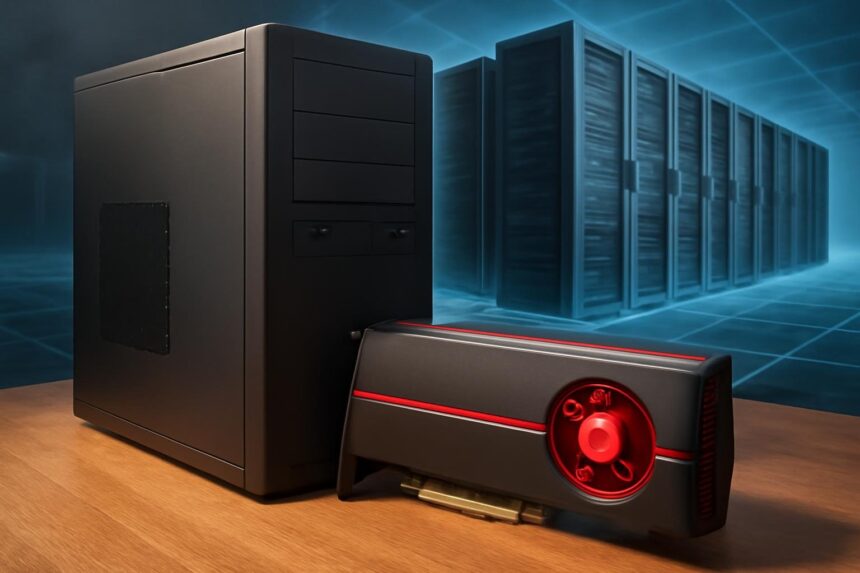
The Radeon HD 5970 is the fastest single card graphics solution – but it is also a powerful supercomputer!

Bright Side of News recently wrote an article reporting on ElcomSoft’s GPU computing attempts.  They used various GPUs to hack WPA-PSK passwords.  Check out the results here.   ElcomSoft leverages the immense computing power of latest generation graphics cards.  Cards such as ATI’s Radeon HD 5970, and nVidia’s GTX 295.  The HD 5970 is ATI’s latest offering, it has 2 GPUs, with 3200 stream processing units, and 2 GB of DDR5 RAM.  Stream processors are a form of parallel processors that are optimized for I/O intense operations.  This GPU is basically an incredibly powerful computing device inside the computer traditionally optimized for video processing.  However, nVidia uses  a process called “CUDA”, and ATI one called “Stream” to utilize the GPUs as parallel processing chips.   These processes enable incredibly powerful and capable parallel processing from GPUs.

CUDA and ATI Stream are valued  by crytopgraphers, developers, and programmers as supercomputers.  They have found these to be (relatively) …

The Radeon HD 5970 is the fastest single card graphics solution – but it is also a powerful supercomputer!

Bright Side of News recently wrote an article reporting on ElcomSoft’s GPU computing attempts.  They used various GPUs to hack WPA-PSK passwords.  Check out the results here.   ElcomSoft leverages the immense computing power of latest generation graphics cards.  Cards such as ATI’s Radeon HD 5970, and nVidia’s GTX 295.  The HD 5970 is ATI’s latest offering, it has 2 GPUs, with 3200 stream processing units, and 2 GB of DDR5 RAM.  Stream processors are a form of parallel processors that are optimized for I/O intense operations.  This GPU is basically an incredibly powerful computing device inside the computer traditionally optimized for video processing.  However, nVidia uses  a process called “CUDA”, and ATI one called “Stream” to utilize the GPUs as parallel processing chips.   These processes enable incredibly powerful and capable parallel processing from GPUs.

More Read

Change Management and Lance Armstrong in the 2009 Tour de France
The Now Economy
Guest Post by Brent Arslaner: The Next Generation of Lead Generation
When Government Officials Should Not Blog
The Big Data Interview: Sanjay Mirchandani, CIO

CUDA and ATI Stream are valued  by crytopgraphers, developers, and programmers as supercomputers.  They have found these to be (relatively) inexpensive ways to boost CPU cycles.  An ATI Radeon HD 5970 runs $650 on the streets, and yet is 25x as powerful as the $250 Intel core i7 920 CPU (at the task of password cracking).  The Core i7 920 is mainly a consumer chip, but has found use in powerful workstations.  Intel has recently released a six-core version on the Core i7 platform, the 980X, which retails around $1,000, yet barely breaks 6,000 guessed passwords per second (the HD 5970 hits 100k, while the 920 is about 4k).  Thus, utilizing GPU processing can be substantially less expensive than upgrading CPUs (with greater pay off).

So what does this mean?  I think we might see malicious actors start to use GPU enabled laptops or remote desktop access to hack into wireless networks.  An actor with a netbook or a properly equipped smartphone can dial into their GPU enabled desktop at home enabling access to this supercomputer.  This capability to crack passwords faster than ever will provide them with powerful capabilities to get into networks, and from there, cause harm.  Additionally,  CUDA/ATI Stream allow users to plug into large grids to enable massive supercomputing.  SETI and Folding@Home are two such efforts that use distributed computing resources to complete monumental tasks.  Smart hackers/adversaries could turn botnets into distributed, powerful supercomputer grids, and leverage them to deploy even more powerful attacks/exploits.

ASUS G Series G73JH-X1 17.3" Windows 7 Home Premium 64-bit NoteBook - Retail

This laptop could hack your WIFI network in just a few seconds!

GPU computing is here to stay, and there will be a wide variety of formats that benefit consumers and corporate users.  I think we will see GPU computing used in more and more fashions.    There are a few barriers to entry (high dollar GPUs, expensive motherboards, large space requirements, and large power requirements).  These GPUs cannot be plugged into your standard desktop PC.  They need motherboards with PCI Express Ports, and a dedicated 300W+  each.  But the ability to readily add incredible computing power to your PC (or laptop) is one that cannot be ignored.

To our readers: do you have any experience with GPU computing? If so, please leave your thoughts, conclusions, and experiences below.


Link to original post

TAGGED:security
Share This Article
Facebook Pinterest LinkedIn
Share

Follow us on Facebook

Latest News

fda14abd c869 4da5 943c c036ad8efc2e
How Data-Driven Journalists Are Using API News Apps to Improve Reporting
Big Data Exclusive News
0622cae5 f7d7 4f74 84b5 eabd1a823dca
How Data-Driven Grocery Recommendations Help Shoppers Eat Better With Less Effort
Big Data Exclusive
business recovering from data loss
How Data-Driven Businesses Protect MySQL Databases from Shutdown
Big Data Exclusive
ai driven task management
Reducing “Work About Work” with AI Task Managers
Artificial Intelligence Exclusive

Stay Connected

1.2KFollowersLike
33.7KFollowersFollow
222FollowersPin

You Might also Like

The Next Wave in Recommendation Systems?

4 Min Read
IoT Security
ExclusiveInternet of ThingsSecurity

Ensuring Cybersecurity When Rolling Out IoT Across Your Business Operations

8 Min Read

Answer to OTP Bypass: Out-of-Band Two-Factor Authentication

8 Min Read
facebook libra cryptocurrency
Big DataBlockchainExclusivePrivacy

Does Facebook “Libra” Illustrate The Dark Side Of Big Data?

6 Min Read

SmartData Collective is one of the largest & trusted community covering technical content about Big Data, BI, Cloud, Analytics, Artificial Intelligence, IoT & more.

AI and chatbots
Chatbots and SEO: How Can Chatbots Improve Your SEO Ranking?
Artificial Intelligence Chatbots Exclusive
giveaway chatbots
How To Get An Award Winning Giveaway Bot
Big Data Chatbots Exclusive

Quick Link

  • About
  • Contact
  • Privacy
Follow US
© 2008-25 SmartData Collective. All Rights Reserved.
Welcome Back!

Sign in to your account

Username or Email Address
Password

Lost your password?