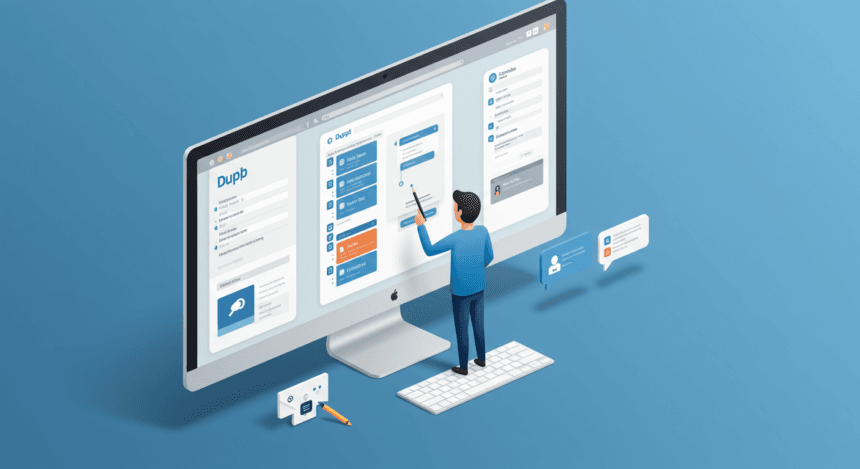
Are you thinking about expanding your digital presence? No matter the scale of your business, it’ll be a challenge, for sure. This is why it’s essential to have a strong foundation for all your online efforts – a content management system that’s both reliable and easy to scale up. And Drupal might be the one for your enterprise. In this article, we’ll explain why you should at least consider adopting Drupal and what differentiates it from other CMS solutions.
Big data is becoming more important for businesses than ever. Around 60% of companies are using data analytics and 56% of business leaders plan to increase their spending on big data.
However, many companies don’t use data wisely. Only around 30% have a formal data strategy at all. One of their biggest mistakes is not knowing how to use big data in their online business strategy.
When you are running a data-driven business, you can’t afford to ignore the benefits of having a strong online presence. One of the things that you need to consider is having a website that can reach customers effectively. You can use data analytics to better understand your target audience and reach them as effectively as possible.
This means that you need a good content management system. Drupal is one of the best for data-driven businesses.
Intro to Drupal
Drupal is an open-source content management system (CMS), used for building and maintaining websites, e-commerce stores, intranets… in fact, all types of digital content. It’s a solution in the same realm as WordPress or Joomla – and just like them, it works both for personal websites and more complex commercial projects. But if we were to specify who Drupal is designed for – truly, it is all about catering to businesses.
What can you build in Drupal?
One of Drupal’s biggest advantages is its versatility. It can serve as a backbone for all kinds of web projects:
- High-traffic corporate websites – that have to maintain a consistent brand presence, support all the company’s content and, of course, guarantee a top-notch experience to all visitors.
- E-commerce stores – probably the most challenging of all; requiring complex integrations with both internal (CRM/PIM/ERP platforms) and external (payment gateways, analytics tools) systems, while having to handle robust product catalogs and keep their performance high, especially during peak traffic times. Plus, nowadays, customers are expecting a heavily-personalized experience.
- Intranets – tailored for specific company needs, with dedicated workflows, access control systems, built-in communication and data-management tools.
- Finance, healthcare and educational services – which not only have to provide professional, high-quality content but also ensure top-notch security for all sensitive data they handle.
Drupal offers solutions to each of these issues. It’s not a coincidence that The European Commission, Tesla and Oxford University (among many) have all decided to rely on Drupal for their websites’ content management. It can also be very effective for creating websites quickly, sometimes in less than an hour.
What makes Drupal different from other solutions?
There are two major reasons why Drupal stands out among other content management systems (even the more widely-used ones, like WordPress).
Reason #1 – modularity
Drupal’s versatility has a lot to do with the way the platform approaches website development. Its environment is fully based on over 50,000 unique modules, each one comes with specific features to implement on a website. A developer’s main task is to choose which modules should be enabled for the needs of the website or application and adapt them to the structure in mind.
The modular structure lets developers add and subtract the site’s functionalities whenever your business demands shift, without a need to develop each new feature from scratch. Of course, many of those modules (and themes – for the look and feel of your website) have to be at least a bit customized to keep the project cohesive and meet your business’s unique requirements – but they also hold their own as the out-of-the-box solutions.
On a side note: Drupal is just as effective at connecting your website with other systems. The platform works flawlessly with APIs by itself – but it also offers multiple modules specifically for integrating third-party solutions. Drupal even has its own API link, which leads us to…
Reason #2 – headless approach to development
There are two types of content management systems – headless and, so to speak, traditional.
Traditional CMS is responsible for both content management and the way it’s displayed. In such cases, they are inseparable and heavily dependent on each other. It has its benefits – with traditional CMS you can easily manage all the website’s resources from one place, without much technical knowledge. And that’s great… until it’s not.
This interdependence between content and its presentation layer can be very limiting. Let’s say that your business publishes content on its website, on the intranet platform and in the mobile app. With a traditional CMS approach, you’d have to manage all these channels separately; of course, you’d be able to use the same platform for the website and the intranet, but what about the app?
Headless CMS is the solution. In that case, the frontend is detached from the content management system, and you’re able to develop it however you want (for example, as a mobile app). CMS serves only as a central hub for creating and managing content, without having any direct impact on the frontend side.
But how is the content published? Through API links. You can connect your headless CMS with all your platforms – websites, apps – through a simple API and then, simultaneously publish content from CMS across all of them. Each platform will process the content in its own way to optimize it according to the design of a presentation layer.
The great thing about Drupal is, it goes with both approaches just as well. If your business is run with an omnichannel strategy at its heart, with multiple communication and sales channels – Drupal’s headless approach will bring you all the flexibility and scalability you need. And if you’re focused on a single channel – you can simply go for a traditional approach, which Drupal’s got covered, too.
Looking for more reasons to grow your online presence with Drupal?
That’s not everything about Drupal that makes it so well-fitted for enterprise use. The CMS:
- is secure and reliable;
- provides a user-friendly low-code platform that is quite easy for content creators lacking technical expertise to navigate;
- when optimized correctly, it can ensure fast loading speeds and strong technical SEO results.
If you want to know more about Drupal’s features and how to choose your development partner – look at what Drupal experts have to say at https://smartbees.co/blog/how-choose-drupal-partner !