
We use cookies, including third-party cookies from Google to serve personalized ads through AdSense, to operate this site and understand how it is used. By continuing to browse, you accept this use. See our Privacy Policy and Terms of Use for details, including how to opt out of personalized advertising.
Accept
SmartData CollectiveSmartData Collective
  • Analytics
    AnalyticsShow More
    What Kind of Problem-Solving Distinguishes Data Analysts From Software Engineers -- AI-generated illustration
    What Kind of Problem-Solving Distinguishes Data Analysts From Software Engineers
    7 Min Read
    chatgpt image jul 21, 2026, 04 34 30 pm
    4 Core Benefits of Predictive Maintenance after Vibration Analysis
    10 Min Read
    How Does Data Mining Boost Customer Satisfaction in Logistics? Harnessing Analytics for Results -- AI-generated illustration
    How Does Data Mining Boost Customer Satisfaction in Logistics? Harnessing Analytics for Results
    11 Min Read
    chatgpt image jul 13, 2026, 04 23 45 pm
    How Data Analytics Helps Companies Improve User Engagement
    19 Min Read
    chatgpt image jul 13, 2026, 03 59 46 pm
    How Data Analytics Improves Multi-Location Search Strategies
    10 Min Read
  • Big Data
  • BI
  • Exclusive
  • IT
  • Marketing
  • Software
Search
© 2008-25 SmartData Collective. All Rights Reserved.
Reading: Who Gets the Call When Your Analytics Process Crashes?
Share
Notification
Font ResizerAa
SmartData CollectiveSmartData Collective
Font ResizerAa
Search
  • About
  • Help
  • Privacy
Follow US
© 2008-23 SmartData Collective. All Rights Reserved.
SmartData Collective > Big Data > Data Mining > Who Gets the Call When Your Analytics Process Crashes?
AnalyticsBig DataData ManagementData MiningModelingPolicy and GovernancePredictive AnalyticsStatistics

Who Gets the Call When Your Analytics Process Crashes?

BillFranks
BillFranks
6 Min Read
Who Gets the Call When Your Analytics Process Crashes?
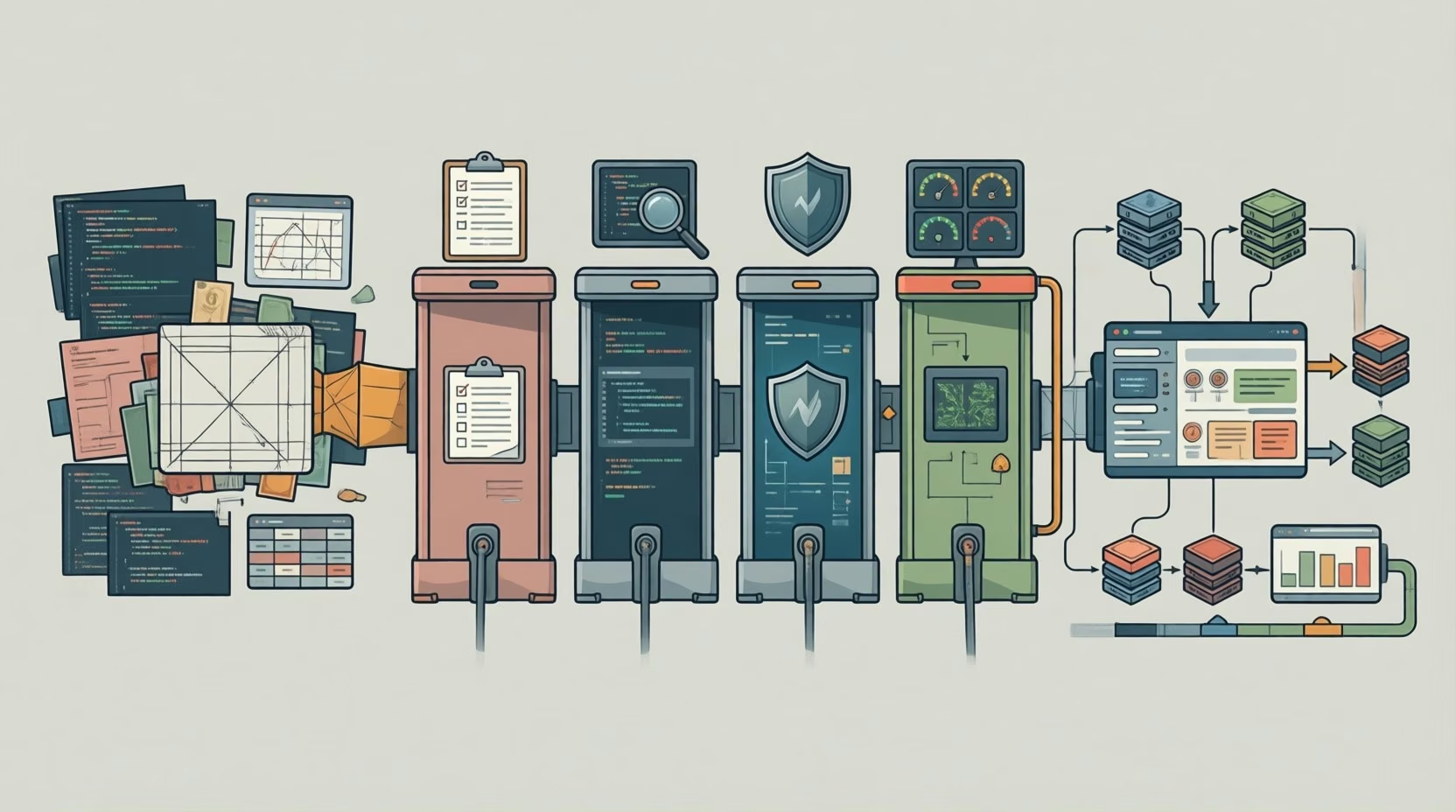
Illustration generated with FLUX.2 [klein 4B] via Cloudflare Workers AI.
SHARE

I recently had a meeting with one of the largest companies in the world, where we discussed concerns about ongoing maintenance and, more importantly, ongoing repair required for analytics processes. The conversation helped solidify in my mind a major disconnect that often occurs when organizations deploy an analytics process into a production setting. Let’s walk through that disconnect here.

Contents
  • The Background
  • Who Gets The Call?

The Background

In this case, I was speaking with the IT leadership team that was responsible for the systems used for production analytics. As is the case with many companies, demand for analytics had been increasing and the IT team wanted to figure out how to best handle the anticipated influx of additional analytics processes that would be coming their way. As our discussion turned to the policies that should guide a process from the discovery phase to the production phase, an interesting issue was raised.

At this client, once a process is turned over to production, it is considered fully IT’s responsibility. This includes even the accuracy and maintenance of the analytic logic within the processes. The IT team is understandably quite concerned about taking ownership and responsibility for the logic of increasingly complex analytics processes. They just don’t have people with the analytical knowledge to effectively take that ownership. The only spots in the company with the requisite skills are the analytic teams creating the processes.

IT feels it has been burned too many times in the past when analytics processes were thrown over the wall to them and then they had to scramble to deal with issues that arose. They were hesitant to continue to add more processes without a better way to handle maintenance. I believe that my client’s real problem is with the contract that IT has with the analytics teams when it comes to placing something into production.
More Read

How To Get An Award Winning Giveaway Bot
Analytics’ Role in Marketing
Planning For The Future: Understanding Scalability Requirements
3 Legal Repercussions of Cyber Attacks
Does information technology create or destroy jobs? Or is this even the right question?

Who Gets The Call?

In this case, I see a serious issue in the precedents that have been set for production processes that must be addressed. Namely, it makes no sense to me that IT should have full responsibility for complex analytics processes built by an analytics team. IT should ensure that the systems are up, the data is accessible, and the necessary system resources are available so that the processes run smoothly. The logic of those processes, however, should remain under ownership of those who built them even when it is in production.

When logic is simple, such as standard reporting, it is reasonable to hand over all responsibility to IT. It does not make sense for complex analytics that may include predictive modeling, machine learning, or other advanced techniques in addition to all the requisite data preparation logic for those techniques. Analytics teams have to step up to the job of maintaining ownership of the processes they build in the long term. That means getting the phone call that something has broken at an inconvenient time. In the end, an organization needs problems with an analytics process solved as swiftly, completely, and accurately as possible. Only those with the knowledge to build such a process have the ability to meet this requirement. The responsibility rests squarely on analytics teams.

In the old days when a new analytics process had to be built on different systems and with different toolsets than the production environment, it was hard to avoid this disconnect. For example, IT often re-coded a process written in SAS to run directly within a mainframe or other operational system. While the analytics team built the initial logic, they weren’t familiar with the deployment environment or the language used to code the production process. Therefore, IT was stuck owning it all. This scenario was never a good one but was a necessary evil. With today’s technology, it is entirely possible for an analytics team to both develop and deploy an analytics process at scale using the same toolsets and to take full advantage of the power of the production system.

I don’t believe that most analytics professionals will balk at maintaining ownership of what they build. I know I wouldn’t. It is just a matter of asking them to maintain ownership and updating the “contract” with IT so that the split of who owns what pieces of the production process is changed. Unfortunately, in many organizations IT has not asked for this change nor has the analytics team suggested it. As a result, the deployment of analytics is much more stressful and carries much more risk than it needs to. Take a few moments to assess if your organization needs to update its deployment policies.

Share This Article
Facebook Pinterest LinkedIn
Share
ByBillFranks
Follow:
Bill Franks is Chief Analytics Officer for The International Institute For Analytics (IIA). Franks is also the author of Taming The Big Data Tidal Wave and The Analytics Revolution. His work has spanned clients in a variety of industries for companies ranging in size from Fortune 100 companies to small non-profit organizations. You can learn more at http://www.bill-franks.com.

Follow us on Facebook

Latest News

Flat editorial illustration: The article's core relationship is the engineering transition from an AI prototype to a production-r
From AI Prototype to Production: Observability and Scalability Requirements for Data-Heavy SaaS Applications
Artificial Intelligence Exclusive
Preparing Data Systems and Governance for a Scaling Global Gaming Brand -- AI-generated illustration
Preparing Data Systems and Governance for a Scaling Global Gaming Brand
Big Data Infographic
How Restaurant POS and Ordering Data Reveal Generational Customer Patterns -- AI-generated illustration
How Restaurant POS and Ordering Data Reveal Generational Customer Patterns
Exclusive Infographic
From Trucks To Data: How Telematics Can Improve Freight Transportation -- AI-generated illustration
From Trucks To Data: How Telematics Can Improve Freight Transportation
Big Data Exclusive Infographic

Stay Connected

1.2KFollowersLike
33.7KFollowersFollow
222FollowersPin

You Might also Like

The Great Debate: SAS vs. R
R Programming LanguageStatistics

The Great Debate: SAS vs. R

3 Min Read
big data in preventative care
AnalyticsBig DataExclusive

Big Data For Preventative Care In The Healthcare Field

4 Min Read
How Real-Time and Location Data Are Revolutionizing the Healthcare Industry
AnalyticsBig DataExclusiveNewsWorkforce Data

How Real-Time and Location Data Are Revolutionizing the Healthcare Industry

7 Min Read
SEO Consultants Made Big Data a Core Strategy Component
Big DataExclusive

SEO Consultants Made Big Data a Core Strategy Component

10 Min Read

SmartData Collective is one of the largest & trusted community covering technical content about Big Data, BI, Cloud, Analytics, Artificial Intelligence, IoT & more.

5 Great Tips for Using Data Analytics for Website UX
Big Data
AI chatbots
AI Chatbots Can Help Retailers Convert Live Broadcast Viewers into Sales!
Chatbots

Quick Link

  • About
  • Contact
  • Privacy
Follow US
© 2008-26 SmartData Collective. All Rights Reserved.
Welcome Back!

Sign in to your account

Username or Email Address
Password

Lost your password?