We use cookies, including third-party cookies from Google to serve personalized ads through AdSense, to operate this site and understand how it is used. By continuing to browse, you accept this use. See our Privacy Policy and Terms of Use for details, including how to opt out of personalized advertising.
Accept
SmartData CollectiveSmartData Collective
  • Analytics
    AnalyticsShow More
    chatgpt image jul 21, 2026, 04 34 30 pm
    4 Core Benefits of Predictive Maintenance after Vibration Analysis
    10 Min Read
    How Does Data Mining Boost Customer Satisfaction in Logistics? Harnessing Analytics for Results -- AI-generated illustration
    How Does Data Mining Boost Customer Satisfaction in Logistics? Harnessing Analytics for Results
    11 Min Read
    chatgpt image jul 13, 2026, 04 23 45 pm
    How Data Analytics Helps Companies Improve User Engagement
    19 Min Read
    chatgpt image jul 13, 2026, 03 59 46 pm
    How Data Analytics Improves Multi-Location Search Strategies
    10 Min Read
    cybersecurity efforts
    How Behavioral Analytics and AI Are Redefining Cybersecurity for Boca Raton Businesses
    14 Min Read
  • Big Data
  • BI
  • Exclusive
  • IT
  • Marketing
  • Software
Search
© 2008-25 SmartData Collective. All Rights Reserved.
Reading: What Does the Modern IT Team Look Like?
Share
Notification
Font ResizerAa
SmartData CollectiveSmartData Collective
Font ResizerAa
Search
  • About
  • Help
  • Privacy
Follow US
© 2008-23 SmartData Collective. All Rights Reserved.
SmartData Collective > Uncategorized > What Does the Modern IT Team Look Like?
Uncategorized

What Does the Modern IT Team Look Like?

LinuxIT
LinuxIT
4 Min Read
What Does the Modern IT Team Look Like?
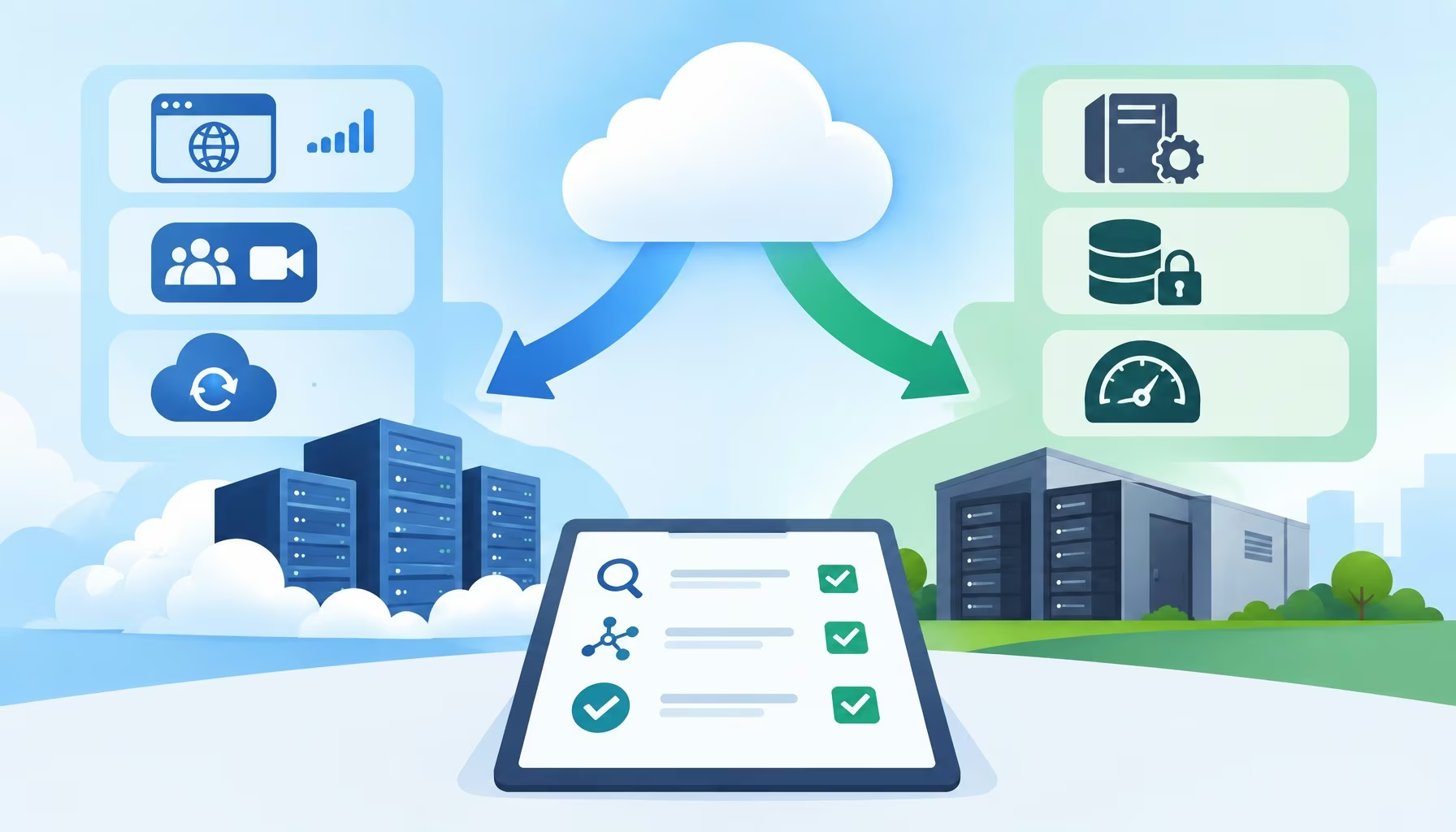
Illustration generated with FLUX.2 [klein 4B] via Cloudflare Workers AI.
SHARE

IT teams need to evolve in order to meet new challenges – make sure you have got the right in-house and outsourced resource with this analysis.

Contents
  • TAKEAWAYS:
  • Get the right mix in your modern IT team, combined with outsourced services: Integrating IT- Making the Old Work with the New
IT teams need to evolve in order to meet new challenges – make sure you have got the right in-house and outsourced resource with this analysis.

More Read

Why Would I Ever Tweet?
The Technology Adoption Life Cycle
Predictive Analytics Interview Series: Jack Levis of UPS
Here Comes Web 3.0: Wolfram|Alpha Launches Today
Rate Your Local Police Online

IT teams are evolving. The old model of a Finance/IT Director supported by Infrastructure and Application managers, with a host of network engineers and developers, is changing to meet new challenges.

In most organisations, IT used to be almost entirely about finance: sales, cash flow, payroll and purchasing. Organisations often developed their own software and built their own networks. They needed network engineers, a Wintel team, a mainframe team … Now, much of the software is off-the-shelf, running on commodity hardware, or abstracted to SaaS – the CIO has emerged to coordinate it all.

The Chief ‘I’ Officer role is complex. Officially the ‘I’ stands for Information, but it includes Infrastructure, Intelligence, Integration and Innovation. In a large organisation, some of these might be individual job descriptions, or they might be bundled into other roles.

Architecture, Business Change, Service Aggregation, SaaS, PaaS, MSP, Cloud Storage, Cloud Compute, Disaster Recovery, Governance, Compliance, Business Intelligence, Infrastructure.

Every organisation is different. The number of people you need to fulfil all the roles depends on the size of the organisation, the market sector in which it operates, and to some extent on location and legacy. Here’s a selection of the sort of people most mid-to-large organisations need in IT.

The IT architect uses IT to meet specific business requirements. IT architects focus on the cost/benefits of investments in IT. This requires skill in planning, implementing, and managing infrastructure and applications.

Business Intelligence analysts use data to improve efficiency and profits. They may work for an organisation or play a consultancy role. Data mining the organisation’s records, they can understand where the organisation stands, where they can improve and where they can reduce costs.

The Chief Compliance Officer is primarily responsible for overseeing and managing all regulatory compliance issues within an organisation. Compliance with data protection and ensuring privacy and security in IT are all so important that this particular aspect may be a separate role.

Orchestrating this changing mix of in-house professionals and outsourced services is a huge job, some of which can itself be outsourced. A carefully designed SLA with a good managed services provider (MSP) can take a lot of weight off the CIO’s shoulders.

TAKEAWAYS:

Remember:

  • The IT landscape is changing constantly – your IT team needs to evolve with it, to keep up with the times
  • Plan intervals to reassess your organisation’s requirements for in-house resource and outsourced services
  • The job of orchestrating a changing mix of in-house professionals and outsourced services can itself be outsourced to experts.

Get the right mix in your modern IT team, combined with outsourced services: Integrating IT- Making the Old Work with the New
Integrating IT- Making the Old Work with the New

TAGGED:it
Share This Article
Facebook Pinterest LinkedIn
Share

Follow us on Facebook

Latest News

Analyst points at colorful circular data dashboard on screen - information technology business metrics
How Fragmented Workplace Tech Undermines Reliable Business Metrics and Reporting
Cloud Computing Exclusive Infographic IT
Using Multi-Source Data and Analytics to Detect Operational Drift Across Franchise Networks -- AI-generated illustration
Using Multi-Source Data and Analytics to Detect Operational Drift Across Franchise Networks
Exclusive Infographic
Beyond The First Impression: The Long-Lasting Impact Of Sensory Marketing -- AI-generated illustration
Beyond The First Impression: The Long-Lasting Impact Of Sensory Marketing
Infographic Marketing
The Infrastructure Gap Slowing Data Center Growth -- AI-generated illustration
The Infrastructure Gap Slowing Data Center Growth
Big Data Cloud Computing Exclusive Infographic IT

Stay Connected

1.2KFollowersLike
33.7KFollowersFollow
222FollowersPin

You Might also Like

Big Data Is More Valuable with Kapow
Big DataBusiness IntelligenceSoftware

Big Data Is More Valuable with Kapow

6 Min Read
Jazz Solos & Nerdy Code
Uncategorized

Jazz Solos & Nerdy Code

7 Min Read
No More CIO? At Forrester, New Title Signals New Approach to IT
Culture/Leadership

No More CIO? At Forrester, New Title Signals New Approach to IT

4 Min Read
Can Enterprise IT Borrow from Lean Startup Thinking?
Uncategorized

Can Enterprise IT Borrow from Lean Startup Thinking?

4 Min Read

SmartData Collective is one of the largest & trusted community covering technical content about Big Data, BI, Cloud, Analytics, Artificial Intelligence, IoT & more.

From Bolts to Bots: How AI Is Fortifying the Automotive Industry
Artificial Intelligence
The Art of Conversation: Enhancing Chatbots with Advanced AI Prompts
Chatbots

Quick Link

  • About
  • Contact
  • Privacy
Follow US
© 2008-26 SmartData Collective. All Rights Reserved.
Welcome Back!

Sign in to your account

Username or Email Address
Password

Lost your password?