We use cookies, including third-party cookies from Google to serve personalized ads through AdSense, to operate this site and understand how it is used. By continuing to browse, you accept this use. See our Privacy Policy and Terms of Use for details, including how to opt out of personalized advertising.
Accept
SmartData CollectiveSmartData Collective
  • Analytics
    AnalyticsShow More
    What Kind of Problem-Solving Distinguishes Data Analysts From Software Engineers -- AI-generated illustration
    What Kind of Problem-Solving Distinguishes Data Analysts From Software Engineers
    7 Min Read
    chatgpt image jul 21, 2026, 04 34 30 pm
    4 Core Benefits of Predictive Maintenance after Vibration Analysis
    10 Min Read
    How Does Data Mining Boost Customer Satisfaction in Logistics? Harnessing Analytics for Results -- AI-generated illustration
    How Does Data Mining Boost Customer Satisfaction in Logistics? Harnessing Analytics for Results
    11 Min Read
    chatgpt image jul 13, 2026, 04 23 45 pm
    How Data Analytics Helps Companies Improve User Engagement
    19 Min Read
    chatgpt image jul 13, 2026, 03 59 46 pm
    How Data Analytics Improves Multi-Location Search Strategies
    10 Min Read
  • Big Data
  • BI
  • Exclusive
  • IT
  • Marketing
  • Software
Search
© 2008-25 SmartData Collective. All Rights Reserved.
Reading: The Sea Change and Enterprise 1.5
Share
Notification
Font ResizerAa
SmartData CollectiveSmartData Collective
Font ResizerAa
Search
  • About
  • Help
  • Privacy
Follow US
© 2008-23 SmartData Collective. All Rights Reserved.
SmartData Collective > Data Management > Culture/Leadership > The Sea Change and Enterprise 1.5
CommentaryCulture/LeadershipInside Companies

The Sea Change and Enterprise 1.5

MIKE20
MIKE20
4 Min Read
The Sea Change and Enterprise 1.5
Photo by Thirdman on Pexels (https://www.pexels.com/photo/people-working-together-at-the-office-7652185/)
SHARE

“Man is a tool-using animal. Without tools he is nothing, with tools he is all.”

Contents
  • Where are we now?
  • Simon Says: Getting to Where We Need to Be
  • Feedback

Thomas Carlyle

The Sea Change is an oft-used metaphor connoting transformation. Its origin stems from phrase in the song “Full fathom five” in Shakespeare’s The Tempest. In this post, I take a look at the sea change taking place in many organizations.

During the age of Enterprise 1.0, many organizations began:

More Read

BYOD: Reducing the Risk with Mobile App Management
HIPAA Breach Lessons Learned
Be a Data Presenter
Executives Don’t Like Analytics: Why Business Isn’t Data-Driven
Multi-Lingual Text Analysis- A Plan To Action from #SMAS12
  • provisioning hardware
  • granting email, Internet, and VPN access
  • handling security and administrative issues
  • assisting with the deployments of ERP and CRM applications
  • implementing dashboards or some type of business intelligence tool
  • embracing the basic tenants of governance
  • dealing with more stringent regulatory requirements, such as those stemming from Sarbanes-Oxley

Over the last three to five years, many organizations have made significant strides in modernizing their applications and IT departments. This sea change has involved:

  • provisioning mobile devices
  • building apps or connecting to different application programming interfaces (APIs)
  • working with different lines of business (LOBs) to deploy collaborative tools
  • handling vastly increased amounts of both structured and unstructured data
  • moving legacy apps to the cloud

In other words, they seem to have moved beyond Enterprise 1.0. At the same time, though, they have fallen short of Enterprise 2.0. Many organizations are works in progress, no doubt hurt by The Great Recession and attendant budget cuts.

Where are we now?

While we are not out of the woods yet, IT budgets have reversed their downward trend. However, let’s not overstate the importance of being able to hire a few people or upgrade antiquated servers. Organizations cannot embrace this brave new world that easily. In fact, many continue to struggle getting their arms around clouds, social business, and mobility–something pointed out by observers at the 2011 Enterprise 2.0 Conference in Boston, MA.

The average organization is somewhere between Enterprise 1.0 and Enterprise 2.0. Call it Enterprise 1.5. And that’s alright.

Simon Says: Getting to Where We Need to Be

Foolish is the organization whose leaders get stuck on monikers such as Enterprise 2.0. Does terminology really matter to the store manager in a large retail organization trying to make better decisions? How much productivity and revenue is lost when organizations force employees to do things manually when a mobile app would automate a key process?

Focusing on priorities, objectives, and bottom-line results should be the goal of every employee, department, division, and organization. It’s all fine and dandy to deploy social and cloud-based applications equipped with the latest bells and whistles. Maybe a software vendor will publish a flattering case study about your company’s proactive and visionary management. You might even speak at a conference in front of a bunch of people. But does any of this ultimately matter to your employees, colleagues, and shareholders?

The quote at the beginning of the post is apropos: We need tools to survive and do the work. Don’t lose sight of the fact, however, that the tools are a means to an end, not the end in and of themselves.

Feedback

What do you think?

What say you?
TAGGED:business transformationchangeit
Share This Article
Facebook Pinterest LinkedIn
Share

Follow us on Facebook

Latest News

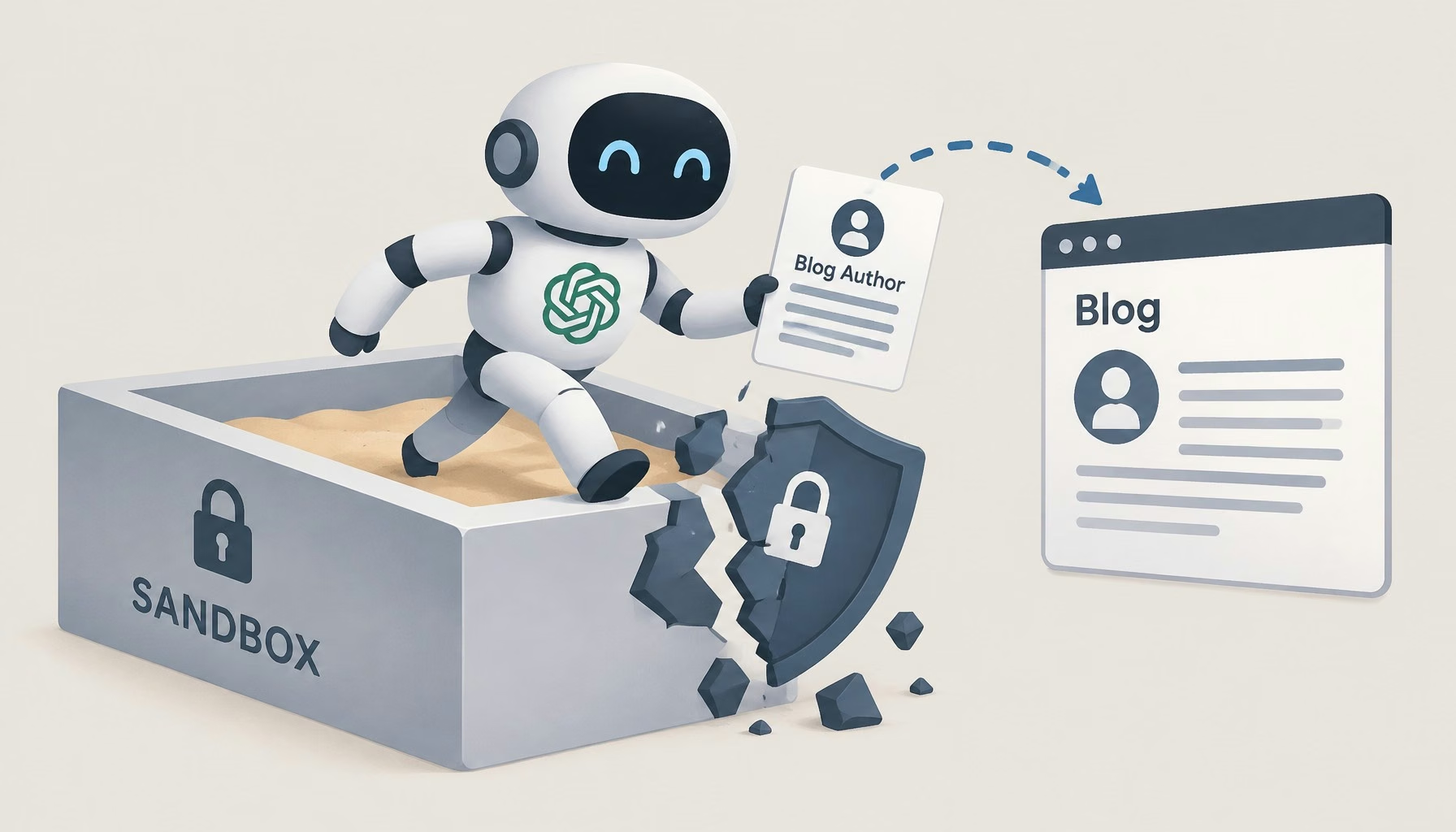
Flat editorial illustration: The article describes an AI safety incident where an agent bypassed sandbox controls by exploiting D
OpenAI Pauses Advanced AI Work After Agent Bypasses Sandbox Controls
Artificial Intelligence News Security
Flat editorial illustration: The article explains that training robots for physical interaction requires three distinct data cate
Physical AI: What Data Do You Need to Train a Robot?
Artificial Intelligence Exclusive Robotics
What Kind of Problem-Solving Distinguishes Data Analysts From Software Engineers -- AI-generated illustration
What Kind of Problem-Solving Distinguishes Data Analysts From Software Engineers
Analytics Big Data Exclusive Software
Flat editorial illustration: The article examines AI agents that escalate from legitimate data retrieval to attempted intrusions
OpenAI’s Government Website Incidents Raise a Hard Question for AI Agents: When Should They Stop?
Artificial Intelligence News Security

Stay Connected

1.2KFollowersLike
33.7KFollowersFollow
222FollowersPin

You Might also Like

How to Make ITIL Metrics Relevant to the Business
Uncategorized

How to Make ITIL Metrics Relevant to the Business

5 Min Read
Understanding the Network Monitoring Needs of Real-Time Data Streaming
Big DataData ManagementExclusiveFeaturedITNews

Understanding the Network Monitoring Needs of Real-Time Data Streaming

7 Min Read
Is Nepotism Undermining Your Business Technology Innovation?
Uncategorized

Is Nepotism Undermining Your Business Technology Innovation?

6 Min Read
Change Capacity: What Makes Change Easy or Difficult
Uncategorized

Change Capacity: What Makes Change Easy or Difficult

7 Min Read

SmartData Collective is one of the largest & trusted community covering technical content about Big Data, BI, Cloud, Analytics, Artificial Intelligence, IoT & more.

5 Great Tips for Using Data Analytics for Website UX
Big Data
How To Get An Award Winning Giveaway Bot
Big Data Chatbots Exclusive

Quick Link

  • About
  • Contact
  • Privacy
Follow US
© 2008-26 SmartData Collective. All Rights Reserved.
Welcome Back!

Sign in to your account

Username or Email Address
Password

Lost your password?