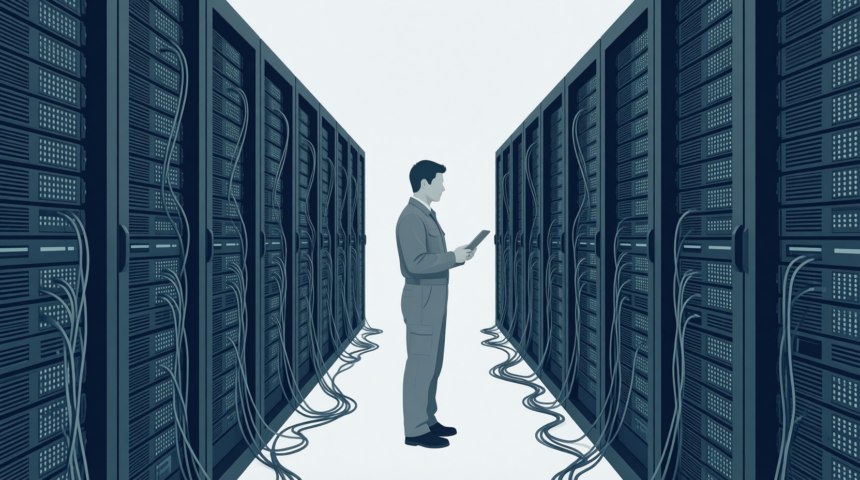
Most people don’t notice that information technology pervades our daily lives. Granted, some IT infrastructure is in the open and easy to spot, such as the computer and router on your desk hooked up via network cables. However, plenty of IT infrastructures are nearly invisible as they reside in locked network rooms or heavily guarded data centers. And some IT infrastructures are bundled underneath city streets, arrayed on rooftops, or even camouflaged as trees at the local park. Let’s take a closer look at a few ramifications of IT infrastructure everywhere.
1. Technology is pervasive and commonplace in our daily lives. Little is seen, much is hidden.
Good news: Companies have spent billions of dollars investing in wired and wireless connections that span cities, countries and oceans. This connectivity has enabled companies to ship work to lower cost providers in developing countries, and for certain IT projects to “follow the sun” and thus finish faster. Also, because we have IT infrastructure everywhere, it makes it possible for police forces and/or governments to identify and prosecute perpetrators of crime that much easier.
Bad news: This same IT infrastructure can also be used to monitor and analyze where and how people gather, what they say, relationships, how they vote, religious and political views and more. Closed circuit TV cameras on street corners (or concealed as mailboxes), ATM machines, POS systems, red-light cameras, and drones make up a pervasive and possibly invasive infrastructure that never sleeps. You may be free to assemble, however, IT infrastructure might be watching.
More Read

2. Some information technology is either affordable or in some cases “free”, but the true costs may be hidden.
Good news: Google’s G+ or Gmail, Facebook, or Yahoo’s portal and email services are no to low cost for consumers and businesses. In addition, plenty of cloud providers such as Amazon, Google or Dropbox offer a base level of storage for documents or photos with no upfront hard dollar cost. On the surface it appears we are getting something for practically nothing.
Bad news: There’s no such thing as a free lunch as Janet Vertesi, assistant professor of sociology at Princeton can attest. For months she tried to hide her pregnancy from Big Data, but she realized that Facebook, Google and other free “services” were watching her every post, email, and interaction in search of ways to advertise and sell her something. While she was not paying a monthly fee for these online services, there was in fact a “cost”—Vertesi was exchanging her online privacy for the ability of advertisers to better target her and serve appropriate advertising.
3. IT infrastructure is expected to be highly available. Smartphones, internet access, computers are simply expected to work and be immediately available for use.
Good news: With IT infrastructure, high availability (four to five 9’s) is the name of the game. Anything less doesn’t cut it. Cloud services from IaaS to SaaS are expected to stay up and running, and phone networks are expected to have enough bandwidth to support our phone calls and web browsing—even at busy sporting events. And for the most part, IT infrastructure delivers time and again because consumers and business have the expectation that technology is highly available.
Bad news: Not only is IT infrastructure always on, but because of Moore’s Law and plummeting costs of disk, it never forgets. For example, when disk and tape space was expensive, closed circuit TVs would record a day’s worth of coverage and then write over it the next day. Now, multiple cameras can record 30 days of surveillance on an 80 GB hard drive. And we haven’t even mentioned offsite or cloud storage which makes it possible to store audio, video, documents, photos, call detail records and more—essentially forever. Youthful transgressions can be published for all time. And mistakes today are recorded for years to come. The internet never forgets, unless you live in the European Union.
In the book, Sorting Things Out, Geoffrey C. Bowker and Susan Leigh Star call “Infrastructural Inversion” the process of focusing on various invisible systems—how they work—and how “people can change this invisibility when necessary”. IT infrastructure is one such system that permeates our daily lives, often unseen but ever so critical to our societies.
There are undoubtedly other ramifications to this unseen IT infrastructure. Here’s hoping you’ll join the conversation with your thoughts!